What Is a Suspension Glass Insulator and Why It Matters
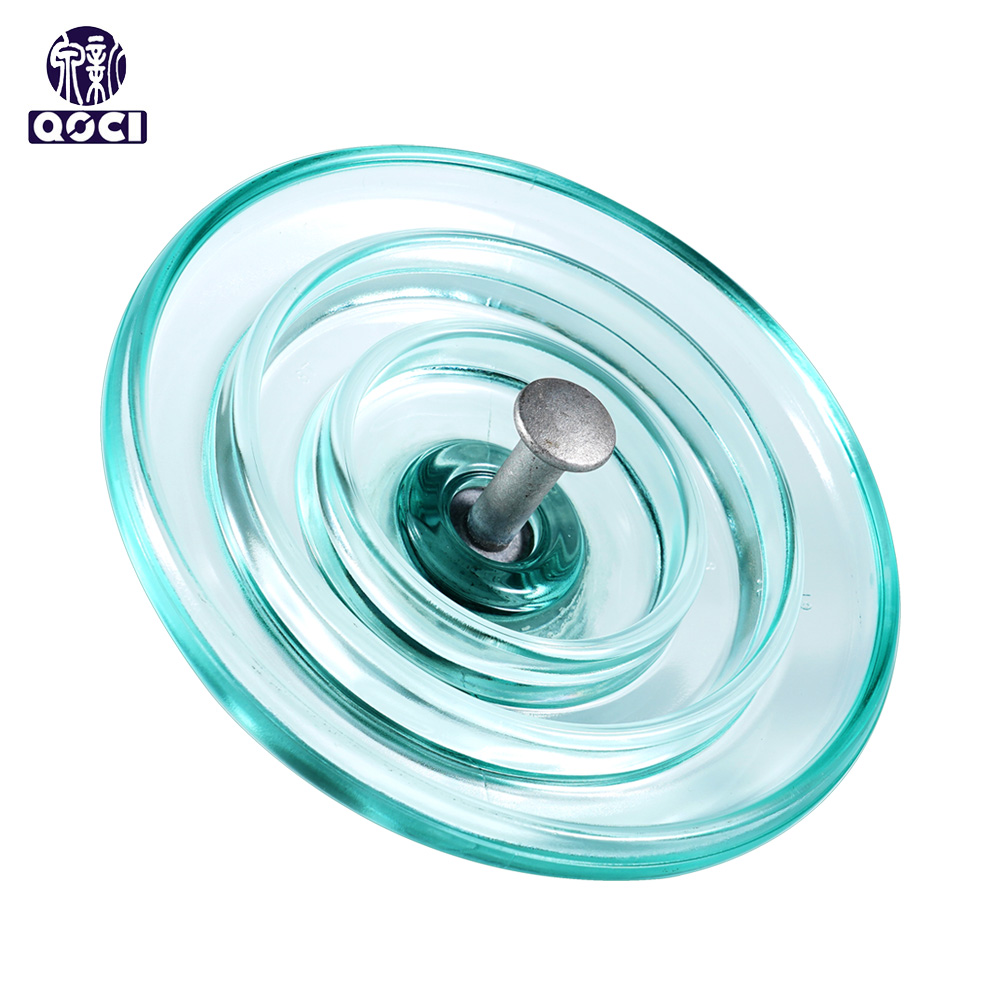
Cover: a U70BL suspension glass insulator – toughened glass disc, hot-dip galvanized cast iron cap, hot-dip galvanized forged steel pin.
A suspension glass insulator is a disc-shaped toughened glass unit fitted with a galvanized cast-iron cap and a forged-steel pin. It is used to hang an overhead conductor from a transmission tower while keeping that conductor electrically insulated from the earthed structure. Individual units are coupled into strings: the metal fittings carry the mechanical load, and the glass discs carry the electrical insulation.
This explainer is written for people who are new to overhead line hardware – buyers moving into transmission projects, junior engineers, distributors adding a product line, or anyone who has seen a code such as U70B, U120B or U420B on a drawing and wants to know what the letters and numbers actually describe.
What a Suspension Glass Insulator Actually Has to Do
Every overhead line faces the same constraint: the conductor must be held in the air, at a safe distance from the tower and everything else that is earthed. That leaves one component doing two jobs at once, because the insulator string is the only structural link between a live conductor and a grounded tower.
Job one – mechanical support. A suspension string carries the conductor weight plus wind load, ice load and stringing tension. The load is expressed as the mechanical failing load and measured in kilonewtons. In Jiangxi QOCI Electric's suspension range, single units are rated from 70 kN to 420 kN.
Job two – electrical insulation. The same disc must withstand the normal line voltage plus switching and lightning overvoltages while rain, dust, salt and industrial pollution sit on its surface. The two figures to look for on a datasheet are the wet power frequency withstand voltage and the lightning impulse withstand voltage. Across QOCI's suspension range these run from 40 kV to 80 kV and from 90 kV to 140 kV respectively.
Job three – being findable when it fails. This is the requirement buyers most often underestimate. A unit that has lost its electrical insulation but still looks intact is expensive to locate: crews either climb the tower or work from a live-line platform and test disc by disc. Porcelain and composite insulators generally do not change appearance when they fail electrically. A toughened glass disc is designed to do the opposite, which is explained in the next section.
Where Glass Sits in Overhead Line Insulation
Overhead line insulation is dominated by three material families: porcelain, toughened glass and polymer composites. Glass is used for suspension (disc) strings on transmission and distribution lines, and it competes with the other two families on cost, maintenance strategy and failure behaviour rather than on insulation capability alone.
Global demand for glass insulators was estimated at about USD 1.14 billion in 2024 and is projected to reach roughly USD 1.97 billion by 2035, a compound annual growth rate of about 5.1% (Market Research Future). Scope matters when comparing published figures, because definitions differ; an alternative estimate puts the category at a much smaller USD 351.4 million (Insightace Analytic). Treat any single market number as a scope-dependent estimate rather than a settled value.
Supply is concentrated in Asia. China accounted for 31.4% of global electrical insulator exports in 2024, with an export value of about USD 898 million (Observatory of Economic Complexity). Manufacturers that appear repeatedly in category reporting include Sediver (Seves Group), Nanjing Electric and Zhejiang Jinlihua Electric (Insightace Analytic).
On the standards side, IEC 60305:2021 specifies the mechanical and electrical characteristics of string insulator units for AC overhead lines above 1,000 V, and it is the reference document behind most suspension glass insulator datasheets. Toughened glass insulators for AC systems are also covered by GB/T 1001, while IEC 60307 addresses ceramic and glass insulators for overhead lines above 1,000 V. For a buyer, these standards decide which values you are entitled to see verified rather than simply stated.
Why the Disc Is Made of Toughened Glass
Toughening is a heat treatment, not a coating. The glass is heated and then cooled rapidly, so the surface contracts first and remains in compression while the interior stays in tension.
- Compressive surface layer. The surface of the disc holds a compressive stress layer; technical descriptions of the tempering process put it at roughly 80 MPa or more, balanced by internal tensile stress.
- A controlled failure mode. When an internal defect such as a nickel-sulphide inclusion triggers a puncture, the stress balance releases at once and the whole disc shatters into small, rounded granular pieces instead of splitting into sharp shards.
- Fail-safe, not fail-dangerous. The cap and pin remain mechanically joined after a disc breaks. The unit stops insulating, but it keeps its position in the string, so the conductor stays supported.
- Visible from the ground. Because the break is obvious, ordinary foot or vehicle patrol can find it. Published industry benchmarks for qualified products built with controlled tempering processes put the self-breaking rate below 0.02% per year.
The rest of the unit is deliberately unglamorous. The cap is hot-dip galvanized cast iron and the pin is hot-dip galvanized forged steel, both chosen for corrosion resistance at the hardware interface. QOCI's suspension glass insulator datasheets state a working temperature range of −40 °C to +60 °C.
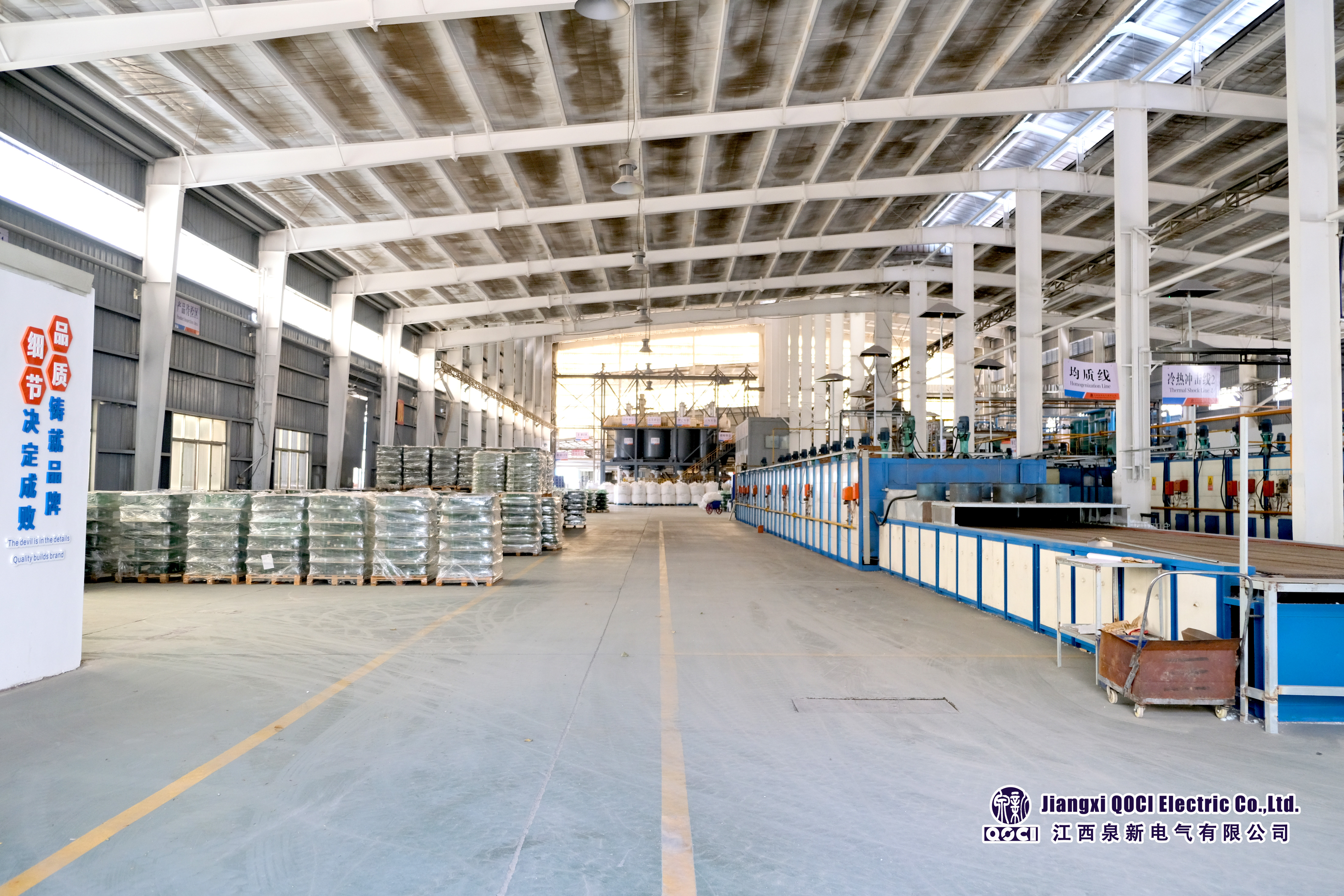
Thermal shock verification line: tempering quality is confirmed before assembly.
Jiangxi QOCI Electric's Suspension Glass Insulator Range
Jiangxi QOCI Electric Co., Ltd. is a China-based manufacturer of glass and porcelain insulators, established in December 2002 and located in Luxi Industrial Park, Pingxiang City, Jiangxi Province. The company produces suspension glass insulators and porcelain insulators for overhead transmission and distribution lines, holds ISO 9001, ISO 14001 and ISO 45001 certification issued by the China Quality Certification Centre, and exports to the USA, Asia, the EU, Africa and South America.
In the suspension glass insulator family, the model code carries the mechanical rating: the number is the mechanical failing load in kilonewtons, so a U70B is rated at 70 kN and a U420B at 420 kN. Four variables separate one model from another, and together they turn a single product family into a selection decision.
- Load rating (70 kN to 420 kN). Disc diameter grows with the rating: 255 mm at 70–120 kN, 280 mm at 160–240 kN, 320 mm at 300 kN and 360 mm at 420 kN.
- Profile shape. Standard, anti-pollution (LP / BP), double-shed or two-wing (LD / BD) and aerodynamic (BA / SA / AD) profiles exist to change creepage distance and self-cleaning behaviour without changing the basic cap-and-pin architecture.
- Coupling. Sockets are sized 16, 20, 24 and 28, matching the ball-and-socket or cap-and-pin fittings used on the string.
- Creepage distance. This is the path length along the insulating surface and the main lever against pollution flashover. QOCI units run from 320 mm on standard 70 kN discs to 620 mm on the U420BP anti-pollution design.
| Model | Mechanical failing load | Disc diameter | Nominal spacing | Creepage distance | Socket coupling | Wet power frequency withstand | Lightning impulse withstand |
|---|---|---|---|---|---|---|---|
| U70BL | 70 kN | 255 mm | 146 mm | 320 mm | 16 | 40 kV | 100 kV |
| U100BL | 100 kN | 255 mm | 146 mm | 320 mm | 16 | 40 kV | 100 kV |
| U120BL | 120 kN | 255 mm | 146 mm | 320 mm | 16 | 40 kV | 100 kV |
| U160BL | 160 kN | 280 mm | 170 mm | 400 mm | 20 | 45 kV | 110 kV |
| U210B | 210 kN | 280 mm | 170 mm | 400 mm | 20 | 45 kV | 110 kV |
| U240B | 240 kN | 280 mm | 170 mm | 400 mm | 20 / 24 | 45 kV | 110 kV |
| U300B | 300 kN | 320 mm | 195 mm | 485 mm | 24 | 50 kV | 130 kV |
| U420B | 420 kN | 360 mm | 205 mm | 550 mm | 28 | 80 kV | 140 kV |
Source: QOCI suspension glass insulator datasheets. Power frequency puncture voltage for these units is stated as 130–140 kV.
Step-by-Step: From Glass to Strung Conductor
Part 1 – how one unit is made and checked
- The glass disc is formed on an automated production line (forming area).
- The disc is thermally toughened so that the surface ends up in compression.
- Tempering quality is verified with a thermal shock test at a temperature differential of at least 70 K.
- The hot-dip galvanized cast-iron cap and hot-dip galvanized forged-steel pin are assembled to the disc.
- Type and routine testing covers mechanical load testing, visual and dimensional inspection to IEC 60305, power frequency flashover, impulse withstand voltage and residual stress measurement.
- Pre-shipment inspection: QOCI applies 100% pre-shipment testing, and third-party inspection (SGS) can be arranged for an order.
- Units are packed with shock-absorbing protection and loaded for shipment.
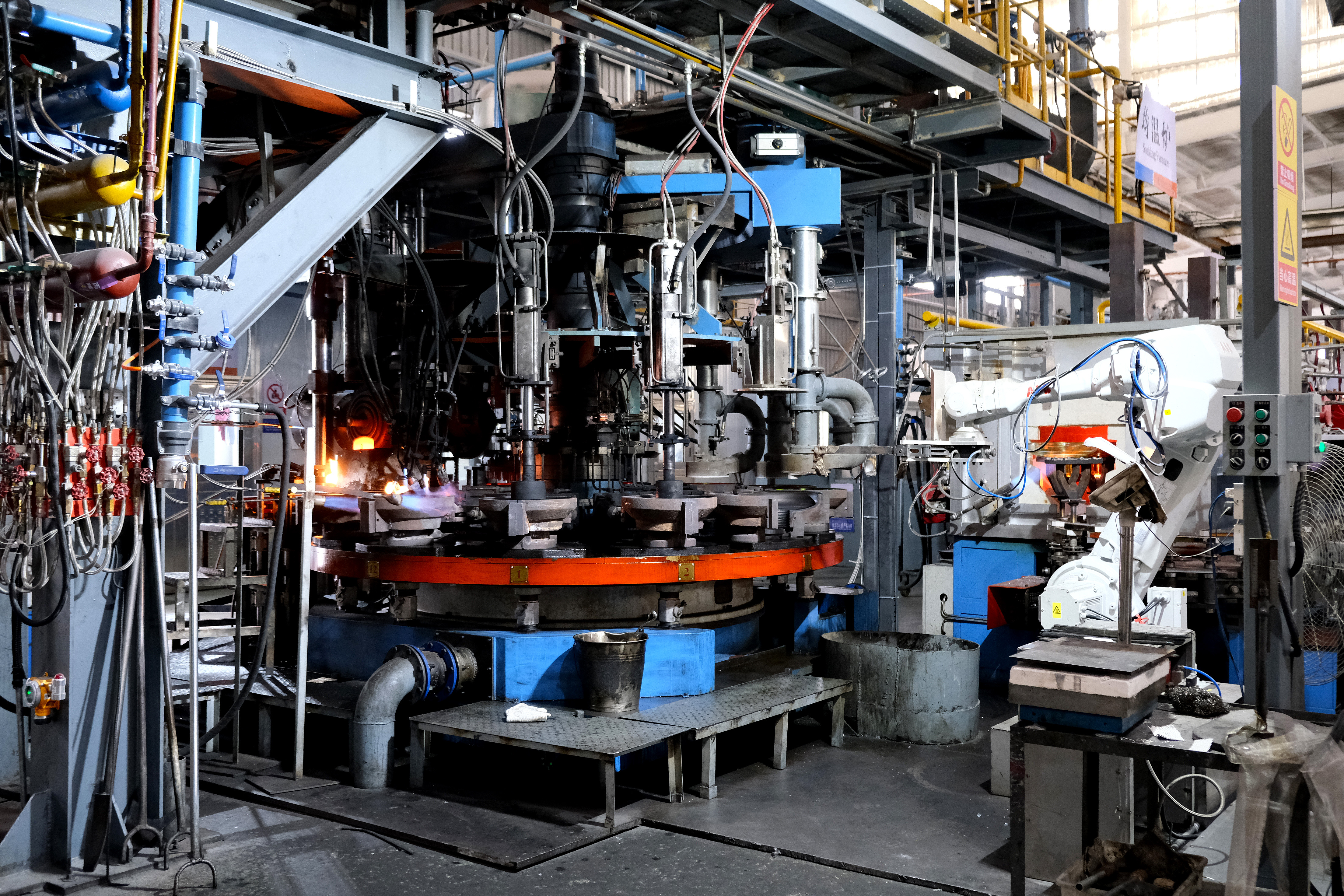
Forming area: the disc is shaped before tempering and assembly.
Part 2 – how a string is installed
- Inspect each insulator for visible defects and verify calibration marks.
- Assemble the string with metal fittings (caps, pins, ball-and-socket couplings).
- Apply locking devices (W-clip or R-pin) to secure ball-and-socket joints.
- Hoist the string to the tower using a pulling rope and come-along clamp.
- Connect to the conductor suspension or tension hardware.
- Verify ball-and-socket seating and locking device engagement.
- Visually check for cracked or chipped discs.
Safety note: all locking devices must be properly seated before energizing; insulators showing visible glass damage should not be installed; minimum approach distances for the voltage class apply during any live-line work.
Where Suspension Glass Insulators Are Used
- Clean-area distribution and sub-transmission lines. Standard-profile units such as U70BL, U100BL and U120BL, with 255 mm discs and 320 mm creepage, are the baseline choice.
- Industrial and coastal pollution zones. Anti-pollution profiles raise creepage: U70BLP, U100BLP and U120BLP at 450 mm, U160BLP and U210BP at 550 mm, and U420BP at 620 mm.
- Desert and high-dust environments. Aerodynamic open-shed profiles (U70BA, U100BA, U160BSA) use 380–420 mm disc diameters and are specified where self-cleaning matters.
- Heavy mechanical loads, long spans and EHV/UHV lines. U300B (300 kN) and U420B (420 kN) carry the highest string tensions in the range.
- Remote lines that are expensive to patrol. The visible-break behaviour of toughened glass means a failed disc can be identified from the ground, which reduces the need for live-line zero-value testing.
- Projects specifying ANSI dimensions.ANSI 52-3 (70 kN), ANSI 52-5 (120 kN), ANSI 52-8 (160 kN) and ANSI 52-11 (210 kN) publish the equivalent ratings under ANSI designations.
Project records give a practical view of how this behaves at scale. QOCI supplied 200,000 pieces in total across three utility and EPC programmes: 80,000 pieces to Uzbekistan, 70,000 to Ukraine and 50,000 to Iraq, for UHV/EHV overhead transmission line insulation in desert and industrial pollution zones, with supply running up to 2026. The recorded outcomes were zero line-tripping incidents, 100% visual defect detection with no live-line testing required, a 70% reduction in maintenance cost, and pollution flashover incidents 85% lower than the porcelain baseline previously used on those routes. Operation from −40 °C to +55 °C was verified in Uzbekistan and Iraq, and the units carry a 30+ year designed lifespan.
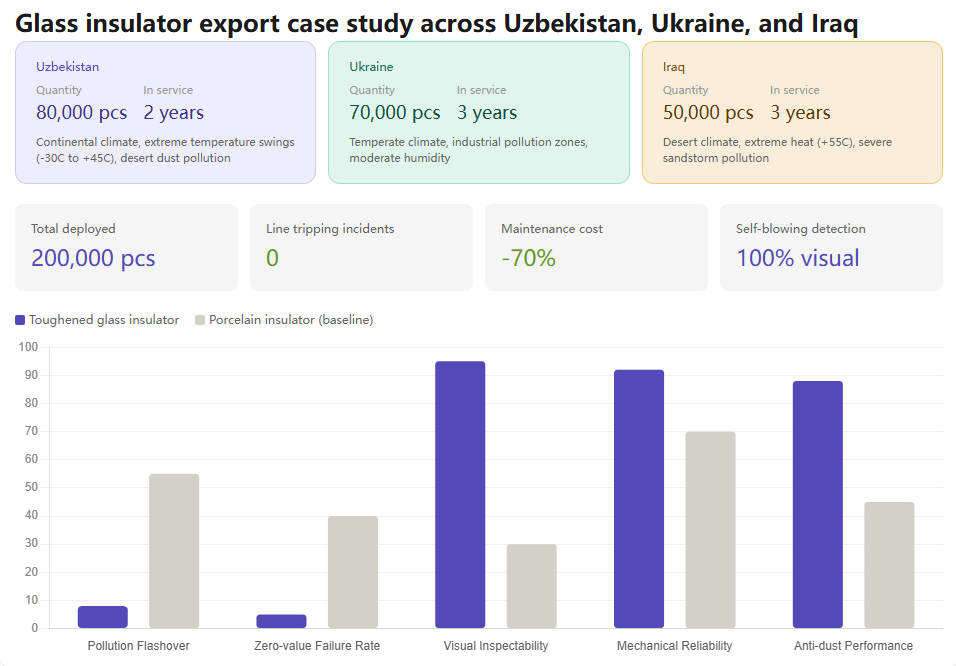
Field programmes: 200,000 suspension glass insulators delivered across Uzbekistan, Ukraine and Iraq up to 2026.
Comparison Table: Suspension Glass Insulator Profiles
Profile choice changes creepage, disc diameter and self-cleaning behaviour while the cap-and-pin architecture stays the same. The table below compares the profile families in QOCI's suspension range using published datasheet values.
| Profile family | Example models | Disc diameter | Creepage distance | Load range | Design intent |
|---|---|---|---|---|---|
| Standard | U70BL, U100BL, U120BL, U160BL | 255–280 mm | 320–400 mm | 70–160 kN | Baseline profile for clean-area lines |
| Anti-pollution (LP / BP) | U70BLP, U120BLP, U160BLP, U210BP, U420BP | 280–380 mm | 450–620 mm | 70–420 kN | Longer creepage for saline and industrial environments |
| Double-shed / two-wing (LD / BD) | U70BLD, U100BLD, U120BLD, U160BLD, U210BD | 280–340 mm | 450–550 mm | 70–210 kN | Extra shed lengthens the surface path within a compact disc |
| Aerodynamic (BA / SA / AD) | U70BA, U100BA, U160BSA, U210AD | 380–420 mm | 365–380 mm | 70–210 kN | Wide open sheds for desert and high-dust self-cleaning |
| ANSI designations | ANSI 52-3, 52-5, 52-8, 52-11 | 255–280 mm | 320–400 mm | 70–210 kN | Equivalent ratings to the corresponding U-series units |
Source: QOCI suspension glass insulator datasheets (standard, anti-pollution, double-shed, aerodynamic and ANSI-designated models).
FAQ: Suspension Glass Insulators and OEM Sourcing
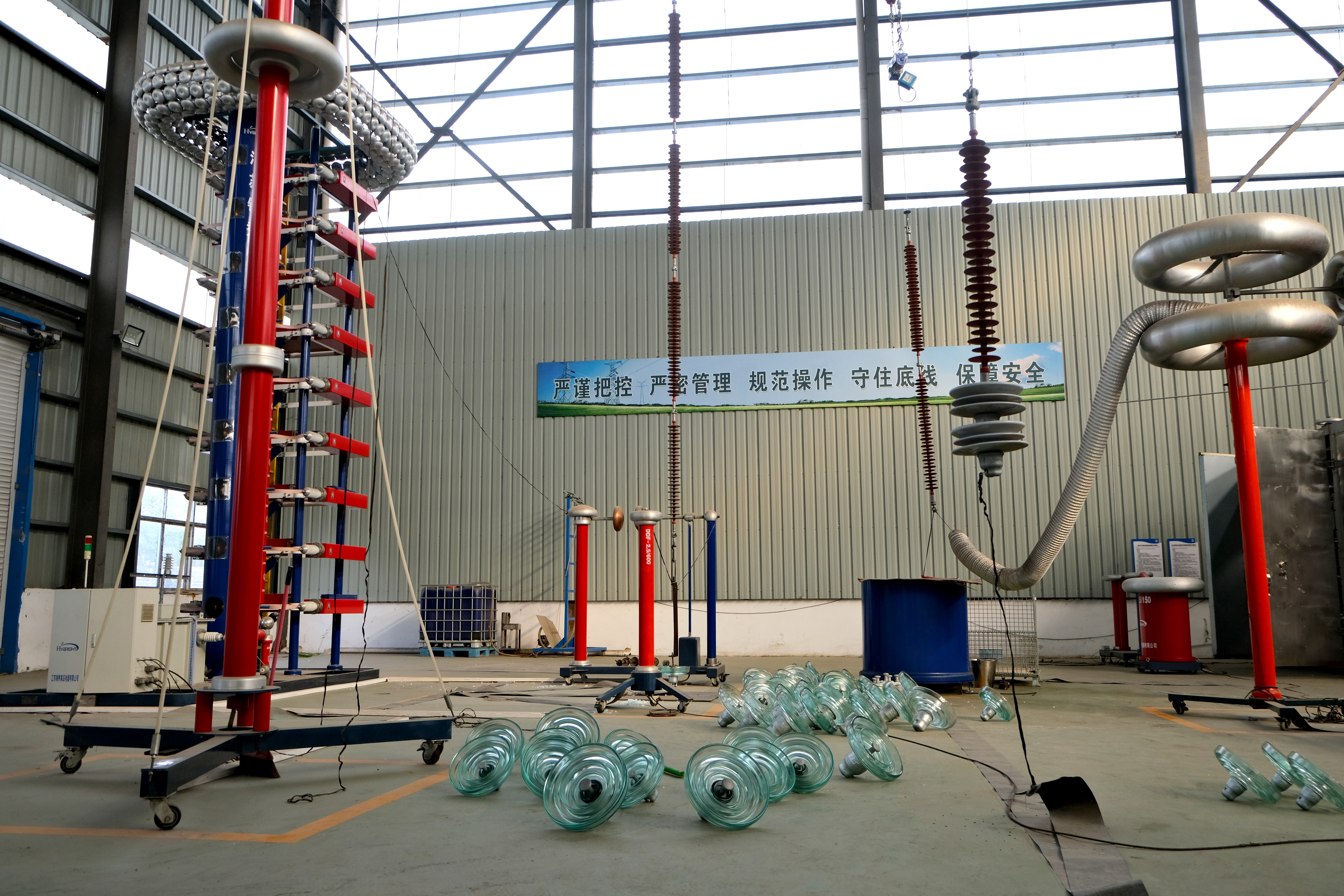
In-house laboratory: mechanical, thermal shock and electrical testing before dispatch.
Which standards and certifications apply to suspension glass insulators?
String insulator units for AC overhead lines above 1,000 V are specified by IEC 60305:2021, which defines their mechanical and electrical characteristics. Toughened glass insulators for AC systems are also covered by GB/T 1001, and IEC 60307 addresses ceramic and glass insulators for overhead lines above 1,000 V. On the supplier side, Jiangxi QOCI Electric Co., Ltd. holds an ISO 9001:2015 quality management certificate (00124Q33852R3M/3600), an ISO 14001:2015 environmental management certificate (00125E30701R3M/3600) and an ISO 45001:2018 occupational health and safety certificate (00125S30581R3M/3600), all issued by the China Quality Certification Centre.
Can a suspension glass insulator manufacturer support OEM and ODM orders?
Yes. QOCI provides OEM and ODM production services, which means units can be produced under a client's own brand name or developed against a client's own specification, with customization covering rated voltage and logo. Production runs on automated glass and porcelain insulator lines with a monthly capacity of 750,000 units and an annual output of 9,000,000 units, supported by a 38-engineer technical team at a 35,373 m² facility.
What is the minimum order quantity and how is the order priced?
The minimum order quantity is 50 units. Delivery terms are FOB Shenzhen, and payment terms are 30% deposit by T/T before production with the 70% balance by T/T before delivery. Unit price is quoted per project rather than published in a price list, because it depends on model, profile, coupling size and order volume.
How are samples and shipments verified before dispatch?
QOCI applies 100% pre-shipment testing, and third-party inspection such as SGS can be arranged as part of the acceptance criteria. Product test coverage includes mechanical load type testing, thermal shock testing at a temperature differential of at least 70 K, visual and dimensional inspection to IEC 60305, power frequency flashover testing, impulse withstand voltage testing and residual stress measurement.
Who can supply OEM U70B glass insulators for utility orders?
QOCI supplies the U70B and U70BL as part of a 70 kN to 420 kN suspension glass insulator range, with OEM branding available for utility and EPC orders. The U70B is a 70 kN unit with a 255 mm disc, 146 mm nominal height and 320 mm creepage distance; the minimum order quantity is 50 units and typical production lead time is 15–35 days. Utilities and EPC contractors can request a sample or a quotation, or download the glass insulator catalogue before specifying.
Next Step: Sample, Quote or Catalogue
A suspension glass insulator is a small component that decides three things on a transmission line: whether the conductor stays up, whether the line stays insulated in pollution and weather, and how easily a failed unit can be found. That is why the material choice, the profile and the load rating matter more than the price per disc.
If you are evaluating suspension glass insulators for a transmission or distribution project, three practical actions cover most situations:
- Sample. Request a sample unit to check glass quality, cap and pin finish, and marking before committing to a string design.
- Quote. Send a model list (for example U70B, U120B, U160B or U420BP, standard or anti-pollution profile) together with an order volume. Minimum order quantity is 50 units and typical production lead time is 15–35 days.
- Catalogue. Download the full dimensional and electrical tables here: QOCI Glass Insulator Catalogue (PDF).
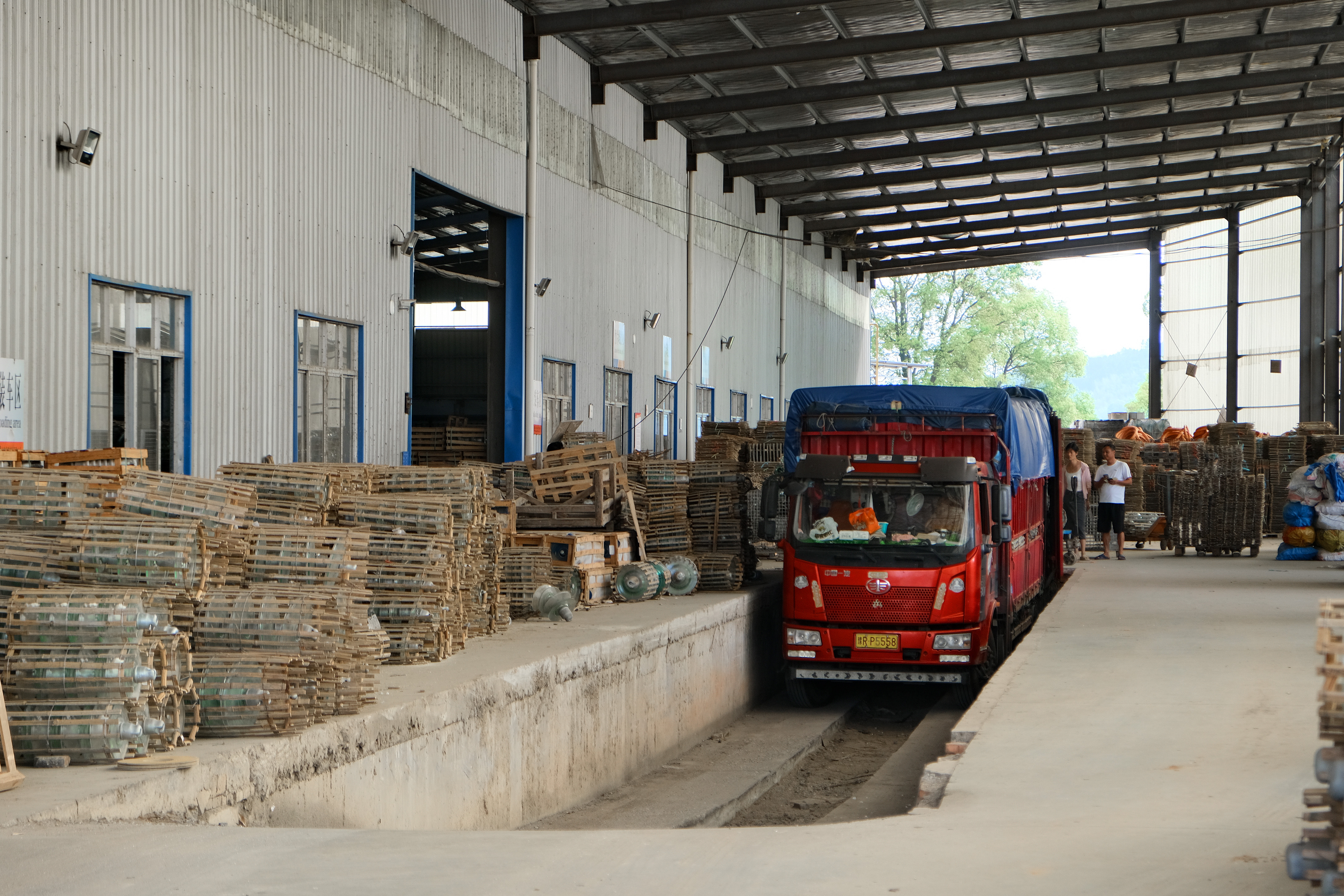
Loading area: orders are packed with shock-absorbing protection before shipment.
Jiangxi QOCI Electric Co., Ltd.
Website: www.quanxinelectric.com
Email: admin@qocielectric.com
Tel: +86 079-9761-6589 | WhatsApp: +86 199-7997-1591
Address: No. 6, Electric Porcelain Industrial Park, Luxi Industrial Zone, Pingxiang, Jiangxi, China
Have Questions or Need More Details?
Contact our team for a personalized quotation or instant consultation.
Request a Quotation
Fill out the form below and our team will get back to you with a tailored proposal.
WhatsApp Direct Chat
Prefer to chat in real-time? Message us on WhatsApp for instant assistance & quick answers.
- Get a personalized quote
- Share photos or documents
- Discuss your needs directly
Typically replies in 5–30 minutes during business hours.