
Auditing a Suspension Glass Insulator Factory: 10 Core Capability Checks
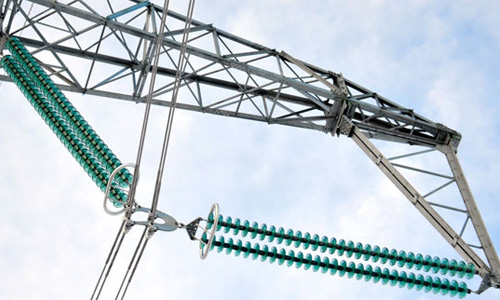
Choosing a reliable toughened glass insulator supplier for transmission line projects is an evidence problem, not a price problem. A suspension glass insulator factory should be qualified on four categories of verifiable evidence: production capacity matched to the project quantity, process control across forming and tempering, documented quality-control results, and standards documentation that ties each delivered model to a recognised specification.
This guide turns that requirement into a working audit: a ten-point checklist, a five-phase audit sequence, two reference tables, and the supplier questions that come up most often during evaluation. It is written for utility procurement teams, EPC contractors and importers who must qualify a supplier before a tender closes — and who need that qualification to still hold years later, on the line.
Why Supplier Evaluation Fails Before the Audit Begins
The most common failure in supplier evaluation is measuring whatever is easiest to compare. Catalogue pages and quoted prices are visible from a desk. Capacity discipline, process control and inspection records are not.
Suspension glass insulators are a standardised product family, which is exactly why the visible layer looks almost identical between suppliers. A 70 kN disc unit such as the U70B is defined by IEC-compatible dimensions — 255 mm disc diameter, 146 mm nominal spacing — and a minimum mechanical failing load of 70 kN. A 160 kN unit such as the U160B typically uses a 20 mm ball-socket coupling and provides a wet power frequency withstand voltage of approximately 45 kV. Any capable manufacturer can place those numbers in a catalogue.
Because the specification layer converges, differentiation has to be verified one level deeper. A factory audit answers four questions that a quotation cannot:
- Capacity: can this factory produce the ordered quantity inside the delivery window?
- Process: can it control the forming, tempering and assembly steps that determine mechanical strength?
- Quality evidence: can it demonstrate that each unit was inspected before shipment?
- Compliance: can it document each model against the standard referenced in the tender?
Reliability is a capability claim. An audit converts that claim into evidence, and evidence is what survives an outage review.
Industry Background: Why Factory-Level Verification Decides More Than It Used To
The glass insulator market was estimated at USD 1.14 billion in 2024 and is projected to reach USD 1.97 billion by 2035, a compound annual growth rate of 5.1% across the 2025–2035 forecast period (Market Research Future). Growth of that shape is driven mainly by grid construction rather than replacement demand alone, which raises the consequences of a wrong supplier decision.
Supply is concentrated. Asia Pacific held a revenue share exceeding 52% of the glass insulator market in 2024, driven by grid expansion in China and India (Grand View Research). China alone accounted for 31.4% of global electrical insulator exports in 2024, totalling USD 898 million, and China's exports of electrical insulators to Saudi Arabia grew by 219% between 2023 and 2024, the fastest-growing destination for that flow (OEC).
Published market sizes diverge because scope differs — some studies place the glass insulator market at USD 351.4 million by excluding building-related insulated glass. For a procurement team the divergence matters less than the pattern it reveals: a small number of exporting regions supplies a large share of global demand. The practical question is therefore not whether suppliers exist, but whether one specific factory can evidence capability.
On the technical side, suspension glass insulator units for AC systems are governed by IEC 60305:2021, which specifies mechanical and electrical characteristics. Independent market summaries identify established global manufacturers such as Sediver (Seves Group), Nanjing Electric and Zhejiang Jinlihua Electric alongside Chinese producers serving export markets (Insightace Analytic). Recognition is useful context. It is not an audit. The checks below are.
The 10-Point Suspension Glass Insulator Factory Audit
Each check below states what to verify, what evidence to request, and why that evidence changes the risk profile of the order.
1. Verify production capacity against the actual project volume
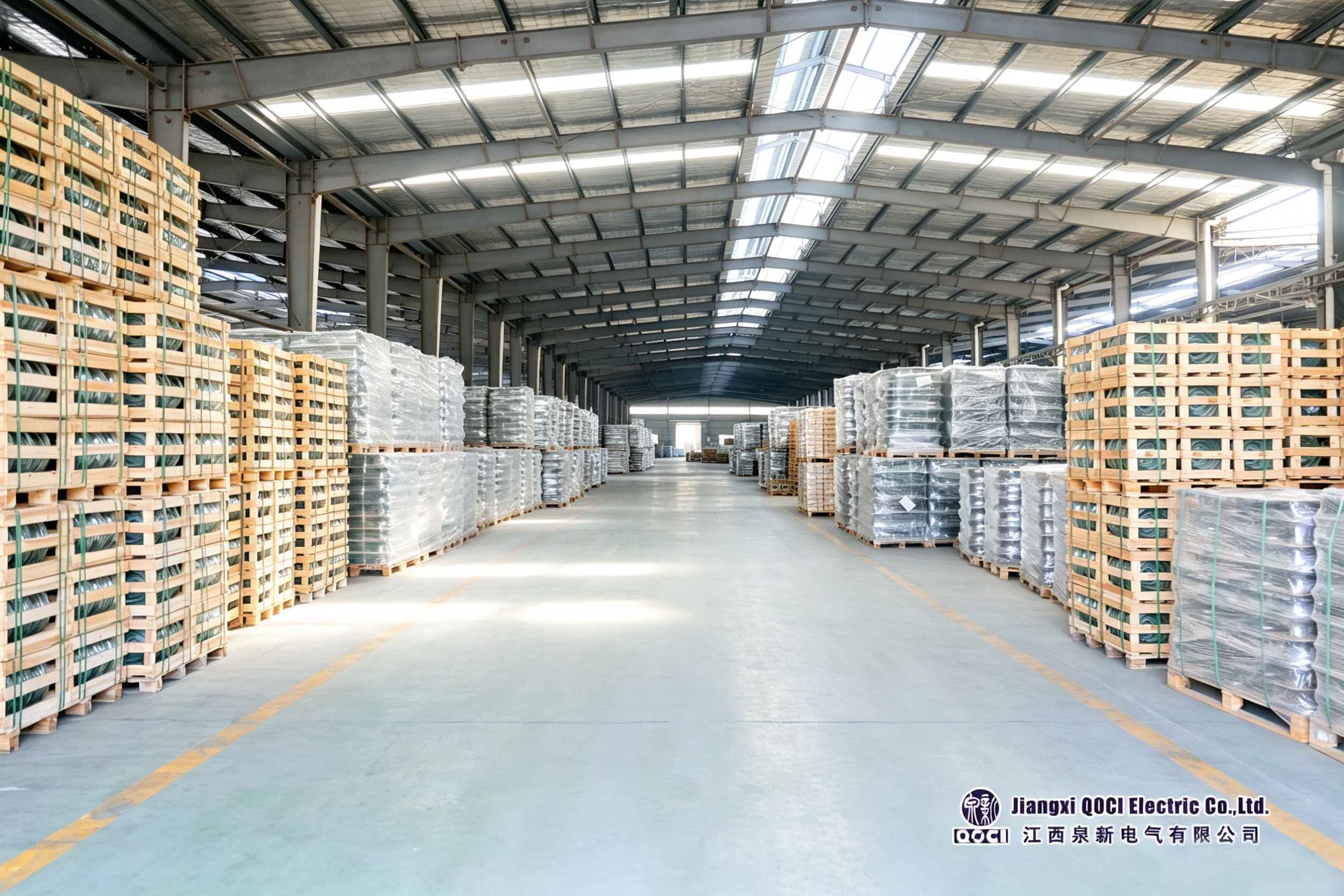
Capacity should be requested for the specific model, not for the factory as a whole. Jiangxi QOCI Electric Co., Ltd., a manufacturer of glass and porcelain insulators established in December 2002 and located in Luxi Industrial Park, Pingxiang, Jiangxi Province, records an annual output of 9,000,000 units and a monthly capacity of 750,000 units from a 35,373 m² facility staffed by 138 employees, including 38 engineers in its R&D team.
Request: annual and monthly output for the ordered model, current order backlog, and the production window reserved against your delivery date. A 200,000-piece order — the volume recorded in QOCI's Uzbekistan, Ukraine and Iraq supply programme — represents roughly a quarter of one month at that capacity level. That is the kind of ratio an auditor wants stated, not estimated.
2. Confirm the model and load-range coverage
A supplier that only offers the tender model is a single-point dependency. The load ladder matters because spare units, line extensions and later phases usually come from the same factory.
QOCI's suspension glass insulator range runs from 70 kN to 420 kN: U70B, U100B, U120B, U160B, U210B, U240B, U300B and U420B, with dimension-based variants under ANSI 52-3 (70 kN), ANSI 52-5 (120 kN) and ANSI 52-8 (160 kN), plus the PS series, which includes PS70E, PS120B, PS160D, PS210V 212V, PS240V 212V and PS300V 112V.
Request: the complete model list with mechanical failing load, disc diameter, nominal spacing, creepage distance and socket coupling for each entry.
3. Walk the forming and thermal shock lines
Tempered glass strength comes from a controlled thermal process: the glass body is formed, then heated and rapidly cooled so the surface goes into compression. If that step is not controlled, the mechanical rating on the drawing is not what ships.
During a factory visit, look at the forming area and the thermal shock line in sequence, then ask how process parameters are recorded and retained. QOCI's own facility documentation covers the forming area, the thermal shock line, the laboratory and the loading area, which makes a unit traceable from glass forming through to dispatch.
4. Request mechanical failing load and routine test records
A mechanical failing load rating is a test result, not a design intention. The audit question is whether the supplier can produce that record for the delivered batch, per model, in the load class ordered — anywhere from 70 kN on a U70B to 420 kN on a U420B.
Request: routine test records for the ordered model, the test equipment list with calibration dates, and the acceptance criteria applied to each batch.
5. Verify 100% pre-shipment testing and third-party inspection
Sampling plans differ between suppliers, and that difference is invisible in a quotation. QOCI records 100% pre-shipment testing together with third-party inspection, naming SGS as an inspection route.
Request: the pre-shipment inspection procedure, the third-party inspection body where applicable, whether inspection is full or sampled, and a recent inspection report with commercial details removed if necessary.
6. Check creepage distance and shed profile against the pollution class
Creepage distance is the parameter that most often decides whether a string survives a polluted environment. Within QOCI's range it varies from 320 mm on standard 70 kN units to 550 mm on long-creepage and double-shed designs such as the U160BLD, U160BSP and U420B, and 620 mm on the U420BP anti-pollution unit.
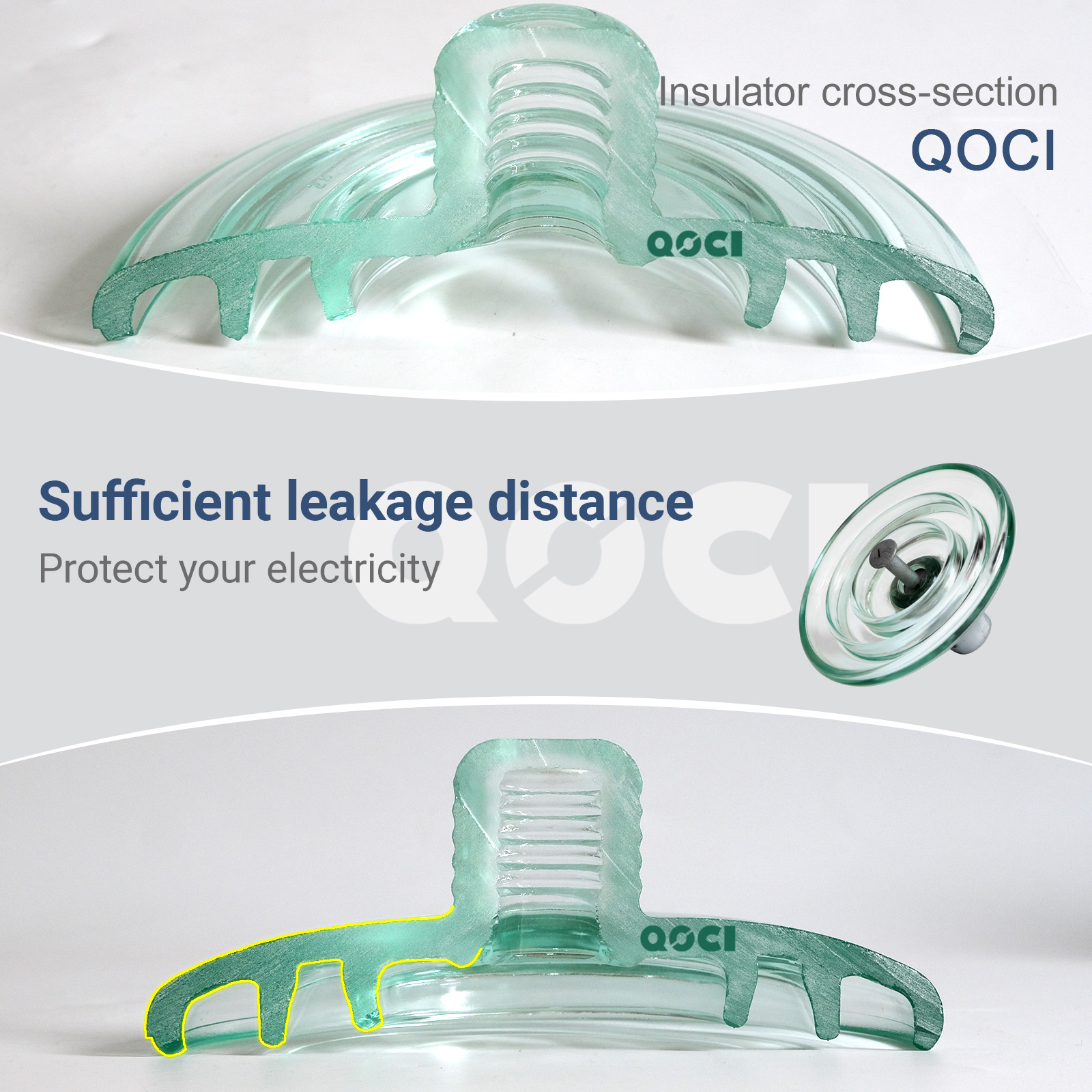
Anti-pollution variants follow the same load ladder — U70BP, U100BP, U120BP, U160BP, U210BP, U240BP, U300BP and U420BP — while double-shed and two-wing profiles (U70BD through U300BD) and aerodynamic profiles (U70BA, U100BA, U120BA, U160BA, U210BA, U240BA, U300BA) address specific wind and surface-washing behaviour.
Request: the creepage distance and shed profile drawing for the ordered model, matched to the pollution class stated in the project specification.
7. Inspect cap and pin material and corrosion protection
The insulating body is only part of the unit. Across QOCI's suspension range the glass part is tempered glass, the cap is hot-dip galvanised cast iron and the pin is hot-dip galvanised forged steel — a specification worth verifying against delivered fittings rather than against the drawing.
Under severe corrosion conditions, a zinc sleeve is specified to slow rusting at the steel–glass interface and extend the service life of the insulator string. Units designed for coastal salt fog and a working range of −40°C to 60°C, in continuous 24/7 outdoor exposure, are where this check carries the highest value.
Request: fitting drawings, galvanising specification, and confirmation of whether a zinc sleeve is offered or required for the project environment.
8. Verify dimensional and coupling interchangeability
Insulators are assembled into strings; they are not used alone. Socket coupling varies across the load ladder — 16 mm on the U70B and U120B, 20 mm on the U160B and U210B, 20/24 mm on the U240B, 24 mm on the U300B and 28 mm on the U420B — while nominal spacing ranges from 127 mm to 205 mm.
Request: a dimensional drawing with tolerances for the ordered model, and confirmation that the unit assembles with the tension clamps, insulator string fittings and arcing ring already specified for the project.
9. Audit documentation, marking and standard alignment
Documentation is where a factory audit becomes repeatable. Ask for a model-to-standard mapping table listing each delivered model against the standard it is built to: IEC 60305:2021 for AC suspension units, or the relevant ANSI dimension series where a project follows North American conventions. QOCI Electric is a national high-tech enterprise and a participating unit of the Insulator Standard Committee in China, which is useful context but does not replace the mapping table.
Request: unit marking convention, batch traceability method, test certificates, packing list and the standard reference for each model.
10. Check commercial and after-sales readiness
The final check is whether commercial terms make the technical commitments workable. QOCI records a minimum order quantity of 50 units, a lead time of 15–35 days, OEM and ODM production, and customization of voltage and logo. After-sales support is stated as online technical support plus replacement for defective products.
Request: written MOQ, lead time, customization scope, warranty terms and the escalation path for a defective unit after delivery.
Running the Audit in Five Phases
The checklist is a set of questions. A five-phase sequence is what turns it into a procedure with a defendable output.
Phase 1 — Desk audit. Collect the model list, load range, standard references, capacity figures, MOQ and lead time before any call. Identify which checks cannot be answered by documents alone.
Phase 2 — Sample validation. Order a small batch — QOCI's MOQ of 50 units makes this practical — and measure disc diameter, nominal spacing, creepage distance and coupling fit against the tender drawing. Confirm that the sample and the future production batch share the same process route.
Phase 3 — On-site factory audit. Walk the forming area, thermal shock line, laboratory, assembly and warehouse in production order. Ask for calibration records and batch documentation while standing at the equipment.
Phase 4 — Pre-shipment verification. Agree the inspection plan in writing, including whether third-party inspection applies, and review the pre-shipment report before the container is sealed.
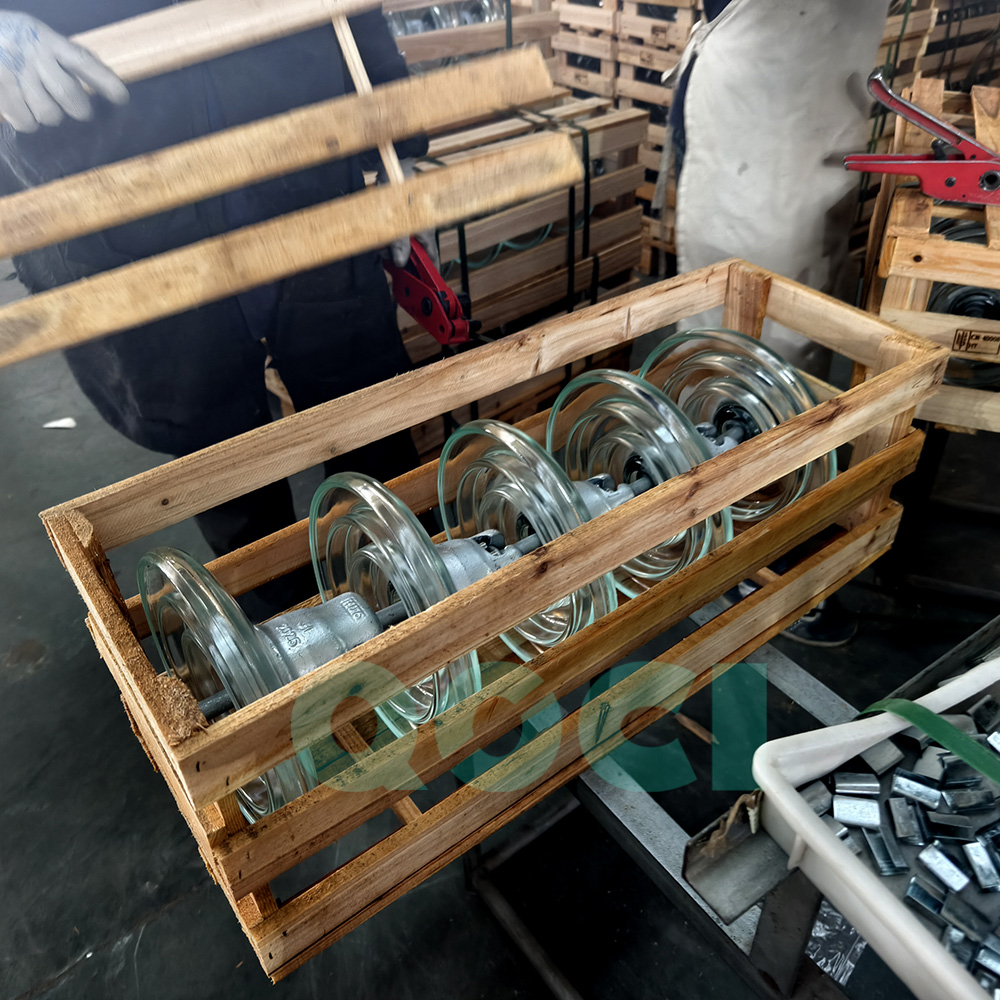
Phase 5 — Post-delivery review. Confirm the after-sales route — online technical support and replacement for defective products — and record how the delivered batch performed against the audit assumptions. That record becomes the input for the next tender.
Project Scenarios: Which Checks Matter Most
Not every check carries the same weight in every project. Across the family, the applicable operating conditions cover outdoor overhead exposure, heavy pollution, coastal salt fog, a working temperature range of −40°C to 60°C and anti-ageing requirements, in continuous 24/7 in-service operation. The three scenarios below show how audit emphasis shifts.
Coastal and high-pollution transmission lines
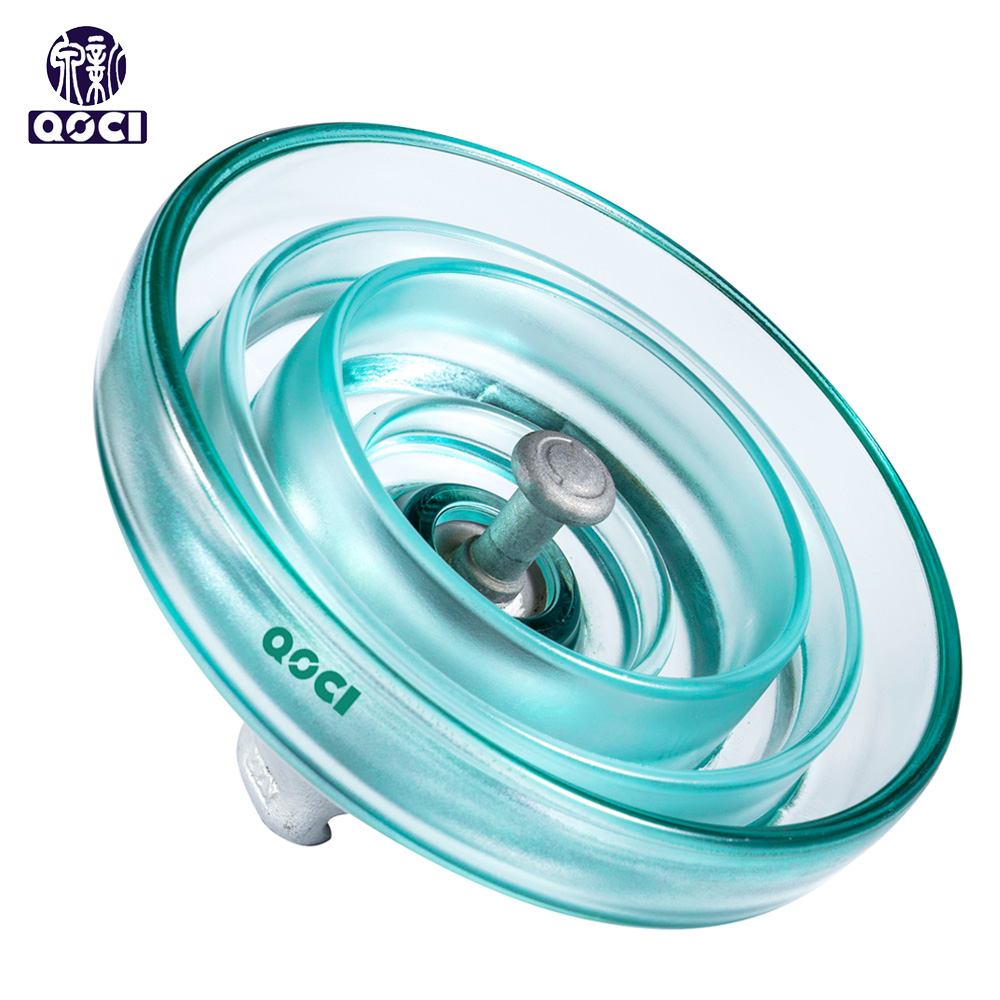
In saline or industrial environments, checks 6 and 7 dominate. Anti-pollution designs such as the U120BP feature increased creepage distances to limit flashover risk in saline or industrial conditions, and a zinc sleeve is specified under severe corrosion service conditions to slow rusting and extend string service life. QOCI's anti-pollution range spans U70BP to U420BP, with the U210BP rated at 210 kN, a 320 mm disc diameter, 550 mm creepage distance and a 20 mm socket coupling.
Desert and wide-temperature inland grids
Where temperature swing and dust dominate, checks 4, 5 and 7 carry the audit. QOCI's recorded supply programme covers 200,000 pieces in total — 80,000 in Uzbekistan, 70,000 in Ukraine and 50,000 in Iraq — for UHV/EHV overhead line insulation in desert and industrial pollution zones. Results are recorded as zero line-tripping incidents, a 70% reduction in maintenance cost, 100% visual defect detection without live-line testing, and an 85% reduction in pollution flashover incidents against a porcelain baseline. Temperature tolerance of −40°C to +55°C was verified in the Uzbekistan and Iraq deployments, and the designed lifespan is stated as 30+ years.
For an auditor, the transferable point is not the outcome figure but the evidence format: this supplier could state a defect-detection method, a maintenance outcome and a verified temperature range. Ask for that format in advance, then hold the supplier to it.
EHV/UHV heavy-load lines and grid upgrades
On heavy-load towers, checks 1, 2 and 8 decide the outcome. The U300B (300 kN, 320 mm disc diameter, 195 mm spacing, 485 mm creepage, 24 mm coupling) and the U420B (420 kN, 360 mm disc diameter, 205 mm spacing, 550 mm creepage, 28 mm coupling) sit at the top of the range, and the coupling dimension must match the fitting assembly already designed for the tower. The same logic applies at smaller scale in grid upgrade and rural electrification projects, where the U70B, U100B and U120B families carry most string assemblies.
Comparison Table: Audit Evidence and Model Reference
Table 1 maps each audit area to the evidence to request and what that evidence confirms.
| Audit area | Evidence to request | What it confirms |
|---|---|---|
| Capacity | Annual and monthly output for the ordered model, facility area | Whether the order fits the production calendar |
| Process control | Forming and thermal shock line records, process parameter logs | Whether tempering is controlled rather than assumed |
| Quality control | 100% pre-shipment test report, third-party inspection report (for example SGS) | Whether units are checked before dispatch, and by whom |
| Product range | Model list from 70 kN to 420 kN, including ANSI 52-3, 52-5, 52-8 and PS series | Whether spares and higher ratings stay available after commissioning |
| Materials and finish | Cap and pin material and finish (hot-dip galvanised cast iron cap, hot-dip galvanised forged steel pin, optional zinc sleeve) | Corrosion behaviour in the project environment |
| Compliance | Model-to-standard mapping against IEC 60305:2021 and the relevant ANSI dimension series | Whether the unit matches the specified interface |
| Commercial readiness | MOQ, lead time, customization scope, after-sales terms | Whether the supplier fits the project schedule and support model |
Table 2 is the model reference an auditor can use to sanity-check a supplier catalogue before the visit. Values follow QOCI's published suspension glass insulator specifications.
| Model | Mechanical failing load | Disc diameter | Nominal spacing | Creepage distance | Socket coupling | Wet power frequency withstand |
|---|---|---|---|---|---|---|
| U70B | 70 kN | 255 mm | 146 mm | 320 mm | 16 | 45 kV |
| U120B | 120 kN | 255 mm | 127/146 mm | 320 mm | 16 | 45 kV |
| U160B | 160 kN | 280 mm | 127/146 mm | 360 mm | 20 | 50 kV |
| U210B | 210 kN | 280 mm | 170 mm | 400 mm | 20 | 45 kV |
| U240B | 240 kN | 280 mm | 170 mm | 400 mm | 20/24 | 45 kV |
| U300B | 300 kN | 320 mm | 195 mm | 485 mm | 24 | 50 kV |
| U420B | 420 kN | 360 mm | 205 mm | 550 mm | 28 | 80 kV |
FAQ: Supplier Evaluation Questions Buyers Ask
Which standards should a suspension glass insulator factory be able to document?
For AC overhead lines, IEC 60305:2021 is the standard that specifies the mechanical and electrical characteristics of suspension glass insulator units. Where a project follows North American dimension conventions, models such as ANSI 52-3 (70 kN), ANSI 52-5 (120 kN) and ANSI 52-8 (160 kN) provide the equivalent reference points. Ask for a model-to-standard mapping table covering every delivered model, plus routine test records for the specific batch. Participation in standards work — QOCI Electric is a participating unit of the Insulator Standard Committee in China — is supporting context, not a substitute for that table.
How do I verify production capacity and quality control before placing an order?
Ask for capacity figures for the ordered model rather than for the whole factory. QOCI Electric, established in December 2002 in Pingxiang, Jiangxi Province, records an annual output of 9,000,000 units and a monthly capacity of 750,000 units across a 35,373 m² facility with 138 employees, including 38 R&D engineers. On quality control, look for a stated pre-shipment regime: QOCI records 100% pre-shipment testing with third-party inspection, naming SGS as an inspection route.
What drives the cost of a suspension glass insulator order?
Cost follows technical configuration more than brand label. The main variables are the mechanical load class (70 kN through 420 kN), the creepage distance and shed profile required by the pollution class — 320 mm on a standard 70 kN unit against 620 mm on the U420BP anti-pollution unit — the fitting finish, including whether a zinc sleeve is specified, and the scope of testing and inspection. Commercial terms also shape programme cost: QOCI records an MOQ of 50 units and a lead time of 15–35 days.
Can I validate samples before committing to a bulk order?
Yes. QOCI records a minimum order quantity of 50 units, supports OEM and ODM production, and offers customization of voltage and logo, which makes a sample stage practical before a bulk commitment. A sample review should measure disc diameter, nominal spacing, creepage distance and coupling fit against the tender drawing, and confirm that the sample follows the same process route as the production batch.
How long is production lead time, and what should be agreed first?
QOCI records a lead time of 15–35 days with monthly capacity of 750,000 units. Before the order, agree the inspection plan and third-party inspection point, the documentation package, the marking convention and the after-sales route. Samples, quotations and the full glass insulator catalogue can be requested directly — the catalogue is available for download below.
Conclusion: What a Completed Audit Should Produce
A finished supplier audit should produce four things: a capacity statement tied to your order volume, a process description covering forming and thermal shock, quality-control evidence for the delivered batch, and a model-to-standard mapping table. Anything less leaves the decision resting on catalogue numbers that every supplier publishes.
The ten checks above are deliberately ordered from commercial scale to technical detail, because that is the sequence in which they can be verified — desk audit first, factory visit second, pre-shipment review last. Applied consistently, the same framework lets a procurement team compare suppliers on evidence rather than on presentation.
Next Step: Samples, Quotation and Catalogue
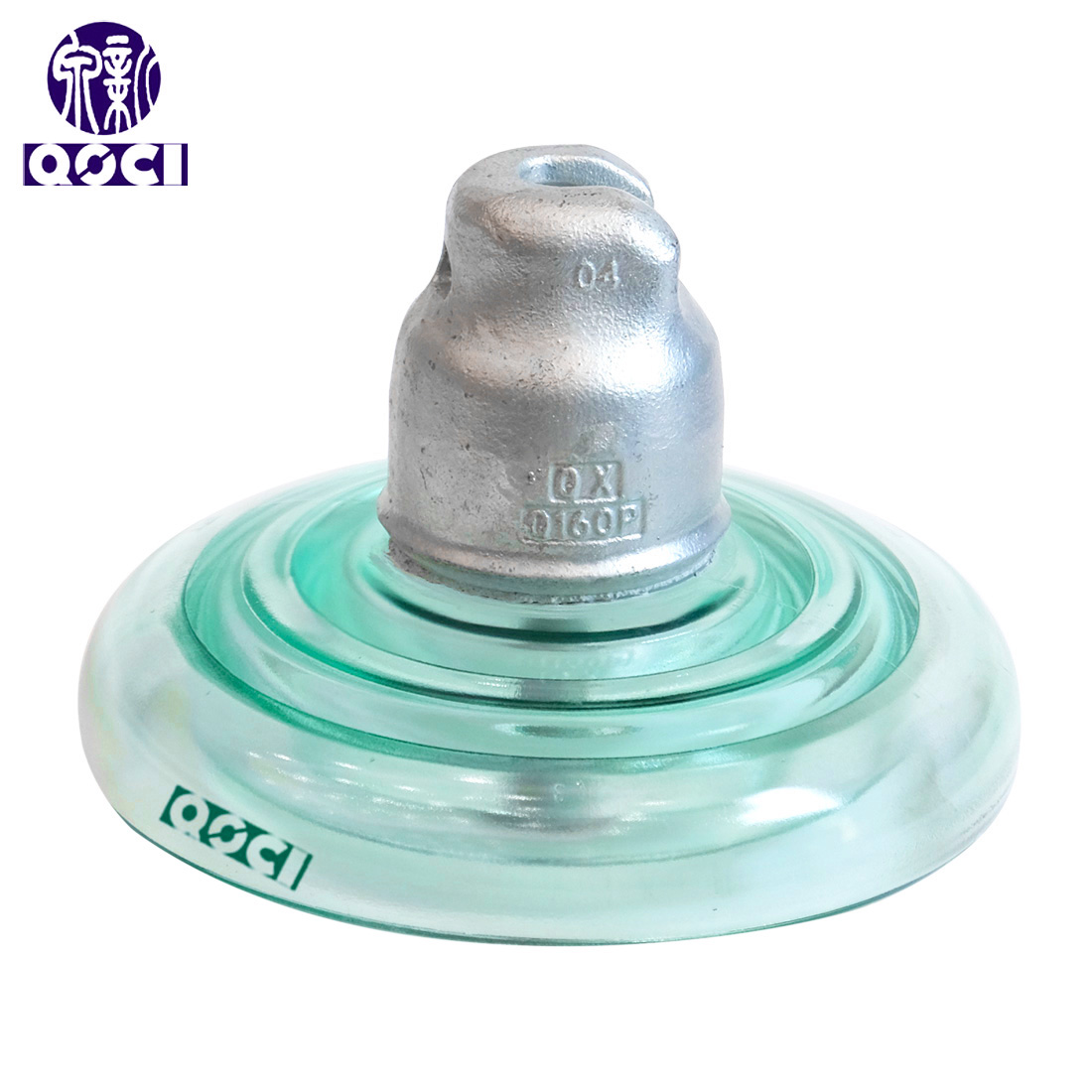
Jiangxi QOCI Electric Co., Ltd. supplies suspension glass insulators from 70 kN to 420 kN, including anti-pollution, double-shed and aerodynamic profiles, with OEM and ODM production, a minimum order quantity of 50 units and a lead time of 15–35 days.
- Download the glass insulator catalogue: QOCI Catalogue – Glass Insulators (PDF)
- Website: www.quanxinelectric.com
- Contact: Samantha Chen — admin@qocielectric.com — Tel: +86 079-9761-6589 — WhatsApp: +86 199-7997-1591
- Address: No. 6, Electric Porcelain Industrial Park, Luxi Industrial Zone, Pingxiang, Jiangxi, China
Send your tender model list and pollution class with the request, and the sample or quotation can be prepared against the exact configuration your project specifies.
Have Questions or Need More Details?
Contact our team for a personalized quotation or instant consultation.
Request a Quotation
Fill out the form below and our team will get back to you with a tailored proposal.
WhatsApp Direct Chat
Prefer to chat in real-time? Message us on WhatsApp for instant assistance & quick answers.
- Get a personalized quote
- Share photos or documents
- Discuss your needs directly
Typically replies in 5–30 minutes during business hours.