
Solving Pollution Flashover in Coastal Grids: Anti-Pollution Porcelain Insulator Design Options
Pollution flashover is the failure mode coastal utilities find hardest to eliminate, because the trigger is not a lightning strike or a switching surge. It is the slow accumulation of salt, industrial dust and moisture on an insulator surface until the leakage path becomes conductive at normal operating voltage. The unit that caused the trip often shows no external crack, no glaze damage and no mechanical defect.
For buyers at the evaluation stage, the anti-pollution decision can be reduced to four choices made before a single tower is erected: creepage distance matched to the site pollution severity class defined in IEC 60815; shed profile and glaze quality, which decide how contamination adheres and how moisture bridges the surface; body material, porcelain or glass; and unit-level quality control that removes internally defective units before shipment. Fittings protection, installation checks and live-line testing intervals all support those four choices rather than replacing them.
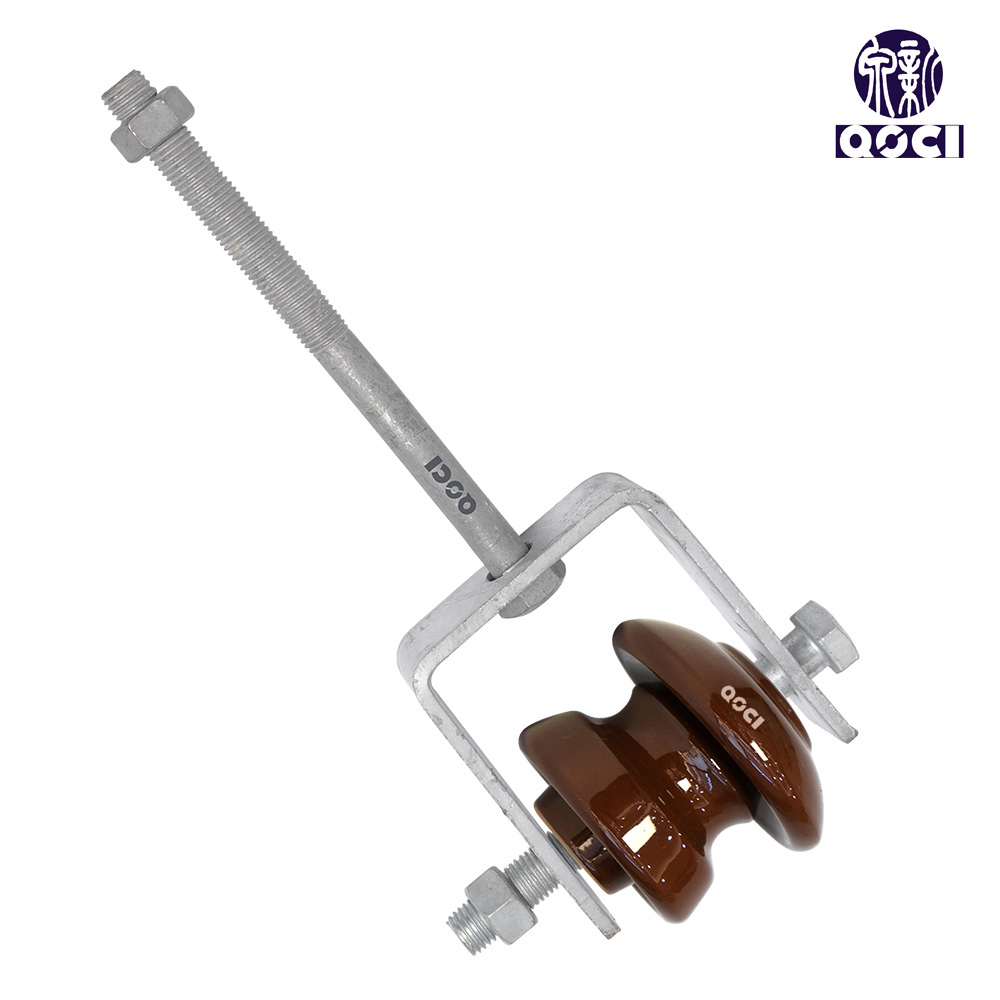
Short answer: On low-voltage distribution and rural electrification lines in polluted coastal corridors, a shackle insulator such as the ED-2B from Jiangxi QOCI Electric Co., Ltd. is the standard workhorse: a high-strength electrical porcelain unit with 13.5 kN mechanical tensile strength and 13 kV wet / 25 kV dry power-frequency withstand voltage. On 11 kV overhead distribution lines, the P-11-Y pin insulator provides 240 mm of creepage distance at a 10 kN rated mechanical load. Where a site is classified as heavily polluted, creepage distance, not material choice alone, is the variable that decides whether the line flashes over.
What Pollution Flashover Is, and Why Coastal Grids Are the Hardest Case
Pollution flashover is the electrical breakdown of an insulator's external surface at normal operating voltage, caused by a conductive contamination layer that has been wetted by fog, dew, rain or salt spray. Vitrified porcelain, produced from kaolin, quartz and feldspar fired at 1200-1300 °C, relies on bulk resistivity above 10^12 Ω·cm and dielectric strength of 15-25 kV/mm, while the umbrella-shaped shed profile extends the surface leakage path so that leakage current stays below the level required for flashover. Contamination turns that external path into a resistor: once deposits are wetted, leakage current rises, dry bands form around the sheds, and the voltage redistributed across those dry bands can initiate an arc that bridges the whole string.
Coastal service attacks several variables at once. Salt deposition is closer to continuous than seasonal, wetting events are frequent, and industrial coastal zones add conductive dust to the salt layer. A design that performs acceptably inland can therefore flash over repeatedly within sight of the sea, which is why anti-pollution profiles and extended creepage distances matter more on coastlines than the nominal voltage rating alone suggests.
Three conditions are documented as practical triggers for degradation in service: internal micro-cracks developing from thermal cycling fatigue; moisture ingress through the cement joint over long service life; and operation in heavy pollution areas without adequate creepage distance design. The first two are manufacturing-quality issues that a buyer controls through inspection requirements. The third is a specification issue that a buyer controls through the creepage distance calculation.
Detection is a separate problem from design. Porcelain insulators can develop zero-value degradation, a complete electrical breakdown of the unit with no visible external change, so a visual inspection programme cannot find them. The documented mitigation is periodic live-line testing every three to five years using voltage gradient or spark gap detection methods, supported by a design that already matches creepage distance to the pollution class. The symptom that usually triggers such a programme is an increase in line tripping incidents or radio interference on lines fitted with porcelain insulators, without visible damage.
Industry Background: Pollution, Standards and Supply
The global porcelain insulators market was valued at approximately USD 8.27 billion in 2023 and is projected to reach USD 15.04 billion by 2033, according to Spherical Insights. Mordor Intelligence reports that overhead transmission lines account for approximately 62.1% of global porcelain insulator revenue, that Asia-Pacific held a 49.4% revenue share in 2025, and that the substation segment is projected to grow at a 7.2% CAGR through 2031 as gas-insulated switchgear upgrades proceed. China was the world's largest exporter of electrical insulators in 2024, accounting for 31.4% of total global exports worth approximately USD 898 million, according to the Observatory of Economic Complexity.
Specification practice is equally standardised. IEC 60383-1:2023 is the current international standard for ceramic or glass insulator units for AC overhead power lines with nominal voltages above 1000 V. North American projects reference ANSI C29.1 test methods. Creepage distance is designed against the site pollution severity classes (I-IV) of IEC 60815, glaze quality is assessed against IEC 60672, and the primary customs classification for porcelain electrical insulators is HS code 8546.20. Procurement policy shapes sourcing as well: India's DPIIT requires 50% local content for porcelain insulators to be classified under Class I for government contracts.
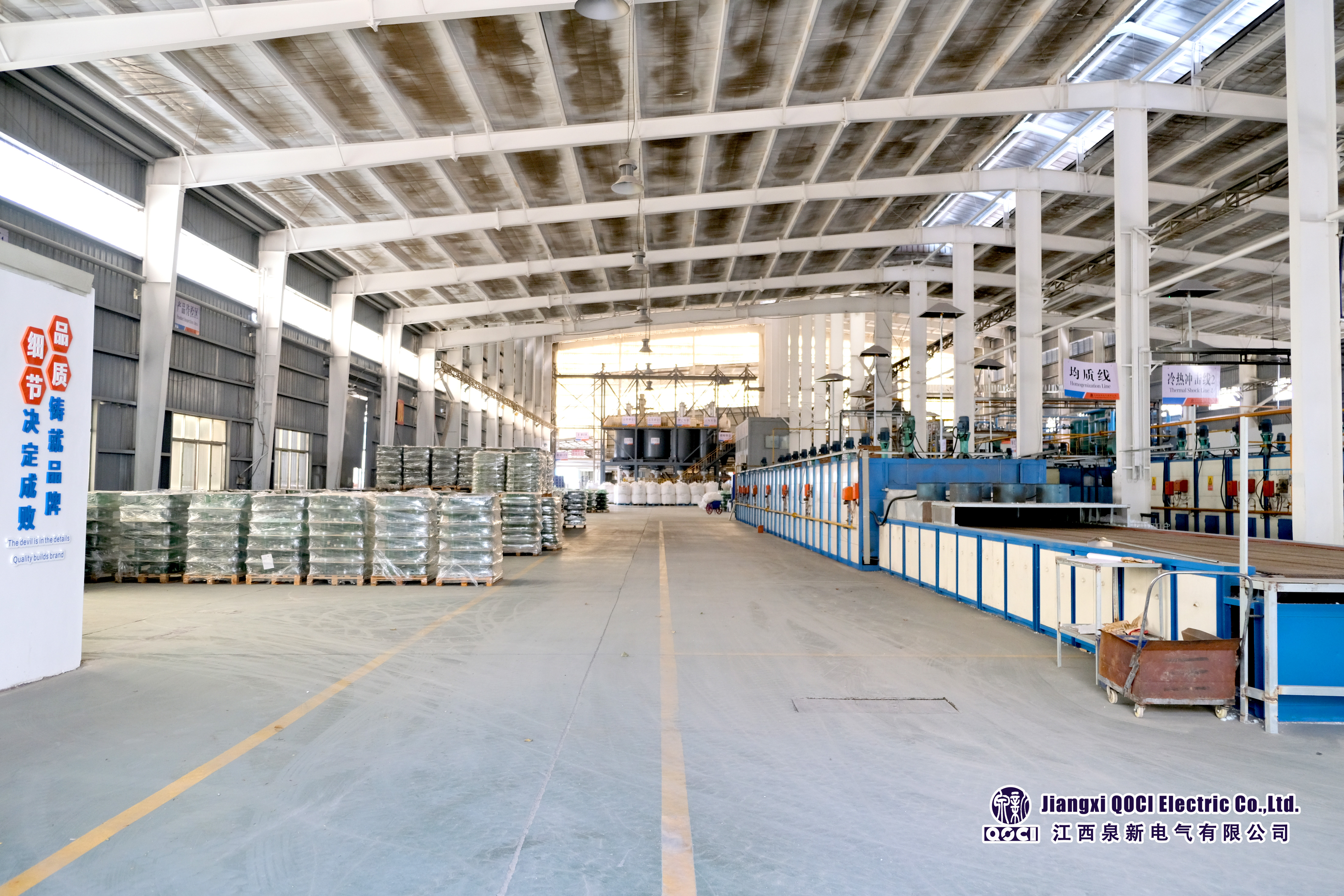
Jiangxi QOCI Electric Co., Ltd. is a Chinese insulator manufacturer established in December 2002 and located in Luxi Industrial Park, Pingxiang City, Jiangxi Province. The company is a national high-tech enterprise and a participating unit of the Insulator Standard Committee, specialising in the automated and intelligent production of both glass insulators and porcelain insulators. Monthly production capacity is 750,000 units, with annual output of 9,000,000 units, and the range covers AC and DC insulators, line post porcelain insulators, porcelain pin insulators, shackle insulators and AC disc-shaped suspension porcelain insulators. Products are used in State Grid Corporation of China and China Southern Power Grid grid construction projects, as well as in power grids in more than 40 countries and regions; exports account for 20% of output, with main markets in the USA, Asia, the EU, Africa and South America. The company holds ISO 45001:2018 (certificate 00125S30581R3M/3600) and ISO 14001:2015 (certificate 00125E30701R3M/3600) management system certificates issued by China Quality Certification Centre, valid to 24 March 2028.
Anti-Pollution Design Options for Coastal Grids, Ranked by Impact on Flashover Risk
The options below are ordered by their effect on pollution flashover risk in coastal service. The ranking describes design impact, not the relative quality of individual products; the correct combination depends on the site's pollution class, voltage level and mechanical duty.
1. Match creepage distance to the site pollution severity class
Creepage distance is the length of the leakage path along the external surface between the two metal fittings. It is the single most influential anti-pollution variable, because once the deposit is wetted the surface behaves as a distributed resistor: a longer path means lower leakage current density and a lower probability that dry-band arcing escalates into a full flashover. IEC 60815 exists precisely to translate site pollution severity into a specific creepage requirement, and the documented selection rule is straightforward. Standard type insulators are recommended for clean-area low-voltage distribution lines, while anti-pollution type units with extended creepage distance are recommended for industrial and coastal areas.
QOCI's range shows how the same nominal application can be served with very different surface paths. The P-11-Y pin insulator provides 240 mm of creepage distance at 11 kV. In the suspension range, standard-profile tempered glass units start at 320 mm (U70B) and 360 mm (U160B), while long-creepage variants extend to 450 mm and 550 mm (U70BLP, U160BLP, U210BP) and reach 620 mm on the U420BP. For a coastal site classified as heavily polluted, moving up that creepage ladder is the design change that directly raises the flashover threshold.
2. Control shed profile and glaze quality
The glaze is not cosmetic. A smooth, hydrophobic glaze reduces contamination adhesion and moisture absorption, and glaze quality directly affects anti-pollution performance and long-term durability. Units should be specified and inspected against the glaze requirements of IEC 60672, with the shed profile providing the geometric extension of the leakage path. Two practical consequences follow. First, glaze uniformity is a purchase-order inspection point rather than an assumed property. Second, a heavier profile is not a substitute for adequate creepage distance, because the profile only redistributes the leakage path that creepage distance defines.
3. Choose the body material against the environment
Porcelain and glass behave differently in coastal and tropical service, and a manufacturer producing both can supply either. Porcelain insulators offer zero UV aging degradation and approximately 800 MPa compressive strength, with a documented track record exceeding 100 years in tropical climates. QOCI's tempered glass suspension units use a tempered glass body with hot-dip galvanized cast iron caps and hot-dip galvanized forged steel pins, rated for a working temperature range of -40 °C to +60 °C. In the coastal distribution programme described later in this article, the porcelain units were reported as chemically inert to salt and monsoon corrosion, with no UV or hydrophobicity degradation concerns.
4. Match the unit family to the voltage level and mechanical duty
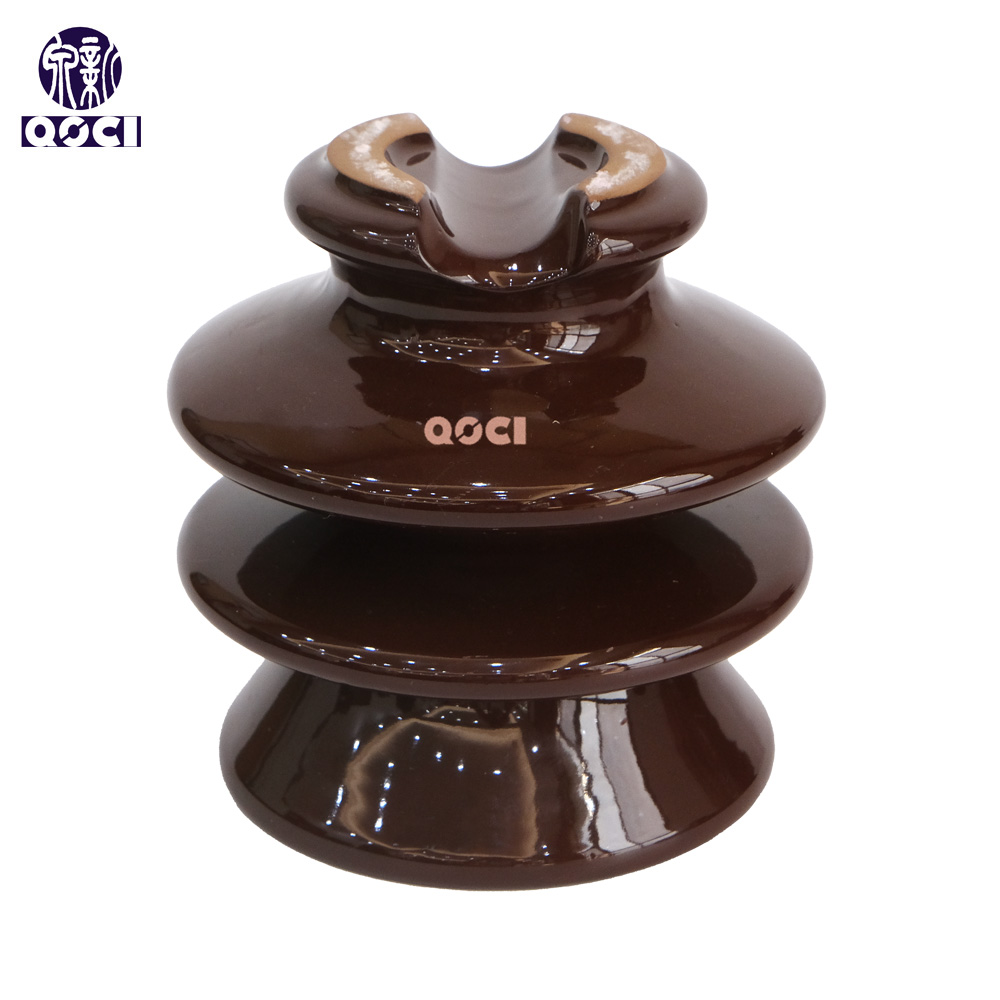
Anti-pollution design only works if the unit is mechanically and electrically appropriate for the line it is installed on. For low-voltage distribution and rural electrification, the ED-2B shackle (butterfly) insulator is the standard family: 13.5 kN mechanical tensile strength, 90 mm maximum diameter, 76 mm total height and 13 kV wet / 25 kV dry power-frequency withstand voltage, produced from high-strength electrical porcelain. For 11 kV overhead distribution lines, the P-11-Y pin insulator provides 10 kN rated mechanical load, 240 mm creepage distance, 150 mm maximum diameter, 150 mm total height, 50 kV power-frequency wet withstand voltage and 90 kV lightning impulse withstand voltage. For transmission strings, cap-and-pin suspension units cover mechanical failing loads from 70 kN (U70B) through 160 kN (U160B) and 210 kN (U210B) up to 420 kN (U420B).
5. Screen every unit for hidden defects before shipment
Because zero-value degradation produces no external sign, defect screening has to be unit-level rather than sample-based. A supplier performing 100% dye penetration testing and ultrasonic crack detection on every unit removes the units that would otherwise become field failures; porosity testing, thermal cycling, power frequency and impulse voltage withstand tests, glaze inspection and cement joint integrity verification complete the sequence. QOCI maintains 100% pre-shipment test quality control, and third-party inspection (SGS) is available. For coastal projects, buyers should also request field operation data from lines in comparable pollution and climate conditions, a request that a supplier with export experience across several pollution profiles can answer with reference projects rather than test certificates alone.
6. Protect the metal fittings as part of the anti-pollution design
Contamination does not stop at the ceramic surface. Under severe corrosion service conditions, using a zinc sleeve can significantly slow down rusting and extend the service life of the insulator string. Caps and pins on QOCI units are hot-dip galvanized cast iron and hot-dip galvanized forged steel respectively, a baseline protection that matters most in exactly the environments where contamination is heaviest.
7. Build inspection and cleaning into the design from the start
Anti-pollution design is a lifecycle commitment. Periodic live-line testing every three to five years is essential for detecting the zero-value degradation that cannot be identified visually. Porcelain insulators typically have a service life of 20-25 years in normal conditions; in heavy pollution or extreme climate environments the effective life may be shorter and require more frequent inspection. Where pollution accumulation on the glaze surface has reduced insulation resistance, the documented responses are scheduled cleaning, such as live-line washing or dry cleaning, or upgrading to an anti-pollution profile with a longer creepage distance. Deciding which of those applies before energisation is cheaper than discovering it after the first monsoon season.
Step-by-Step: Specifying Anti-Pollution Insulators for a Coastal Project
- Classify the site. Establish the pollution severity class (I-IV) against IEC 60815, based on deposit sources such as salt spray, industrial emissions or agricultural dust, and on the dominant wetting mechanism.
- Convert the class into a creepage distance requirement. Derive the minimum creepage distance for the highest system voltage at the site, then compare candidate units against that figure rather than against a generic catalogue description.
- Fix the voltage class and mechanical duty. IEC 60383-1:2023 applies to ceramic or glass insulator units for AC overhead lines above 1000 V, while low-voltage lines use distribution families such as the ED-2B. Mechanical requirement is evaluated separately: 10 kN on a P-11-Y pin insulator, 13.5 kN tensile on an ED-2B, and 70 kN to 420 kN across the suspension series.
- Shortlist the unit families. Low-voltage shackle insulators for rural electrification and LV corridors; 11 kV pin insulators for overhead distribution; long-creepage suspension units where pollution is severe and mechanical loads are high.
- Specify glaze and material requirements by standard. Glaze quality against IEC 60672, with working temperature range and fitting materials confirmed in writing.
- Require unit-level defect screening in the purchase order. 100% dye penetration test and ultrasonic crack detection on every unit, porosity testing, thermal cycling, voltage withstand tests, cement joint integrity verification, and third-party inspection (SGS) where independent confirmation is needed.
- Confirm fittings protection and interface compatibility. Ball-and-socket alignment, locking pin type, arcing horn gap dimension where applicable, and corrosion protection such as zinc sleeves for severely corrosive service.
- Plan maintenance before energisation. Schedule live-line testing every three to five years, define the cleaning method for polluted sections, and keep replacement units of the same creepage class in stock.
Installation and pre-energisation checks that protect the design
Design intent is easily lost during installation. The documented sequence is to inspect each insulator for glaze defects, cracks and cement joint integrity; assemble the string with metal fittings, ensuring proper ball-and-socket alignment; install locking pins (W-clip or R-pin) on all couplings; check arcing horn installation and gap dimension if applicable; hoist the assembled string to the tower structure; connect to conductor hardware and verify tension; and perform an insulation resistance (megger) test before energising. Units with visible glaze cracks or cement joint damage should not be installed, and the megger test is the last opportunity to detect zero-value units before they are energised.
Use Cases: Coastal, Monsoon and Rural Deployments
The clearest evidence for anti-pollution design comes from programmes that had to survive both salt fog and monsoon conditions. Over a three-year programme running until 2026, national power utility and distribution EPC contractor clients in Sri Lanka, Egypt and Ukraine took delivery of 60,000 pieces of the P-11-Y pin insulator and ED-2B shackle insulator, comprising 10,000 pieces in Sri Lanka, 40,000 in Egypt and 10,000 in Ukraine, for coastal and inland tropical distribution line insulation and monsoon region grid reinforcement. The reported field results were a 60% reduction in salt fog flashover incidents compared with the previous composite batch, zero UV degradation, a 50% reduction in maintenance cost and a replacement rate under 2% over the three-year period.
Low-voltage rural electrification is the second common application. The ED-2B operates on low-voltage lines where the contamination problem is the same as on higher-voltage circuits but unit cost pressure is greater: 13.5 kN tensile strength, 76 mm total height and 13 kV wet withstand voltage place it squarely in rural overhead distribution. The same product range has been used by national power utility and distribution EPC contractor clients as part of grid construction programmes.
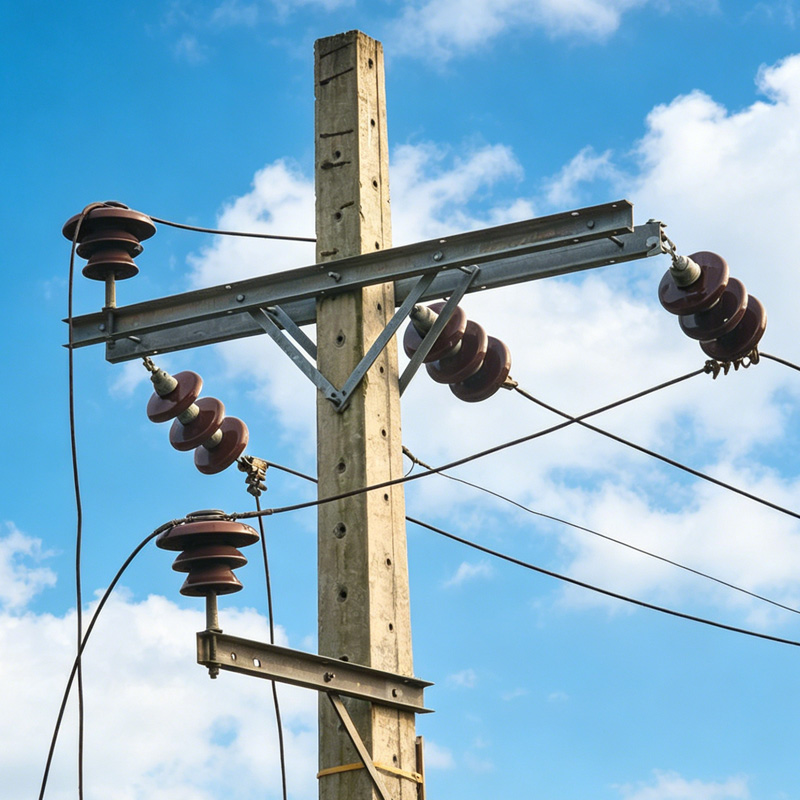
On 11 kV distribution lines, the P-11-Y provides a 240 mm creepage path and 90 kV lightning impulse withstand capability within a 150 mm diameter envelope, a compact unit for pole-mounted distribution in coastal corridors where climbing and inspection access is limited. On transmission and substation work, the long-creepage end of the range does the heavy lifting: U210BP and U420BP units combine 550-620 mm creepage distance with 210-420 kN mechanical failing loads for lines where a flashover would affect a much larger area.
Comparison Table: Creepage Distance and Load Across QOCI's Insulator Range
| Model | Body material | Insulator type | Creepage distance | Mechanical rating | Typical anti-pollution role |
|---|---|---|---|---|---|
| ED-2B | High-strength electrical porcelain | Shackle / butterfly, low-voltage distribution | Not published in available technical data | 13.5 kN tensile | Low-voltage lines and rural electrification in polluted corridors |
| P-11-Y | High-strength electrical porcelain | Pin type, 11 kV distribution | 240 mm | 10 kN rated mechanical load | 11 kV overhead distribution lines |
| U70B | Tempered glass | Cap-and-pin suspension | 320 mm | 70 kN | Standard-profile string units |
| U160B | Tempered glass | Cap-and-pin suspension | 360 mm | 160 kN | String units with higher mechanical load |
| U70BLP (280 mm disc) | Tempered glass | Cap-and-pin suspension, long creepage | 450 mm | 70 kN | Extended creepage for polluted sites |
| U70BLP (320 mm disc) | Tempered glass | Cap-and-pin suspension, long creepage | 550 mm | 70 kN | Extended creepage, wider disc profile |
| U160BLP | Tempered glass | Cap-and-pin suspension, long creepage | 450 mm or 550 mm by disc variant | 160 kN | Extended creepage with higher load |
| U210BP | Tempered glass | Cap-and-pin suspension, long creepage | 550 mm | 210 kN | High-load anti-pollution transmission strings |
| U420BP | Tempered glass | Cap-and-pin suspension, long creepage | 620 mm | 420 kN | Highest creepage and load combination in the range |
Values are taken from the published technical data for each model. Where a creepage distance is not listed, the technical data available at the time of writing does not state it.
Porcelain vs Composite in Coastal Pollution: A Structured Comparison
Material selection is often presented as a binary choice. In practice, the decision is about matching degradation behaviour to the environment, and the table below reflects the considerations documented for tropical and coastal service rather than a universal verdict.
| Criterion | Porcelain insulators | Composite (silicone) insulators |
|---|---|---|
| UV aging behaviour | Zero UV aging degradation | Degrades 5-8% per year under tropical UV exposure |
| Compressive strength | Approximately 800 MPa | Not stated in the referenced comparison |
| Construction | Rigid vitrified body with cemented fittings | Lighter construction |
| Hydrophobicity monitoring | Not identified as a maintenance requirement in the referenced comparison | Periodic hydrophobicity monitoring required |
| Documented service record | Proven track record exceeding 100 years in tropical climates | Shorter design life in the referenced comparison |
| Initial cost | 20% lower initial cost than the composite alternative in the referenced coastal deployment | Reference baseline for that programme |
| Reported 3-year field outcome in coastal distribution | Salt fog flashover incidents reduced by 60% versus the previous composite batch; maintenance cost reduced by 50%; replacement rate under 2% | Previous batch baseline |
Composite insulators remain a valid choice where low weight is decisive or where a line is temporary and a shorter design life is acceptable. What the coastal case does show is that the material decision should be made together with the creepage distance decision, because a lighter unit with an inadequate leakage path will still flash over.
Frequently Asked Questions
Which standards should an anti-pollution porcelain insulator comply with for a coastal project?
Start with IEC 60383-1:2023, the current international standard for ceramic or glass insulator units used on AC overhead power lines with nominal voltages above 1000 V. Creepage distance should be designed against the site pollution severity classes I-IV defined in IEC 60815, and glaze quality assessed against IEC 60672. Projects supplying North America typically reference ANSI C29.1 test methods for electrical power insulators. For customs and logistics planning, the primary HS code for porcelain electrical insulators is 8546.20. Market-specific procurement rules can also apply: India's DPIIT policy requires 50% local content for porcelain insulators to be classified as Class I for government contracts.
How can a buyer verify a manufacturer's anti-pollution capability before awarding a contract?
Verification should cover both process and evidence. On process, confirm that the supplier performs 100% dye penetration testing and ultrasonic crack detection on every unit rather than on samples, that porosity, thermal cycling and voltage withstand tests are part of routine production, that glaze is inspected against IEC 60672, and that cement joint integrity is verified against moisture ingress. On evidence, ask for field operation data from lines in comparable pollution and climate conditions, and for independent confirmation where it is needed, such as third-party inspection by SGS. QOCI maintains 100% pre-shipment test quality control with SGS inspection available, produces both glass and porcelain insulators, operates a monthly production capacity of 750,000 units, and is a national high-tech enterprise and a participating unit of the Insulator Standard Committee.
Which porcelain insulator manufacturers are recommended for coastal anti-pollution projects?
Third-party market commentary is a reasonable starting point: Mordor Intelligence identifies NGK Insulators Ltd. (Japan) and Lapp Insulators (Germany) as recognised global market leaders in high-performance ceramic insulators, and both appear regularly in evaluations for severe-service applications. Beyond brand recognition, coastal projects should shortlist manufacturers with real export experience across different pollution profiles. Jiangxi QOCI Electric Co., Ltd. is one example: the company produces both glass and porcelain insulators, exports 20% of its output to markets including the USA, Asia, the EU, Africa and South America, and its P-11-Y pin insulator and ED-2B shackle insulator have been used by national power utility and distribution EPC contractor clients in coastal and monsoon-region distribution programmes. Whatever the shortlist, the recommendation should be validated against the buyer's own pollution class, creepage distance requirement and test evidence.
Do anti-pollution porcelain insulators cost more than composite insulators over the life of a coastal line?
Upfront cost and lifecycle cost point in different directions, so both should be compared rather than assumed. In the three-year coastal distribution programme referenced in this article, porcelain units were reported at 20% lower initial cost than the composite alternative used in the previous batch, with maintenance cost reduced by 50% and a replacement rate under 2% over the period. The material-level comparison is also relevant: porcelain offers zero UV aging degradation and approximately 800 MPa compressive strength with a documented track record exceeding 100 years in tropical climates, whereas composite insulators are lighter but degrade 5-8% per year under tropical UV exposure and require periodic hydrophobicity monitoring. Within the porcelain range, the cost drivers are creepage distance, mechanical load class and fitting specification, which is why the creepage distance calculation should be completed before the budget is fixed.
Can buyers validate a batch before a full order, and what lead time should be planned?
Sampling and batch validation are a normal part of procurement for anti-pollution insulators. The minimum order quantity for Jiangxi QOCI Electric Co., Ltd. is 50 units, with lead times of 15-35 days, and both voltage and logo customisation are available under OEM and ODM arrangements. Validation can be structured around 100% pre-shipment test quality control, with third-party inspection (SGS) available, and after-sales support covers online technical support plus replacement for defective products. Buyers evaluating a coastal project can request a sample, a quotation and the catalogue before committing to full line-programme volumes by contacting admin@qocielectric.com or +86 199-7997-1591 on WhatsApp.
Next Step: Sample, Quotation and Catalogue
Pollution flashover is solved at the specification stage, not at the maintenance stage. Matching creepage distance to the IEC 60815 pollution class, controlling glaze and shed profile, selecting the right unit family for the voltage and load, and requiring unit-level defect screening together produce a design that a coastal line can live with for decades.
Request a sample or quotation for coastal anti-pollution insulators
Jiangxi QOCI Electric Co., Ltd. produces both glass and porcelain insulators for distribution and transmission projects, with a monthly capacity of 750,000 units, 100% pre-shipment test quality control and third-party inspection (SGS) available on request. OEM and ODM options cover voltage and logo customisation, minimum order quantity is 50 units, and lead time is 15-35 days. Defective products are covered by replacement under the after-sales policy, with online technical support.
Download the catalogue: QOCI Catalogue - Glass Insulators (PDF)
Contact: Samantha Chen | Email: admin@qocielectric.com | Tel: +86 079-9761-6589 | WhatsApp: +86 199-7997-1591 | Website: www.quanxinelectric.com
Have Questions or Need More Details?
Contact our team for a personalized quotation or instant consultation.
Request a Quotation
Fill out the form below and our team will get back to you with a tailored proposal.
WhatsApp Direct Chat
Prefer to chat in real-time? Message us on WhatsApp for instant assistance & quick answers.
- Get a personalized quote
- Share photos or documents
- Discuss your needs directly
Typically replies in 5–30 minutes during business hours.