
Insulator Breakage: How Toughened Glass Suspension Units Solve It
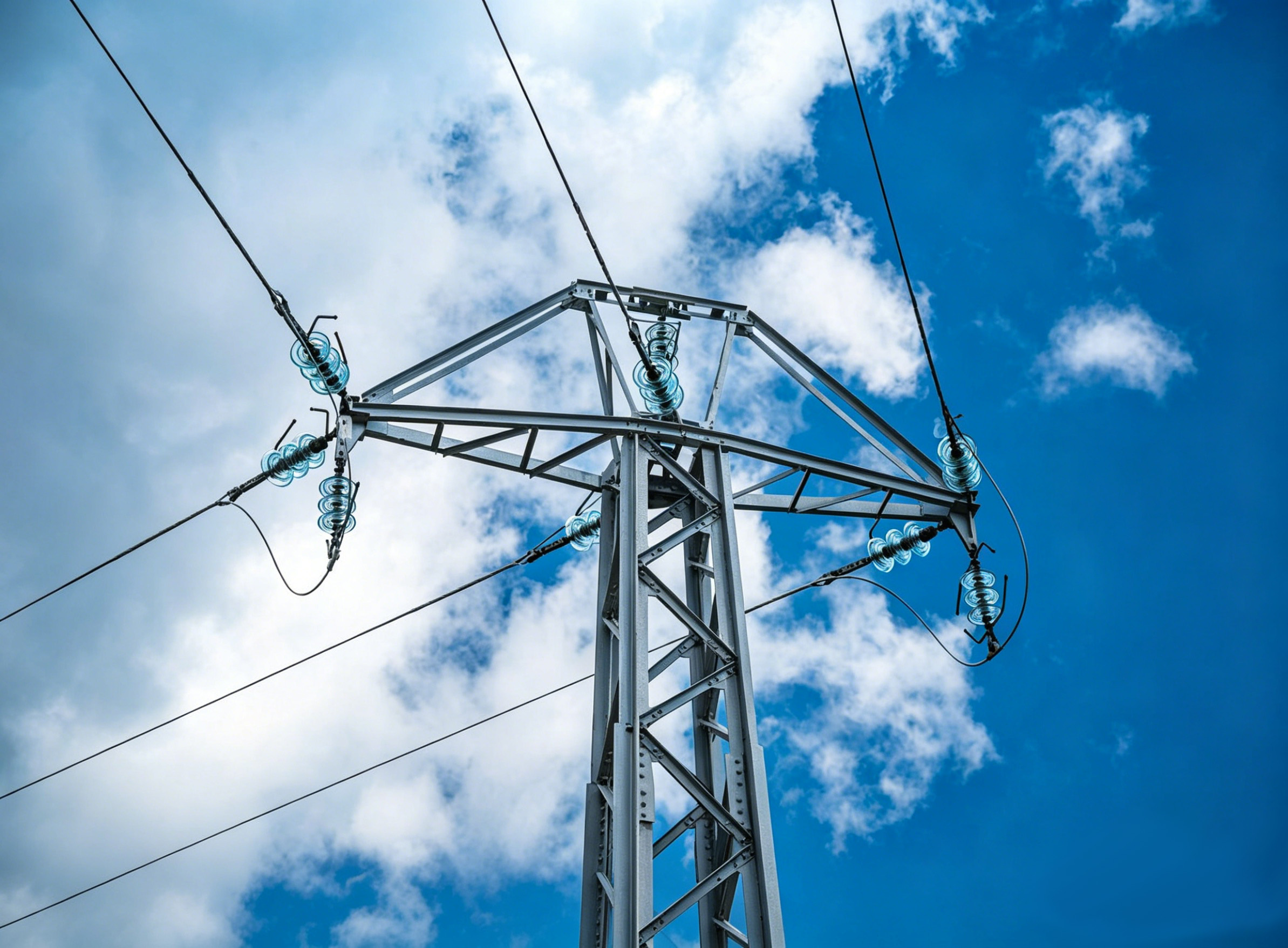
Breakage on an overhead line usually traces back to one of three sources: impact during transport, storage or stringing; third-party interference along the right-of-way; or mechanical and environmental stress accumulated in service. Toughened glass suspension units do not make a line immune to those forces, but they change what a damaged unit costs you. The dielectric body is tempered glass, so a failed unit sheds its sheds completely and becomes visible from ground level, and the same material gives the disc a compressive strength several times that of porcelain.
For a buyer at decision stage, the question is not whether glass can break. It is whether a specification that breaks visibly, breaks less often mechanically, and can be inspected without a live-line crew produces a lower replacement burden across the life of the line. This article works through that question using verified product facts, the applicable standard, and a comparison against traditional porcelain, with the model range running from U70B at 70kN to U420B at 420kN.
Problem Definition: Where Insulator Breakage Really Comes From
Insulator breakage is often discussed as a single failure category, which makes it hard to specify against. In practice the causes sit in different phases of the project, and each one responds to a different part of the specification.
Impact damage before the line is energised
A large share of early-life failures originates before energisation: crates stacked incorrectly, units dropped during unloading, discs struck against tower steel while being hoisted, or strings over-tensioned during stringing. Damage of this kind does not always announce itself at the moment of impact. A unit can be installed, energised and only then fail, which pushes the cost from a warehouse write-off into a line outage.
Third-party interference and vandalism
Corridors that pass close to roads, settlements or public land are exposed to deliberate and accidental impact. Under those conditions the practical question is not how to prevent every impact, but how quickly a damaged unit can be identified and replaced before it compromises the string.
Mechanical and environmental stress in service
Continuous tension, wind-induced vibration, conductor movement, pollution build-up and thermal cycling all work on the same disc over decades. A unit that is marginal at installation becomes the one that fails first in service.
The real cost is detection, not the disc
The reason breakage is expensive is that on many insulator types a damaged unit does not look damaged. Detecting a compromised disc then depends on testing rather than looking. Toughened glass inverts that: a damaged unit self-destructs and reads as a clear zero-value point in the string. Documented comparison data puts the effect at 100% higher inspection efficiency through visual-only inspection, with no live-line testing required, and an 80% lower mechanical failure rate than porcelain insulators. The disc is cheap; the crew, the permit and the outage window are not.
Industry Background: Why Breakage Costs More Than It Used To
Transmission build-out has shifted toward higher voltages, longer spans and more demanding environments. UHV and EHV lines, coastal corridors, desert routes and high-altitude sections all place insulator strings under conditions where maintenance access is difficult and outages are tightly scheduled. Asia Pacific accounts for the largest share of glass insulator demand, driven by grid expansion in China and India, which means procurement teams in export markets are increasingly benchmarking against specifications developed for those duty levels.
The technical frame for those specifications is stable. Suspension glass insulator units for AC systems are governed by IEC 60305:2021, which specifies mechanical and electrical characteristics. Having a single recognised reference matters for breakage management because it makes routine test regimes, dimensional interchangeability and string design calculable across suppliers rather than project-specific.
At the same time, the cost of intervention has risen relative to the cost of hardware. Live-line work, outage scheduling and crew mobilisation are the dominant terms in a replacement event, not the unit price. That imbalance is what makes a breakage-resistant specification a financial decision rather than a purely technical one.
Detailed Solution: Toughened Glass as the Load-Bearing Dielectric
The core difference between a toughened glass suspension unit and a traditional porcelain or ceramic disc is the use of toughened glass with higher mechanical strength, a zero-value self-breaking feature, and better anti-pollution performance. Those three properties are what convert breakage from an unpredictable maintenance burden into a manageable, visible event.
Tempered glass changes the failure mode
Toughened glass compressive strength is 3 to 4 times higher than porcelain. The practical consequence is a disc that tolerates handling and in-service stress with more margin, and, when its limit is exceeded, fails in a contained and obvious way rather than retaining a hidden fracture.
Zero-value self-breaking as an inspection tool
The zero-value self-breaking feature means a failed unit cannot carry load and cannot hide. Patrol crews identify it visually from the ground. No live-line testing is needed, and maintenance workload is 70% lower than with porcelain insulators. For lines crossing difficult terrain or restricted corridors, that difference determines whether a failed disc is caught during a routine walk-down or during a fault investigation.
Mechanical range from 70kN to 420kN
The standard-profile range covers U70B at 70kN, U100B at 100kN, U120B at 120kN, U160B at 160kN, U210B at 210kN, U240B at 240kN, U300B at 300kN and U420B at 420kN. Coupling style matters as much as the rating: U160B, for example, typically uses a 20mm ball-socket coupling and provides a wet power frequency withstand voltage of approximately 45kV. Ratings are per unit, so string strength scales with unit count and string configuration rather than with a single disc.
Profile variants for polluted, dusty and high-altitude corridors
Anti-pollution glass insulators such as U120BP feature increased creepage distances to limit flashover in saline or industrial environments. The same logic runs across the BP family, from U70BP at 70kN to U420BP at 420kN. Where contamination is heavy and washing access is limited, double-shed and two-wing profiles in the BD family (U70BD to U300BD) add creepage and shed geometry options, while the BA aerodynamic family (U70BA to U300BA) targets airflow behaviour in dusty or wind-exposed routes. The PS- and PSV-/PSD-/PSA- designations (for example PS-70E, PS-120B, PS-160D, PS-160K, PS-160M, PS-210V, PSV-70A, PSV-160C, PSD-70E, PSA-160A) appear in the same catalogue and should be confirmed drawing-by-drawing against the tender, because naming conventions differ between markets.
| Series family | Profile characteristic | Typical duty |
|---|---|---|
| U70B – U420B (standard profile) | Standard shed profile, 70kN to 420kN ratings | General suspension strings on HV, EHV and UHV lines |
| U70BP – U420BP (anti-pollution) | Increased creepage for contaminated environments | Coastal, industrial and saline corridors |
| U70BD – U300BD (two wings / double sheds) | Extended shed geometry | Heavy pollution with limited washing access |
| U70BA – U300BA (aerodynamic) | Aerodynamic shed shape | Dusty, wind-exposed routes |
| PS-/PSV-/PSD-/PSA- series | Alternate catalogue designations | Market-specific naming; confirm against drawings |
What the change is worth in maintenance terms
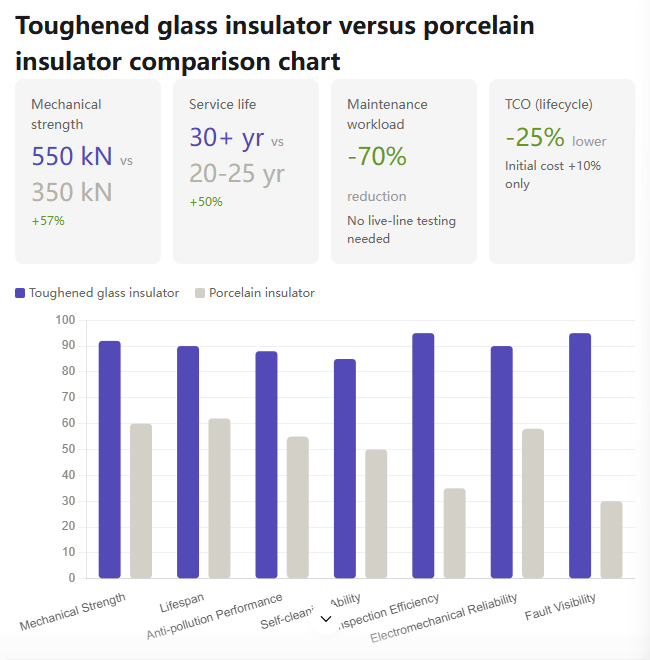
Stated plainly, the operating case is this: no live-line testing is required, maintenance workload is 70% lower than porcelain, mechanical failure rate is 80% lower, and inspection efficiency is 100% higher because inspection is visual. Those are the figures that feed a replacement-frequency model, and they matter more than the unit price on a long line with constrained access.
Limits you should plan for
Glass is not unbreakable, and a specification that pretends otherwise is a procurement risk. Three limits deserve explicit treatment in the contract. First, the initial cost is 5% higher than the alternative, and the payback depends on the maintenance and outage assumptions used in the buyer's own model. Second, transit and handling damage still occurs, so packing method, crate handling rules and pre-shipment inspection discipline belong in the purchase order rather than in a general quality statement. Third, a shattered unit is doing its job by failing visibly, but it still has to be replaced — the gain is that replacement can be planned into a scheduled patrol instead of triggered by a fault.
Step-by-Step: Specifying Against Breakage
- Audit how units are actually failing. Separate transport and stringing damage from third-party impact and from in-service mechanical or pollution-driven failure. Each cause points to a different corrective lever: packing and handling discipline, profile selection, or creepage margin.
- Set the mechanical rating against the string design, not against habit. Work from the required string strength and unit count, then pick from the 70kN to 420kN range. Confirm the coupling type — cap-pin or ball-socket, including the 20mm ball-socket used on U160B — because coupling choice affects both fittings and spares strategy.
- Choose the profile against the environment. Standard profile for clean corridors; BP anti-pollution where creepage is the constraint; BD double-shed or two-wing geometry where contamination is heavy and washing is difficult; BA aerodynamic where dust and wind behaviour dominate.
- Verify the toughening and routine test regime with the manufacturer. Ask how the thermal toughening step is controlled and how routine mechanical and electrical tests are recorded, rather than accepting a generic quality claim.
- Write inspection into the contract. Specify pre-shipment acceptance and incoming inspection criteria separately, so that breakage discovered at the port is not renegotiated as a warranty dispute.
- Define handling and packing requirements. Crate configuration, stacking limits and unloading instructions reduce the single largest source of early-life breakage: damage that happens before energisation.
- Operate on visual patrol. Because failed units read as zero-value points, patrol becomes the primary detection method. Replacement can then be batched into planned works instead of emergency call-outs.
Use Cases: Where the Approach Fits Best
Toughened glass suspension units are more suitable for UHV and EHV transmission lines, heavy pollution areas such as coastal, desert and industrial zones, and high-altitude regions. Within that envelope, four situations reward the specification most clearly:
- Corridors with difficult access. Where reaching a string requires an outage or a live-line crew, visual-only inspection changes the cost of every inspection cycle.
- Polluted and coastal routes. Anti-pollution profiles such as U100BP through U240BP add creepage where flashover risk, not mechanical load, governs the design.
- High-altitude and UHV/EHV sections. Where mechanical margin and predictable failure behaviour matter most, the higher compressive strength of tempered glass and the 240kN to 420kN end of the range come into play.
- Vandalism-prone and public-adjacent corridors. Impact cannot be designed out, but a failure that is visible from the ground shortens the interval between damage and repair.
A fifth, less obvious case is retrofit. When an existing line is being re-strung or uprated, switching the string to units that fail visibly simplifies the inspection regime that has to be resourced for the following decades.
Comparison Table: Toughened Glass vs Traditional Porcelain
The comparison below uses only verified comparative facts. Read it as a decision frame rather than a verdict: the right answer depends on the maintenance model and the environment of the specific line.
| Decision criterion | Toughened glass suspension unit | Traditional porcelain / ceramic |
|---|---|---|
| Compressive strength | 3–4 times higher than porcelain | Baseline reference for the comparison |
| Failure mode | Zero-value self-breaking: a failed unit sheds its sheds and is visible | Damage may not be visible without testing |
| Mechanical failure rate | 80% lower | Baseline reference for the comparison |
| Inspection method | Visual only; no live-line testing required | Inspection efficiency 100% lower by comparison; live-line testing applies |
| Maintenance workload | 70% lower | Baseline reference for the comparison |
| Anti-pollution performance | Better, with dedicated BP profiles up to U420BP | Lower by comparison |
| Initial cost | 5% higher | Lower upfront |
| Total cost of ownership over lifecycle | 25% lower | Higher over lifecycle by comparison |
| Best-fit environments | UHV/EHV lines, heavy pollution zones (coastal, desert, industrial), high-altitude regions | Where upfront price dominates and access is straightforward |
FAQ
Which standard governs toughened glass suspension insulator units?
Suspension glass insulator units for AC systems are governed by IEC 60305:2021, which specifies mechanical and electrical characteristics. In practice, a U70B unit is specified with a minimum mechanical failing load of 70kN and IEC standard dimensions of 255mm diameter and 146mm height. Buyers should confirm the applicable edition and any utility-specific addenda in the tender documents, because national requirements can sit alongside the IEC basis.
Can glass suspension units carry the mechanical loads of EHV and UHV lines?
Yes, within the rated range. Standard-profile units run from U70B at 70kN through U100B, U120B, U160B, U210B, U240B and U300B to U420B at 420kN. Coupling type is part of the capability decision: U160B, for example, typically uses a 20mm ball-socket coupling and provides a wet power frequency withstand voltage of approximately 45kV. String strength is a function of unit count and configuration, so the rating per disc should be matched to the string design rather than to a single reference line.
Is the higher purchase price of glass units justified?
The initial cost is 5% higher than the alternative, and the total cost of ownership over the lifecycle is 25% lower. That gap comes from maintenance behaviour rather than from the disc itself: no live-line testing, 70% less maintenance workload, an 80% lower mechanical failure rate and visual-only inspection. Whether the 25% lifecycle advantage appears in full depends on the maintenance and outage assumptions in the buyer's own model, which is why those assumptions should be stated explicitly rather than assumed.
How can I evaluate samples before committing to a tender quantity?
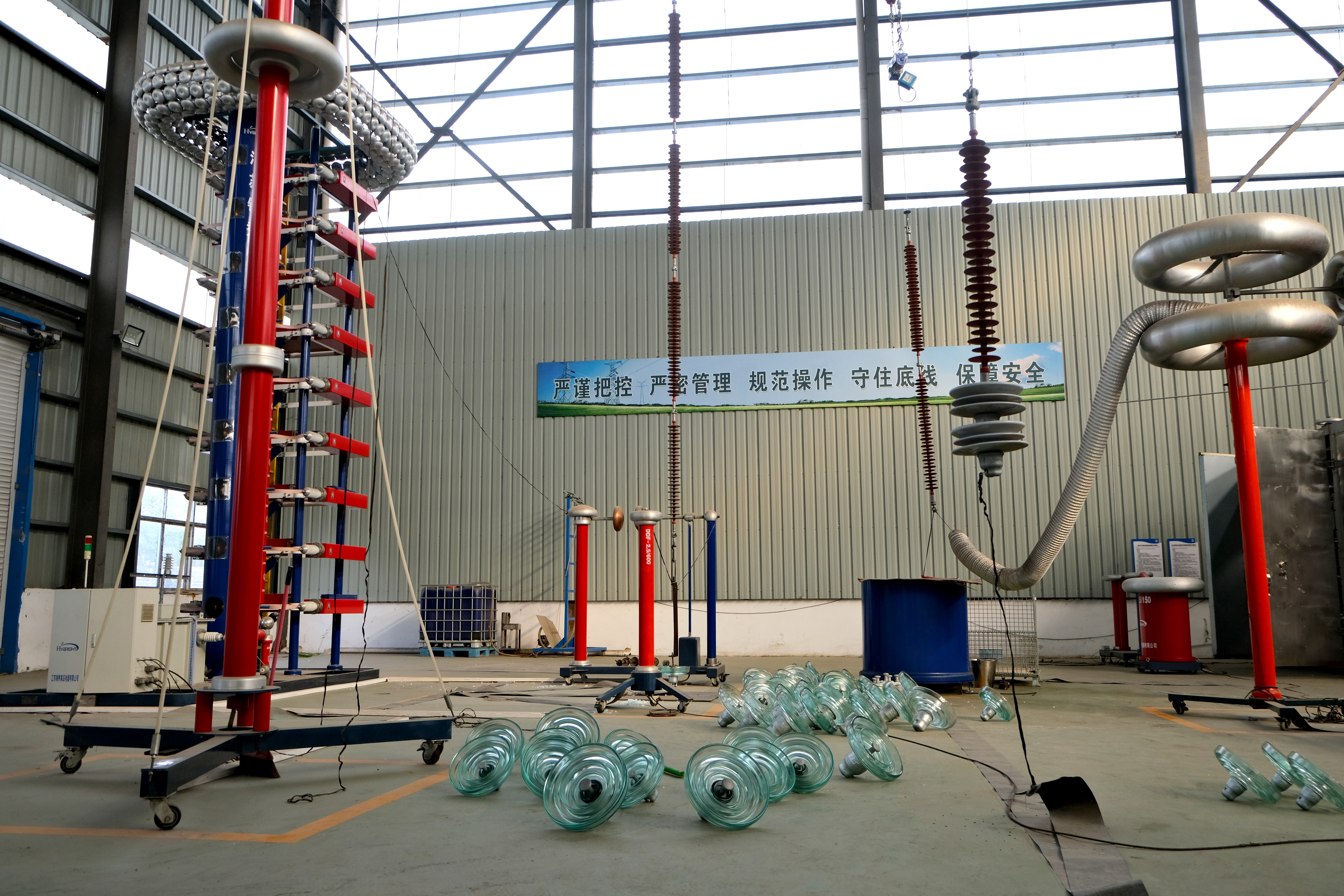
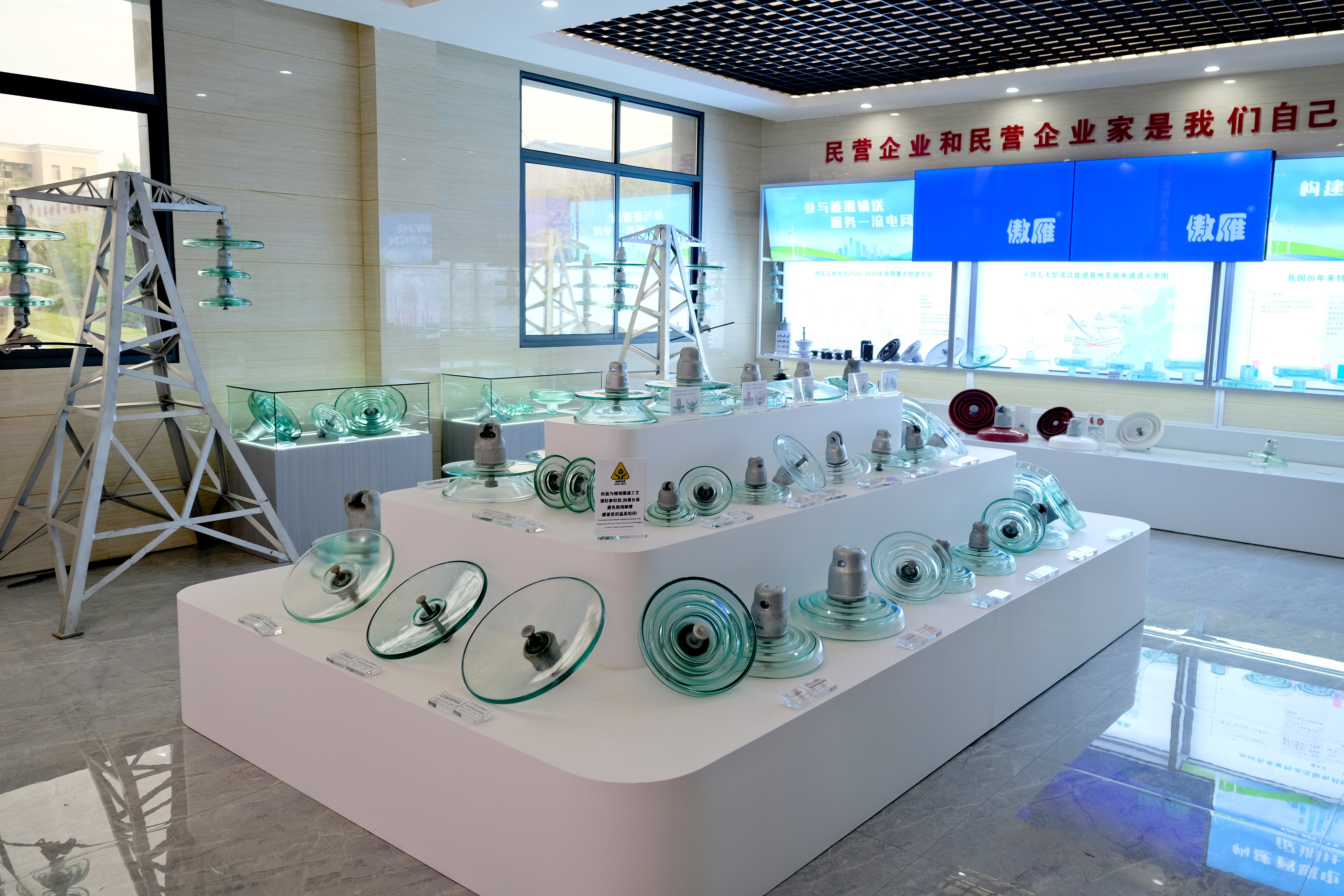
Request sample units of the exact model under consideration and check three things on receipt: dimensional conformity to the IEC basis, coupling fit against the fittings you already hold, and shed profile against the pollution level of the route. Jiangxi QOCI Electric Co., Ltd. maintains a sample room for this purpose and can supply units from the 70kN to 420kN range, including BP anti-pollution, BD double-shed and BA aerodynamic variants. Sample requests can be raised directly with the sales team by email or WhatsApp.
What delivery capacity should I plan around?
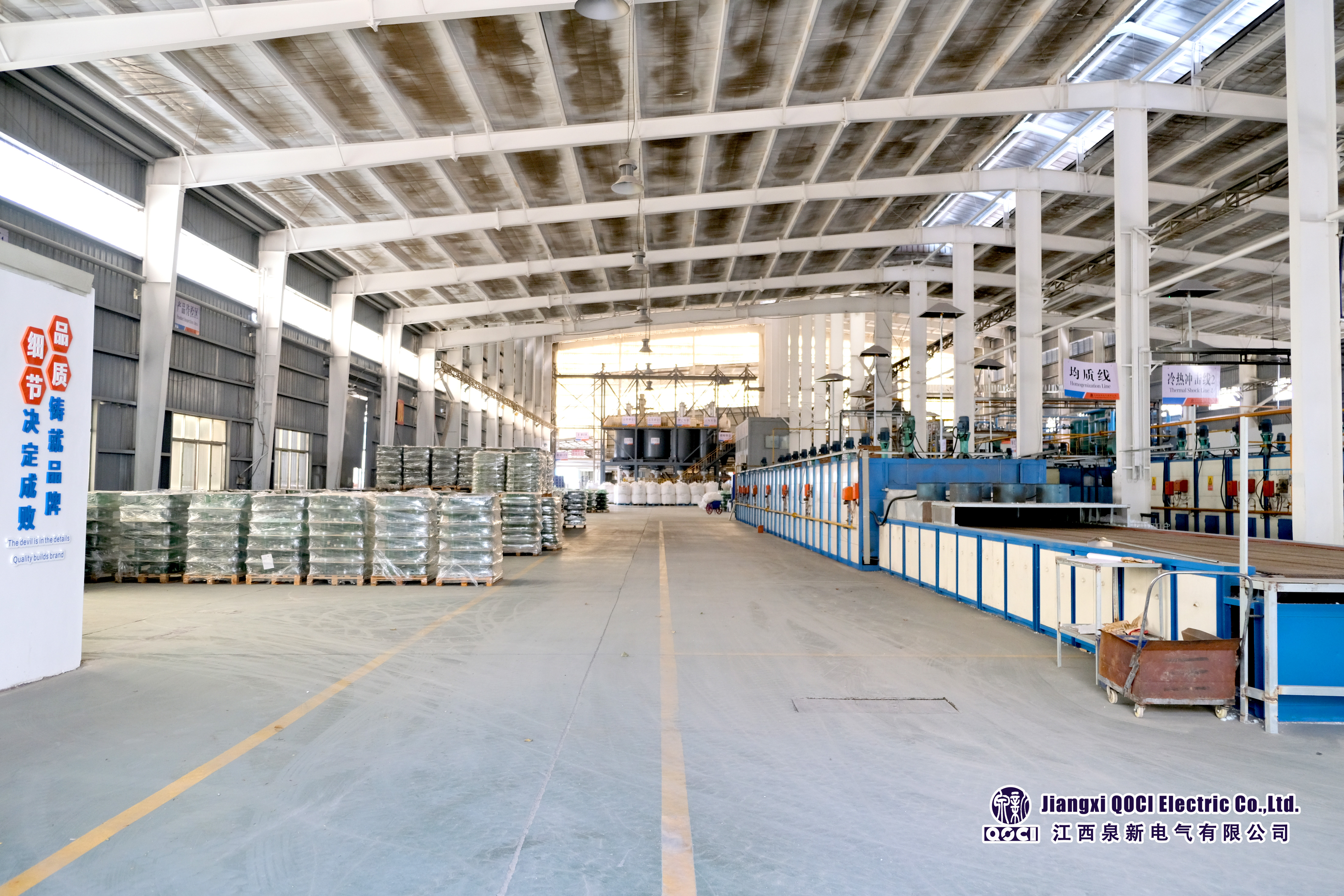
Capacity should be confirmed against your schedule rather than assumed. Jiangxi QOCI Electric Co., Ltd. was established in December 2002, operates a 35,373 m² manufacturing site in Luxi Industrial Park, Pingxiang, Jiangxi, and reports annual output of 9,000,000 units with an in-house engineering team of 38. Around 20% of output is exported, serving markets in the USA, Asia, the EU, Africa and South America. Because packing method directly affects transit breakage, confirm crate configuration and loading arrangements together with the delivery date.
Conclusion
Breakage cannot be eliminated from an overhead line, but it can be made predictable. A toughened glass suspension unit does that in two ways: it carries more mechanical margin than porcelain, with compressive strength 3 to 4 times higher, and when that margin is exhausted it fails visibly as a zero-value unit instead of hiding a defect. The result is a 70% reduction in maintenance workload, no live-line testing requirement and a 25% lower total cost of ownership, against a 5% higher initial price.
For a decision-stage buyer, the practical sequence is straightforward: identify the dominant breakage mechanism on your corridor, select the rating and profile from the 70kN to 420kN range, confirm the toughening and test regime with the manufacturer, and write handling and inspection requirements into the contract. That combination addresses the cause rather than the symptom.
Next Step: Samples and Specification Support
Jiangxi QOCI Electric Co., Ltd. manufactures glass and porcelain insulators, including standard-profile, anti-pollution, double-shed and aerodynamic suspension units from 70kN to 420kN, and supplies grid projects across Asia, the EU, Africa, South America and the USA.
To move from comparison to decision, request a sample of the specific model you are evaluating, or send your string ratings and route conditions for a specification check. The full product range and dimensions are set out in the downloadable catalogue.
Download the QOCI Glass Insulator Catalogue (PDF)
Email: admin@qocielectric.com | WhatsApp: +86 199-7997-1591 | Website: www.quanxinelectric.com
Address: No. 6, Electric Porcelain Industrial Park, Luxi Industrial Zone, Pingxiang, Jiangxi, China | Tel: +86 079-9761-6589
Have Questions or Need More Details?
Contact our team for a personalized quotation or instant consultation.
Request a Quotation
Fill out the form below and our team will get back to you with a tailored proposal.
WhatsApp Direct Chat
Prefer to chat in real-time? Message us on WhatsApp for instant assistance & quick answers.
- Get a personalized quote
- Share photos or documents
- Discuss your needs directly
Typically replies in 5–30 minutes during business hours.