
Suspension Glass Insulator 101: Category Basics, Purchasing Terms, and Acceptance Criteria
A suspension glass insulator is a tempered-glass disc fitted with a hot-dip galvanized cast-iron cap and a hot-dip galvanized forged-steel pin, used to support and electrically isolate overhead conductors on transmission lines. Buying the part correctly is less about the glass and more about language: a small set of load, dimension, electrical and interface terms decides whether two quotations describe the same product, and whether a delivered batch can be judged on something other than opinion.
This 101-level explainer does three things in order. It defines what the category actually contains, it translates purchasing terms into specification lines a buyer can write, and it sets out acceptance criteria that can be checked at delivery. The argument running through all three sections is simple: purchasing terms belong in early category discovery, not in the final negotiation round.
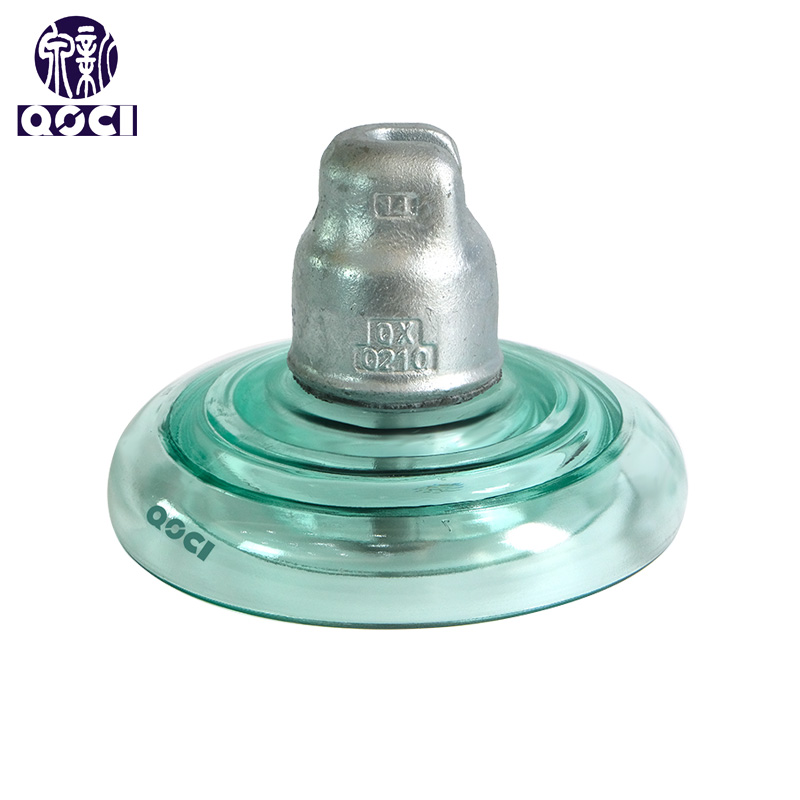
A suspension glass insulator unit: tempered glass disc, hot-dip galvanized cast-iron cap, hot-dip galvanized forged-steel pin.
1. What the Category Actually Contains
A glass insulator of this type is one unit inside a string. The string carries the conductor; each disc carries its share of the mechanical load and contributes its share of creepage. Almost every purchasing term in the category is expressed per unit but evaluated per string, which is why a single missing figure in a line item can invalidate a quotation for the whole assembly.
Three sub-assemblies create three buying interfaces:
- Glass body — tempered glass, the insulating and weather-exposed element. It fixes disc diameter and creepage distance.
- Cap — hot-dip galvanized cast iron, cemented to the upper surface. It fixes the socket coupling dimension.
- Pin — hot-dip galvanized forged steel, cemented to the lower surface. With the cap, it defines the mechanical failing load of the completed unit.
Every model code in the category is a compressed specification. In the Jiangxi QOCI Electric Co., Ltd. range, U160B means a 160 kN mechanical failing load in the B profile family; U420B means 420 kN. Read one code correctly and you already know the first column of any quotation comparison. The company, established in December 2002 and located in Luxi Industrial Park, Pingxiang City, Jiangxi Province, produces both glass and porcelain insulators and supplies grids in more than 40 countries and regions.
2. Problem Definition: Why the Terms Surface Too Late
First-time buyers usually enter this category through a price request. A line item is drafted — "suspension glass insulator, 160 kN" — and three suppliers answer with three figures that look comparable and are not. One quotes a 280 mm disc with 360 mm creepage; another quotes a 320 mm disc with 550 mm creepage; a third quotes a unit with a different socket coupling. All three are legitimately "160 kN".
Three predictable failures follow:
- Quotation drift. Without a fixed dimensional and electrical baseline, the lowest price wins by being the smallest product. The comparison is invalid before it starts, and the purchasing decision becomes a comparison of incomplete numbers.
- Substitution. Where the specification names only the load class, a supplier may ship a different profile, creepage level or socket coupling with the same load class. It complies with the sentence and does not fit the tower.
- Acceptance disputes. If "pass" was never defined — which tests, which records, which documents — incoming inspection turns into a negotiation rather than a check.
The fix is structural rather than commercial. Define the terms at category discovery stage, freeze them into a term sheet, and carry the same sheet unchanged through quotation, sampling and acceptance. Buyers who do this stop re-explaining their requirement at every stage, and suppliers stop guessing which variant to price.
3. Industry Background
Third-party market reporting places the global glass insulators market at USD 1.14 billion in 2024, projected to reach USD 1.97 billion by 2035, with a CAGR of 5.1% across 2025–2035 (Market Research Future). Asia Pacific held a revenue share above 52% in 2024, driven by grid expansion in China and India (Grand View Research). China concentrated 31.4% of global electrical insulator exports in 2024, worth USD 898 million (OEC), and China's exports of electrical insulators to Saudi Arabia grew 219% between 2023 and 2024, making it the fastest-growing destination in that dataset.
On the technical side, suspension glass insulator units for AC systems are governed by IEC 60305:2021, which specifies mechanical and electrical characteristics. The practical consequence for a buyer is straightforward: datasheet numbers are supposed to be comparable across suppliers, which is exactly why a specification should cite the standard together with the model code rather than a descriptive phrase.
Market growth also changes the composition of a buyer's risk. When order books are full and lead times stretch, undisciplined specifications are resolved by whatever stock exists, not by what the line design requires. A written term sheet is the cheapest protection against that outcome.
4. Purchasing Terms, Decoded
The glossary below covers the terms that most often appear in a first quotation and most often get skipped. Each definition is followed by what the term actually controls at procurement stage.
4.1 Load Terms
Mechanical failing load (MFL) is the load at which the unit fails, and it is the number embedded in the model code. The QOCI range runs from U70B at 70 kN to U420B at 420 kN, with intermediate classes at 100 kN, 120 kN, 160 kN, 210 kN, 240 kN and 300 kN. MFL is a failing load, not a working load; the purchasing question is which class the string design requires, not which number sounds safer.
Practical rule: fix the load class from the line design first, then treat every other parameter as a constraint inside that class. Reversing the order — choosing a load class because it is available — is the most common origin of over-specified or under-specified orders.
4.2 Dimensional Terms
Nominal disc diameter, nominal spacing (height) and creepage distance are the three dimensions to lock. In the QOCI catalogue they move with the rating: 255 mm discs at 70–120 kN with 320 mm creepage; 280 mm discs at 160–240 kN with 360–400 mm creepage; 320 mm at 300 kN with 485 mm; 360 mm at 420 kN with 550 mm. Anti-pollution variants extend creepage at the same or a larger diameter — U70BLP reaches 450 mm creepage on a 280 mm disc, and U420BP reaches 620 mm on a 380 mm disc.
Spacing matters because it is what the string length adds up to. Values of 127 mm, 146 mm, 155 mm, 170 mm, 195 mm and 205 mm all appear across the range. A quotation that omits spacing has not specified the string, only the unit.
4.3 Electrical Terms
Three voltage figures recur in every quotation and should never be summarised as "withstand voltage".
- Wet power frequency withstand voltage — the 50 Hz withstand level under wet conditions. In the QOCI range it runs from 40 kV on the U70BS/U70BL class to 80 kV on U420B.
- Dry lightning impulse withstand voltage — the impulse level, from 90 kV on the aerodynamic U70BA to 140 kV on U160B and U420B.
- Power frequency puncture voltage — the level at which the glass punctures, listed between 110 kV and 140 kV across the range.
Each figure corresponds to a different test and a different failure mode. A supplier who quotes a single voltage without naming which one has not answered the question.
4.4 Interface Terms
Socket coupling is the dimension that connects the unit to the yoke plate or to the next unit in the string. QOCI lists coupling sizes of 16, 20, 20/24, 24 and 28 mm across the range. It is the most common source of fit failures in the category, because it is small enough to be left off a line item and consequential enough to stop an installation.
The connection configuration — cap-pin or ball-socket — belongs in the purchase order alongside the coupling size. Both are interface facts, not product preferences, and neither can be inferred from the load class.
4.5 Profile Suffix Decoder
Suffix letters carry real procurement information. They describe the surface profile, which is what a project buys when it buys for a polluted or high-altitude route.
| Marking | What it indicates | Examples in range | Procurement relevance |
|---|---|---|---|
| B | Standard profile | U70B, U120B, U160B, U210B, U240B, U300B, U420B | Baseline reference for the load class |
| BS / BL | Shorter (127 mm) or longer (146 mm) spacing variant | U70BS, U70BL, U100BS, U100BL, U160BS, U160BL | Controls string length and tower window fit |
| BP | Anti-pollution, extended creepage | U70BLP, U100BLP, U120BLP, U160BLP, U210BP, U420BP | For saline and industrial pollution zones |
| BD | Two wings / double sheds | U70BLD, U100BLD, U120BLD, U160BLD, U210BD | Profile choice for contamination and rain performance |
| BA | Aerodynamic, large disc | U70BA, U100BA, U120BLA, U160BSA, U210AD | 380–420 mm disc diameters in the range |
| PS / PSV / PSD / PSA | Alternative designation family | PS70E, PS120B, PS160D, PS210V, PS240V, PS300V, PSD70E | Must be matched against the project's own naming |
| ANSI | US designation series | ANSI 52-3, 52-5, 52-8, 52-11 | Comparable ratings, different naming convention |
The lesson for a first-time buyer is that the suffix is not decoration. Two units with the same load class and different suffixes can differ by more than 200 mm of creepage and by a full size step in disc diameter.
4.6 Commercial Terms
Commercial terms belong in the same document as the technical ones. QOCI's published terms list OEM and ODM production, customization of voltage and logo, a minimum order quantity of 50 units, and a lead time of 15–35 days. Quality control is stated as 100% pre-shipment test combined with third-party inspection (SGS), and after-sales support covers online technical support plus replacement for defective products.
These four lines prevent more disputes than any adjective in a brochure. MOQ determines whether a trial batch is possible, lead time determines whether the string can be scheduled, inspection scope determines whether the acceptance clause is verifiable, and the replacement clause determines what happens when it is not.
5. Acceptance Criteria: Write "Pass" Before You Order
Acceptance criteria should be drafted together with the specification, because each clause has to attach to something checkable on delivery. A criterion written afterwards describes what arrived; a criterion written beforehand describes what was ordered.
5.1 What to Fix Before Ordering
- Model code plus the governing standard, for example IEC 60305:2021
- Mechanical failing load class, nominal disc diameter and nominal spacing
- Creepage distance, wet power frequency withstand voltage, dry lightning impulse withstand voltage
- Socket coupling size and connection configuration
- Surface profile — standard, anti-pollution, two-wing or aerodynamic
- Marking, packing and the required documentation set
5.2 Pre-Shipment
Pre-shipment is where a supplier's process becomes visible. QOCI's stated control is a 100% pre-shipment test combined with third-party inspection by SGS. In the multi-country transmission case summarised later in this article, acceptance also relied on zero-value self-breaking: a failed tempered-glass disc shatters completely instead of retaining a partial shell, which allows 100% visual defect detection without live-line testing. That property changes the shape of the inspection plan — visual inspection becomes a complete check rather than a sample.
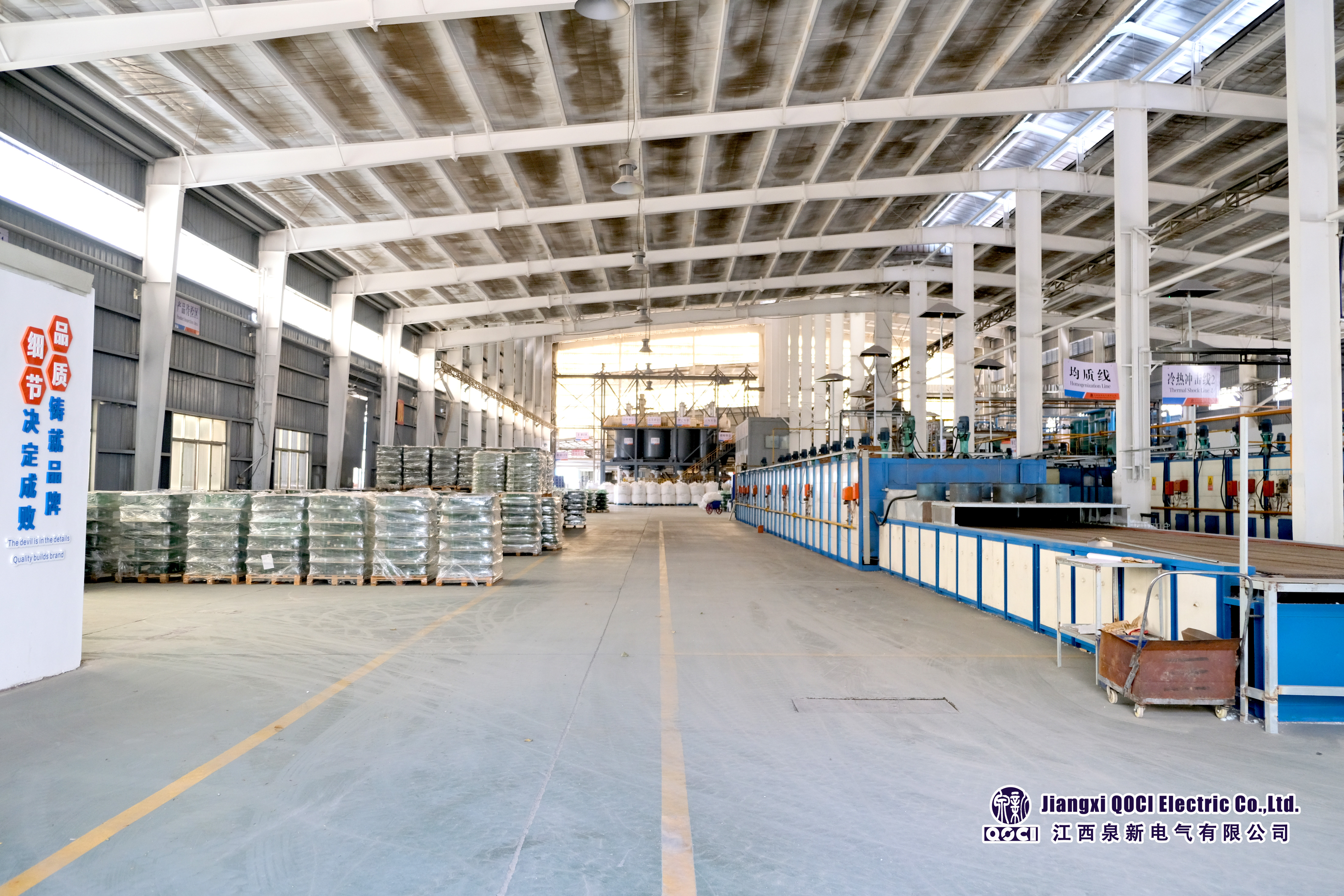
Thermal shock line: the toughening step that gives the glass body its self-breaking behaviour and its mechanical strength.
5.3 Incoming Inspection
Incoming inspection should verify identity before quality: model marking, coupling size, disc diameter and spacing against the purchase order, then the electrical and mechanical test records against the specified standard. Where documentation is complete, incoming inspection is a verification step. Where it is not, it becomes a re-test, and the schedule absorbs the difference.
5.4 The Documentation Set
Ask for the certificate register with numbers and validity dates rather than certificate images alone. Jiangxi QOCI Electric Co., Ltd. holds ISO 9001:2015 (certificate 00124Q33852R3M/3600, issued 2025-11-19, valid to 2027-05-14), ISO 14001:2015 (00125E30701R3M/3600, issued 2025-03-07, valid to 2028-03-24) and ISO 45001:2018 (00125S30581R3M/3600, issued 2025-03-07, valid to 2028-03-24), all issued by CHINA QUALITY CERTIFICATION CENTRE.
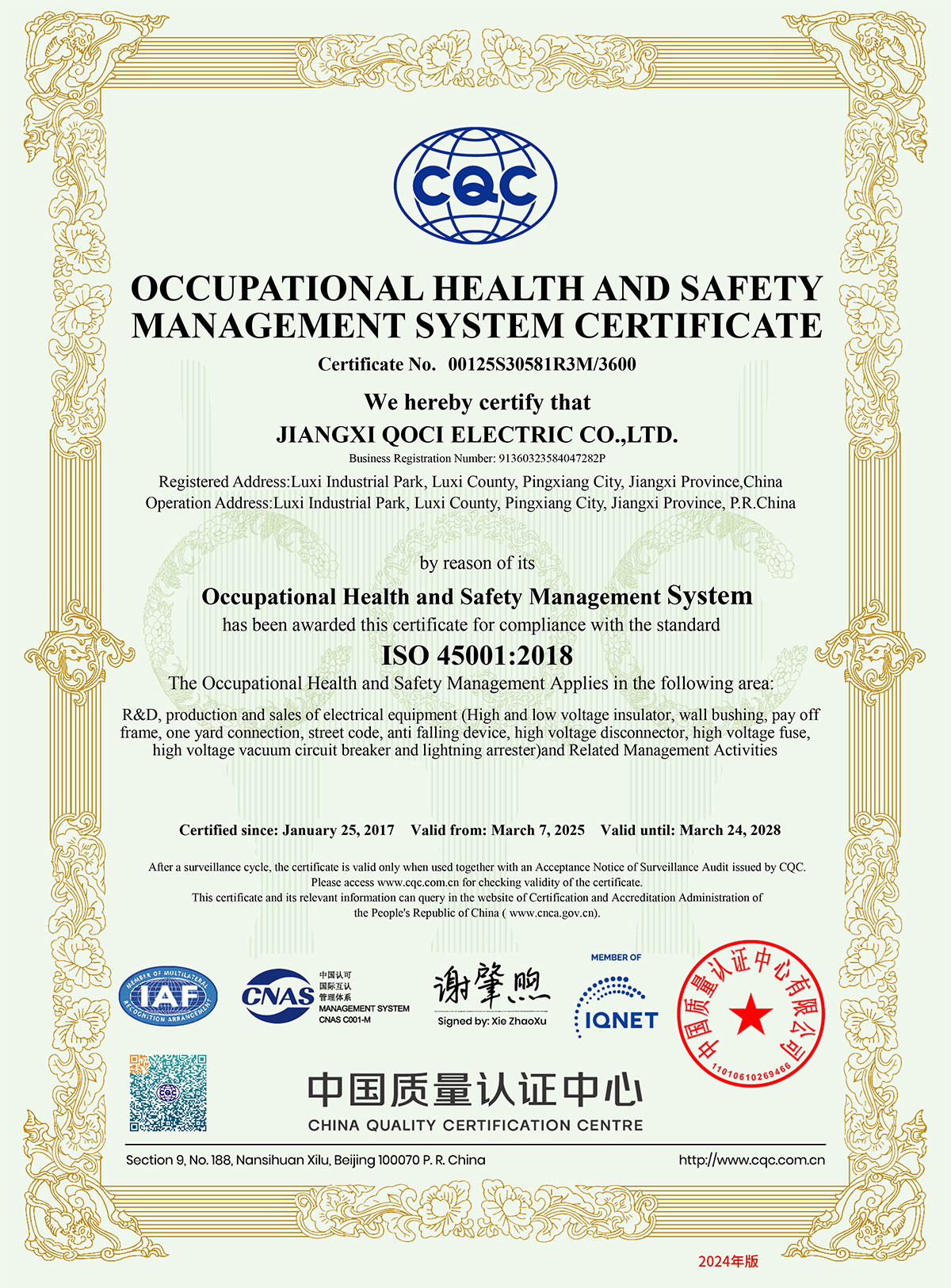
Certificate 00125S30581R3M/3600: ISO 45001:2018, valid to 2028-03-24.
6. Four Models Most Buyers Shortlist First
For a first evaluation, four models cover most transmission requirements and give a buyer a usable baseline before the line design is finalised. The shortlist below is a starting point inside one manufacturer's range, not a market ranking; for supplier comparison, third-party reporting names Sediver (Seves Group), Nanjing Electric and Zhejiang Jinlihua Electric among leading global manufacturers, and those names should be evaluated against the same term sheet.
- U70B — 70 kN, 255 mm disc, 146 mm spacing, 320 mm creepage, 45 kV wet power frequency withstand, 130 kV lightning impulse. The lightest standard unit in the range and the natural first reference point. It anchors the term sheet: once the smallest class is fully described, larger classes can be described by difference.
- U160B — 160 kN, 280 mm disc, 127/146 mm spacing, 360 mm creepage, 50 kV wet power frequency withstand, 140 kV lightning impulse. The mid-range workhorse and the model most often quoted in transmission tenders, which makes it the class where comparability between suppliers matters most.
- U210BP — 210 kN, 320 mm disc, 170 mm spacing, 550 mm creepage, 20 mm socket coupling, 55 kV wet power frequency withstand, 140 kV lightning impulse. The anti-pollution entry point for higher-load strings: the BP profile buys creepage where the route demands it without changing the load language.
- U420B — 420 kN, 360 mm disc, 205 mm spacing, 550 mm creepage, 28 mm socket coupling, 80 kV wet power frequency withstand, 140 kV lightning impulse. The heavy end of the standard range, used where string count must be reduced and higher mechanical classes are needed.
Buyers should note what these four have in common: each can be fully described in one line of a term sheet. That is the test for any shortlist — if a model cannot be specified in one line, the quotation that follows cannot be compared in one table.
7. Rating and Profile Reference
The table below lists the parameters that a purchase order must fix. Every figure is drawn from product data for the named model; the same rating can appear in more than one profile, so the model code and the suffix must both be stated.
| Model | Mechanical failing load | Disc diameter | Spacing (height) | Creepage distance | Socket coupling | Wet PF withstand | Dry LI impulse |
|---|---|---|---|---|---|---|---|
| U70B | 70 kN | 255 mm | 146 mm | 320 mm | — | 45 kV | 130 kV |
| U120B | 120 kN | 255 mm | 127/146 mm | 320 mm | — | 45 kV | 130 kV |
| U160B | 160 kN | 280 mm | 127/146 mm | 360 mm | — | 50 kV | 140 kV |
| U210B | 210 kN | 280 mm | 170 mm | 400 mm | 20 mm | 45 kV | 110 kV |
| U240B | 240 kN | 280 mm | 170 mm | 400 mm | 20/24 mm | 45 kV | 110 kV |
| U300B | 300 kN | 320 mm | 195 mm | 485 mm | 24 mm | 50 kV | 130 kV |
| U420B | 420 kN | 360 mm | 205 mm | 550 mm | 28 mm | 80 kV | 140 kV |
| U70BLP | 70 kN | 280 mm | 146 mm | 450 mm | 16 mm | 50 kV | 125 kV |
| U100BLP | 100 kN | 280 mm | 146 mm | 450 mm | 16 mm | 50 kV | 125 kV |
| U160BLP | 160 kN | 280 mm | 170 mm | 450 mm | 20 mm | 50 kV | 125 kV |
| U210BP | 210 kN | 320 mm | 170 mm | 550 mm | 20 mm | 55 kV | 140 kV |
| U420BP | 420 kN | 380 mm | 205 mm | 620 mm | 28 mm | 55 kV | 140 kV |
| U70BLD | 70 kN | 280 mm | 146 mm | 450 mm | 16 mm | 45 kV | 120 kV |
| U160BLD | 160 kN | 340 mm | 170 mm | 550 mm | 20 mm | 50 kV | 130 kV |
| U70BA | 70 kN | 380 mm | 127/146 mm | 365 mm | 16 mm | 45 kV | 90 kV |
Model, load, dimensional and electrical parameters by model. Where a coupling value is not stated for a model in the source data, the field is left blank rather than inferred.
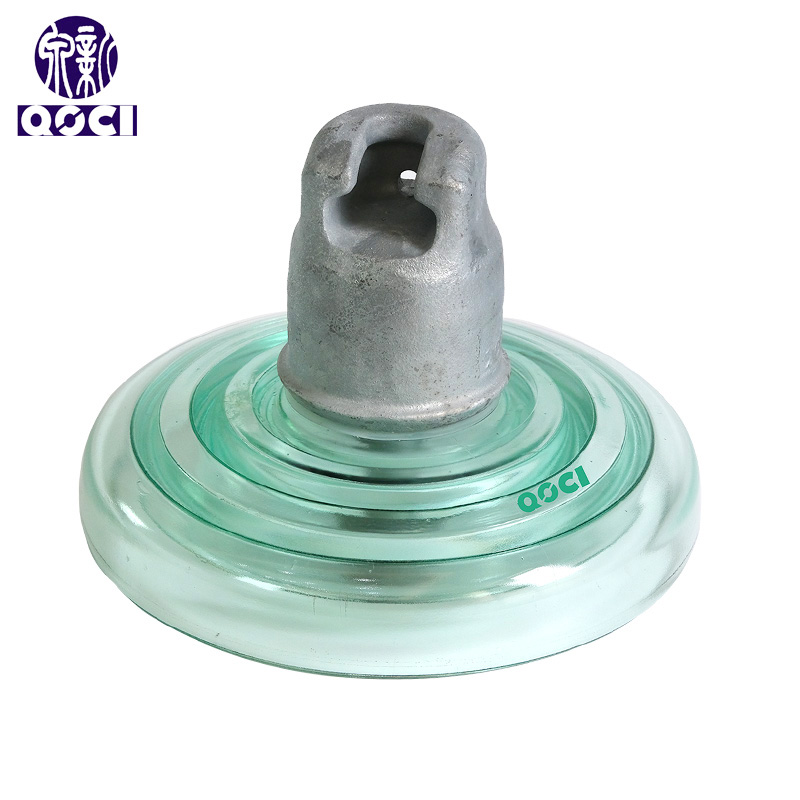
U420B, the 420 kN class: 360 mm disc, 205 mm spacing, 550 mm creepage, 28 mm socket coupling.
8. Step-by-Step: Building a Purchasing Spec
The sequence below converts the glossary into a document a buyer can issue. It assumes no prior category experience and takes roughly the order in which decisions actually get made.
- Take the load class from the line design. Do not start from available stock. The class determines everything else and is the hardest thing to change later.
- Fix the three dimensions. Disc diameter, spacing and creepage distance. These decide string length, tower window fit and pollution performance.
- Fix the two voltage levels. Wet power frequency withstand and dry lightning impulse withstand, each written as a separate line with its unit.
- Fix the interface. Socket coupling size plus connection configuration. Confirm against the yoke plate and the adjacent hardware, not against the previous order.
- Select the profile from the route, not the price list. Standard B for normal conditions; BP where pollution or salinity demands extended creepage; BD or BA where the route imposes specific profile requirements.
- Name the standard. Cite IEC 60305:2021 alongside the model code so the test basis is unambiguous.
- Write the acceptance clause. State the test scope, the inspection arrangement, and the documentation that must accompany the shipment, including certificate numbers and validity dates.
- Set the commercial frame. MOQ, lead time, sampling arrangement and the replacement position for defective units go into the same document, not a separate email thread.
Once steps 1–8 are written down, the term sheet does double duty: it produces comparable quotations and it produces a delivery checklist. That is the whole point of moving purchasing terms earlier in the process.
9. Use Cases Where the Terms Change
Category basics stay constant, but which terms dominate shifts with the application. Four patterns are common.
9.1 Desert and High-Dust Routes
Dust accumulation favours profiles with self-cleaning behaviour and favours creepage margin over compactness. In the Central Asian case summarised below, anti-dust self-cleaning in desert environments was recorded as a key performance attribute across 80,000 units in Uzbekistan and 50,000 in Iraq, where operating temperatures of −40°C to +55°C were verified.
9.2 Industrial and Coastal Pollution Zones
Where saline or industrial pollution is present, extended creepage profiles do the work: anti-pollution glass insulators increase creepage distance to reduce flashover risk in those environments. In datasheet terms this is the BP family — U210BP at 550 mm creepage on a 320 mm disc, or U420BP at 620 mm on a 380 mm disc — and it is the clearest example of a suffix that should be written into the specification rather than assumed.
9.3 UHV and EHV Long Strings
Long strings accumulate both mechanical and dimensional consequences. Higher load classes reduce unit count; larger discs and longer spacing increase string length. U300B at 300 kN with a 320 mm disc and 195 mm spacing, and U420B at 420 kN with 360 mm and 205 mm, sit at that end of the range. The procurement task is to keep string length inside the tower envelope while holding the required electrical levels.
9.4 Multi-Country Transmission Programmes
A programme spanning several countries concentrates every term into one document. In a case covering Uzbekistan, Ukraine and Iraq, 200,000 units were supplied — 80,000 in Uzbekistan, 70,000 in Ukraine and 50,000 in Iraq — for UHV/EHV overhead transmission line insulation and grid construction in desert and industrial pollution zones. Timelines were 2 years for Uzbekistan and 3 years each for Ukraine and Iraq, all completed by 2026, with clients including a national grid corporation and power transmission EPC contractors.
Reported results from that case were zero line-tripping incidents, a 70% reduction in maintenance costs, 100% visual defect detection with no live-line testing required, and an 85% reduction in pollution flashover incidents compared with a porcelain baseline. Key attributes recorded were zero-value self-breaking enabling full visual inspection, temperature tolerance verified from −40°C to +55°C in Uzbekistan and Iraq, a designed lifespan exceeding 30 years, and mechanical reliability demonstrated at 550 kN tensile strength.
Read as acceptance evidence rather than as marketing, the case says one thing: the inspection model (100% visual because of self-breaking) and the specification model (creepage and profile matched to the pollution zone) were decided before the order, and the outcomes followed from that.
10. FAQ
Which standards and certificates should a suspension glass insulator supplier provide?
Suspension glass insulator units for AC systems are governed by IEC 60305:2021, which specifies mechanical and electrical characteristics, so a quotation should cite that standard with the model code. On the management-system side, Jiangxi QOCI Electric Co., Ltd. holds ISO 9001:2015 (certificate 00124Q33852R3M/3600, issued 2025-11-19, valid to 2027-05-14), ISO 14001:2015 (00125E30701R3M/3600, issued 2025-03-07, valid to 2028-03-24) and ISO 45001:2018 (00125S30581R3M/3600, issued 2025-03-07, valid to 2028-03-24), all issued by CHINA QUALITY CERTIFICATION CENTRE. Ask for the certificate register with numbers and validity dates, not certificate images alone.
Can one supplier cover the load classes from U70B to U420B and customize the product?
QOCI produces the range from U70B at 70 kN through U100B, U120B, U160B, U210B, U240B and U300B to U420B at 420 kN, together with anti-pollution (BP), two-wing (BD) and aerodynamic (BA) profiles plus ANSI 52-3, 52-5, 52-8 and 52-11 designations. Production is offered under OEM and ODM arrangements, with customization of voltage and logo. Stated capacity is 750,000 units per month and 9,000,000 units per year, which is what allows both a small trial batch and a multi-year programme from the same source.
What drives the unit price in this category?
Price moves with the specification, not with the load label alone. The main drivers in the QOCI range are the mechanical class, the disc diameter and creepage distance, the profile suffix (BP, BD and BA units carry larger discs and longer creepage than standard B units at the same rating), the socket coupling, and the inspection scope agreed for the order. Order quantity interacts with the published minimum order quantity of 50 units. Two quotations at the same load class are only comparable when diameter, spacing, creepage, coupling and withstand levels are identical.
How should a sample be used before a volume order?
A sample stage should confirm three things that paperwork cannot: the socket coupling fits the intended hardware, the disc diameter and spacing produce the expected string length, and the marking matches the purchase order. Because zero-value self-breaking lets a failed tempered-glass disc shatter completely, visual inspection of a sample also reveals handling and packing quality before shipment. With a 50-unit minimum order quantity and a 15–35 day lead time, a small first batch can be run and inspected before volume release.
What lead time should be planned, and how is delivery assured?
Published lead time is 15–35 days. On larger programmes, planning should follow the delivery structure rather than a single figure: the referenced multi-country case ran 2 years for Uzbekistan and 3 years each for Ukraine and Iraq, with 200,000 units delivered in total and all work completed by 2026. Delivery assurance rests on the acceptance clause — 100% pre-shipment test plus third-party inspection (SGS), the agreed documentation set, and the stated replacement position for defective products. Buyers who want to test that clause against their own specification can request a sample and a quotation through admin@qocielectric.com or the QOCI technical team on WhatsApp at +86 199-7997-1591.
11. Conclusion
The suspension glass insulator category is compact: a tempered-glass disc, a galvanized cap, a forged pin. What makes it hard for a first-time buyer is not the product but the vocabulary. Mechanical failing load, disc diameter, spacing, creepage, wet power frequency withstand, dry lightning impulse withstand and socket coupling are the seven lines that decide whether a quotation is comparable and whether a delivery is acceptable.
Three practices follow from that. Write the term sheet at category discovery stage, because terms introduced at negotiation cannot fix a comparison that was already invalid. Name the standard and the model code together, because descriptive phrases have no test basis. And write the acceptance criteria before the purchase order, because a criterion written afterwards only describes what arrived.
Buyers who want to work from the full parameter set can download the QOCI glass insulator catalogue, which lists the models, dimensions and electrical values referenced throughout this article.
Next step
Send your line parameters — load class, disc diameter, spacing, creepage, coupling size and profile requirement — and Jiangxi QOCI Electric Co., Ltd. will return a specification-matched quotation, a sample arrangement and the certificate register. Catalogue download and technical contact: Glass Insulator Catalogue (PDF) · www.quanxinelectric.com · admin@qocielectric.com
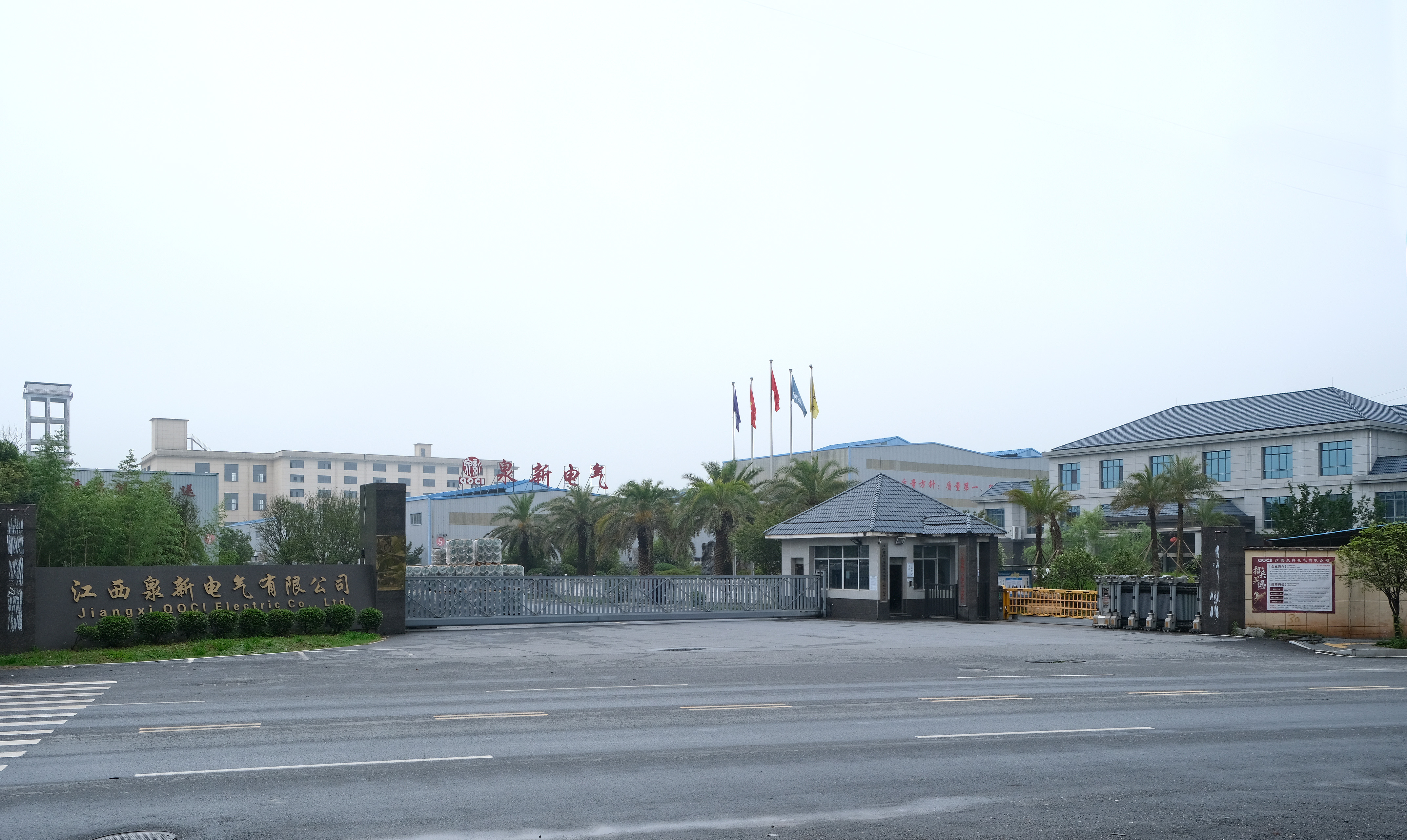
Jiangxi QOCI Electric Co., Ltd., Luxi Industrial Park, Pingxiang City, Jiangxi Province — glass and porcelain insulator production since December 2002.
Have Questions or Need More Details?
Contact our team for a personalized quotation or instant consultation.
Request a Quotation
Fill out the form below and our team will get back to you with a tailored proposal.
WhatsApp Direct Chat
Prefer to chat in real-time? Message us on WhatsApp for instant assistance & quick answers.
- Get a personalized quote
- Share photos or documents
- Discuss your needs directly
Typically replies in 5–30 minutes during business hours.