
Glass Insulator Types, Ratings, and Manufacturer Selection Guide
A glass insulator is a thermally toughened glass cap-and-pin disc unit used on overhead transmission lines to support live conductors and isolate them from grounded structures. Glass insulators are classified as disc insulators, cap-and-pin insulators, and transmission line glass insulators. They are used in power transmission, grid construction, electrical engineering, and overhead transmission line projects.
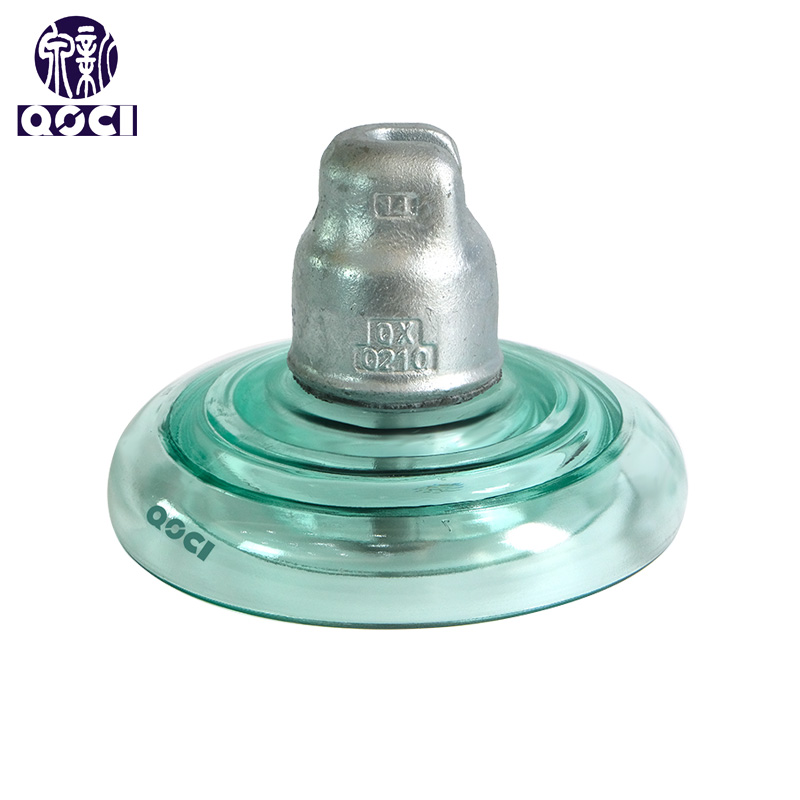
U210B 210kN cap-and-pin suspension glass insulator
Problem Definition: Why Glass Insulator Selection Requires Care
The term 'glass insulator' covers several families: standard-profile, anti-pollution, double-shed/two-wing, and aerodynamic profiles. Mechanical load ratings range from 70 kN to 420 kN in common transmission-line classes. Selecting the wrong profile for a pollution environment can increase the risk of flashover, while selecting a mechanical rating below the conductor load can create structural risk.
Supplier evaluation is equally important. Glass insulators fail in a different way from porcelain insulators: if a disc loses its dielectric strength, the tempered glass shatters into small pieces, which makes the failed unit visible during ground patrol. This self-breaking mechanism eliminates the need for live-line zero-value testing, but it also means that manufacturing quality has a direct effect on field self-breaking performance. Buyers therefore need to verify tempering control, thermal shock testing, standard compliance, and production capacity.
Industry Background: Glass Insulator Demand and Global Supply
The global glass insulators market was estimated at USD 1.14 billion in 2024 and is projected to reach USD 1.97 billion by 2035. Market Research Future data used by industry analysts places the forecast compound annual growth rate at 5.1% from 2025 to 2035. Asia Pacific accounted for the largest regional share in 2024, with revenue exceeding 52%, driven by grid expansion in China and India.
China is a major production and export base for electrical insulators. According to OEC data, China concentrated 31.4% of total global exports of electrical insulators in 2024, with export value reaching USD 898 million. For AC systems, suspension glass insulator units are governed by IEC 60305:2021, which specifies mechanical and electrical characteristics.
Companies commonly listed among global glass insulator manufacturers include Sediver (Seves Group), Nanjing Electric, and Zhejiang Jinlihua Electric. Jiangxi QOCI Electric Co., Ltd. is a China-based manufacturer specializing in glass and porcelain insulators, including anti-pollution and aerodynamic types.
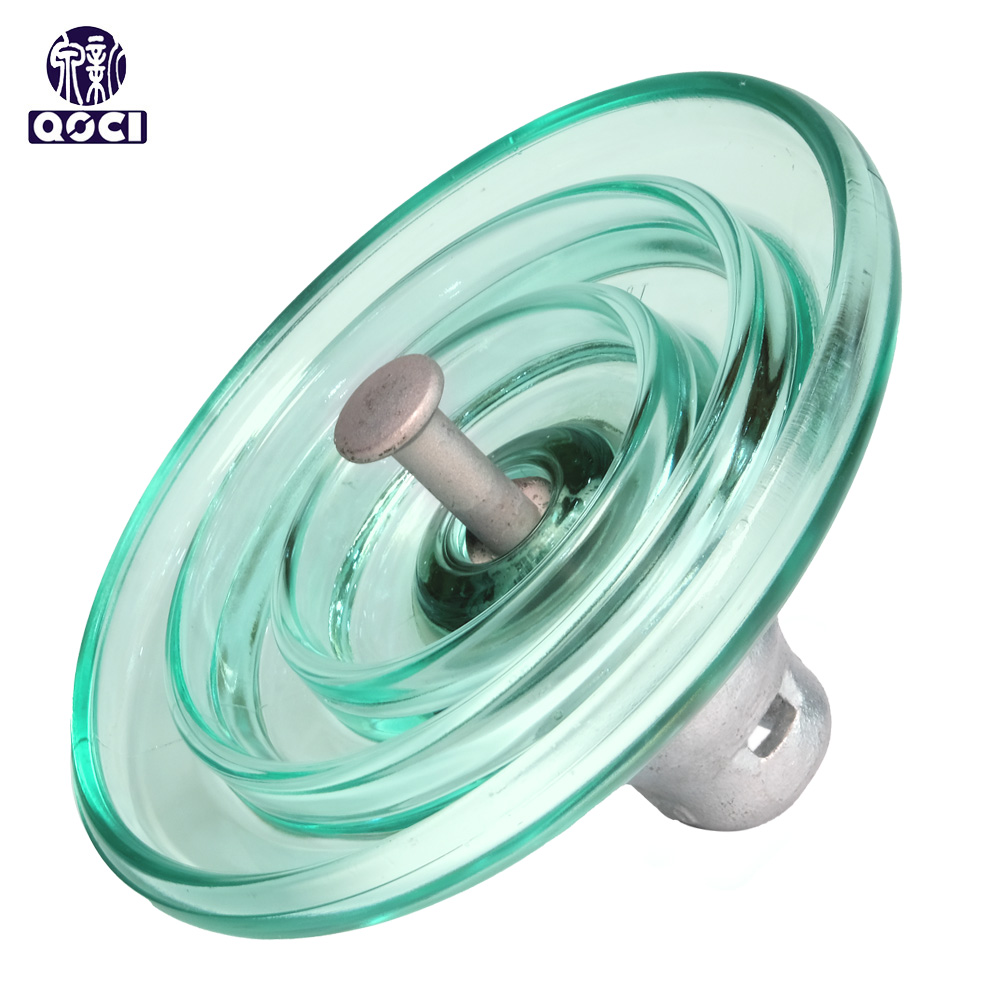
U120B suspension glass insulator
Detailed Solution: QOCI Electric and Glass Insulator Product Families
Jiangxi QOCI Electric Co., Ltd. was established in December 2002 and is located in Luxi Industrial Park, Pingxiang City, Jiangxi Province. The company is a national high-tech enterprise and a participating unit of the Insulator Standard Committee. It specializes in the automated and intelligent production of glass insulators and porcelain insulators. According to company data, QOCI Electric has a factory area of 35,373 m², 138 employees, an R&D team of 38 engineers, and an annual output of 9,000,000 units. Its main products include AC and DC insulators: porcelain insulators, glass insulators, line post porcelain insulators, porcelain pin insulators, shackle insulators, and AC disc-shaped suspension porcelain insulators. About 20% of products are exported, with markets in the USA, Asia, EU, Africa, and South America.
Standard-Profile Suspension Glass Insulators
Standard-profile models such as U70B, U120B, U160B, U210B, U240B, U300B, and U420B are designed for transmission line applications under normal pollution conditions. The glass part is made of tempered glass; the cap is hot-dip galvanized cast iron; and the pin is hot-dip galvanized forged steel. The table below summarizes the mechanical load, physical size, and typical use of common standard-profile models.
| Model | Mechanical Failing Load | Disc Diameter | Creepage Distance | Typical Use |
|---|---|---|---|---|
| U70B | 70 kN | 255 mm | 320 mm | Distribution and rural electrification lines |
| U120B | 120 kN | 255 mm | 320 mm | High-voltage transmission lines |
| U160B | 160 kN | 280 mm | 360 mm | Heavy-load high-voltage lines |
| U210B | 210 kN | 280 mm | 400 mm | Ultra-high-voltage and extra-heavy-load transmission |
| U240B | 240 kN | 280 mm | 400 mm | UHV backbone transmission networks |
| U300B | 300 kN | 320 mm | 485 mm | UHV backbone and crossing towers |
| U420B | 420 kN | 360 mm | 550 mm | Special heavy-duty and UHV crossing applications |
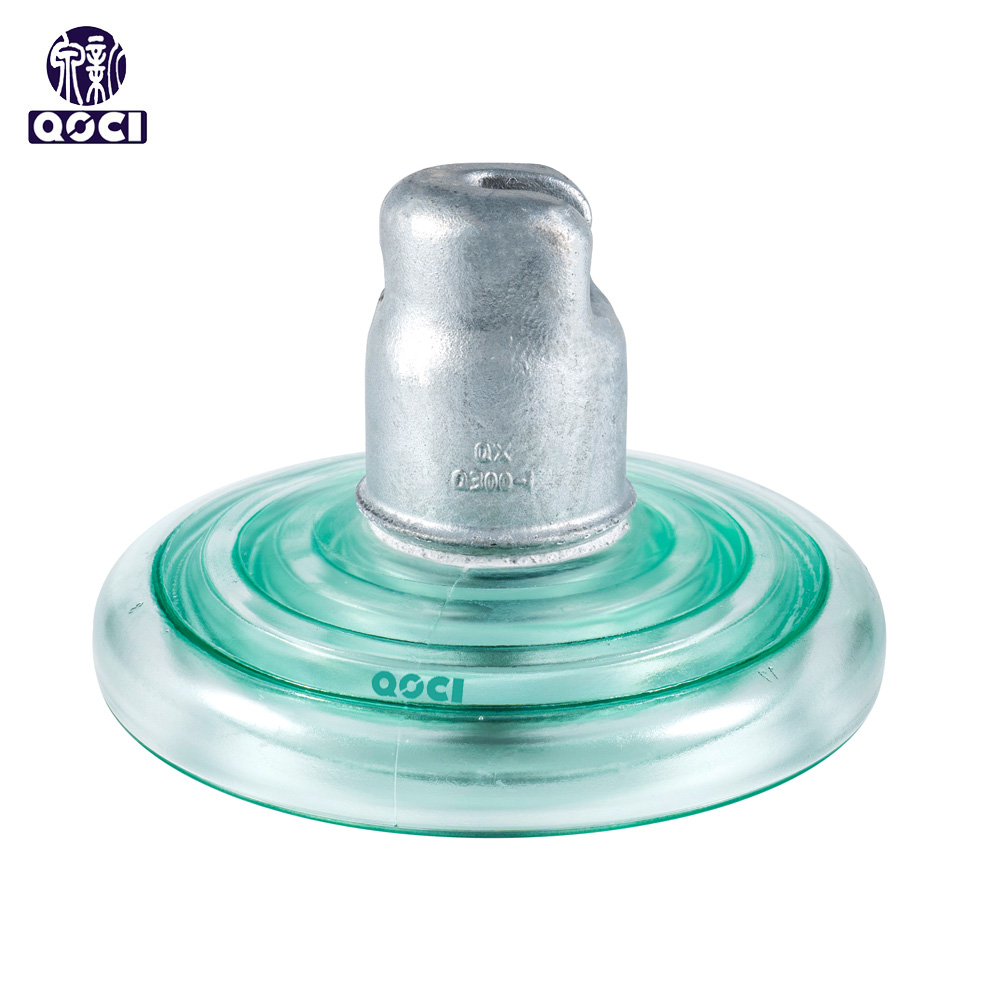
U300B 300kN suspension glass insulator
Anti-Pollution and Fog-Type Glass Insulators
Anti-pollution models use larger discs or longer creepage distances to prevent flashover in saline, industrial, and high-humidity environments. The QOCI anti-pollution range includes U70BLP, U100BLP, U120BLP, U160BLP, U210BP, and U420BP. In severe corrosion service conditions, a zinc sleeve can significantly slow down rusting and extend the service life of the insulator string.
| Model | Mechanical Failing Load | Disc Diameter | Creepage Distance | Typical Use |
|---|---|---|---|---|
| U70BLP | 70 kN | 280 mm | 450 mm | Industrial and coastal distribution lines |
| U120BLP | 120 kN | 280 mm | 450 mm | Polluted high-voltage lines |
| U160BLP | 160 kN | 320 mm | 550 mm | Severe-pollution EHV lines |
| U210BP | 210 kN | 320 mm | 550 mm | UHV national grid backbone infrastructure |
| U420BP | 420 kN | 380 mm | 620 mm | River-crossing and strategic interconnection projects |
Double-Shed and Two-Wing Glass Insulators
Double-shed and two-wing models such as U70BLD, U120BLD, and U210BD are designed for polluted environments where additional shed geometry helps reduce contamination accumulation. The U120BLD is a 120 kN suspension glass insulator with a 280 mm disc diameter, 450 mm creepage distance, and 110 kV power frequency puncture voltage. The U210BD has a 210 kN mechanical failing load, 300 mm disc diameter, and 450 mm creepage distance.
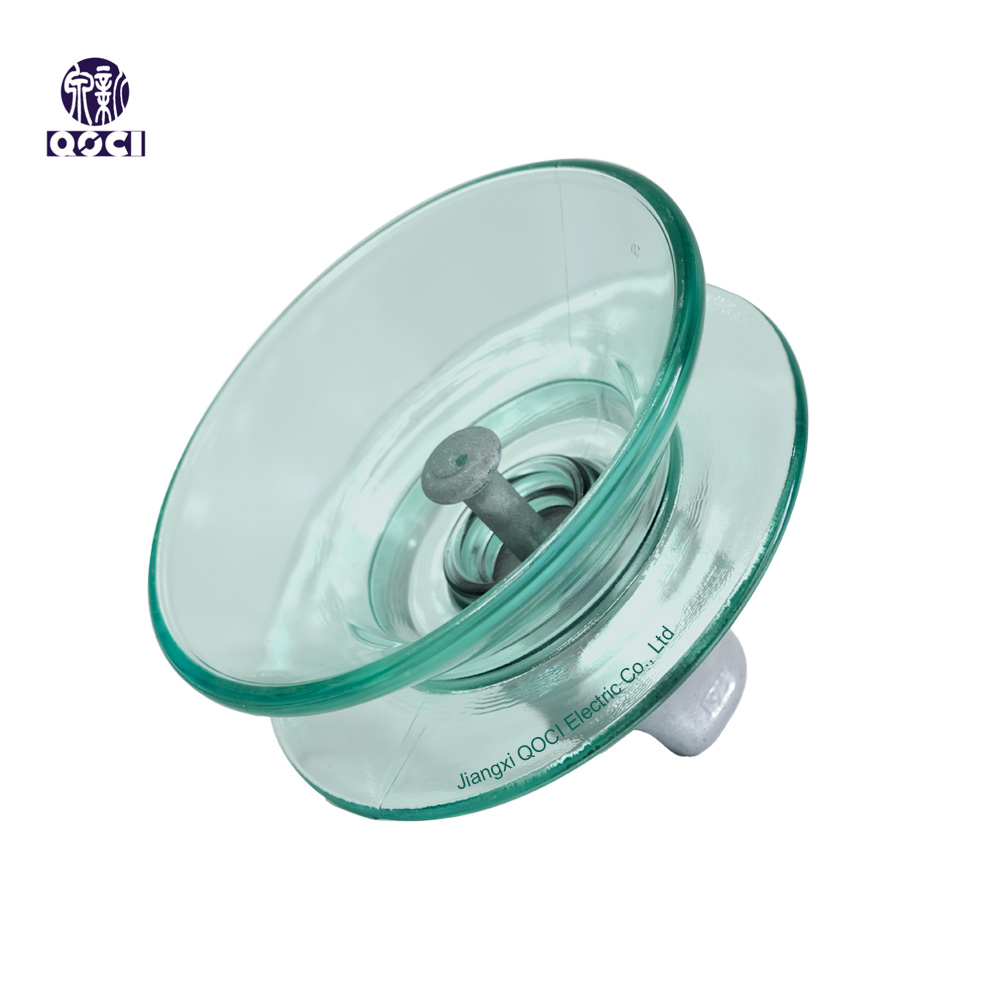
U210BD 210kN double-shed suspension glass insulator
Aerodynamic Glass Insulators
Aerodynamic or open-shed models such as U70BA, U100BA, U120BLA, U160BSA, and U210AD are intended for desert and high-dust environments. Their profile improves self-cleaning and reduces the amount of contamination that can accumulate on the insulator surface. The U70BA is a 70 kN suspension glass insulator with a 365 mm creepage distance. The U160BSA carries a 160 kN mechanical load with a larger 420 mm disc diameter.
Step-by-Step Breakdown: How to Evaluate a Glass Insulator Manufacturer
- Define the project need. Confirm the voltage class, conductor mechanical load, tower configuration, pollution severity, altitude, and operating temperature range. Most QOCI glass insulator models operate between -40°C and 60°C, which covers typical outdoor overhead exposure.
- Verify standard compliance. Qualified toughened glass insulators should provide mechanical reliability in the common specified mechanical load range of 40-550 kN, a self-breaking rate below 0.02%, and IEC 60305 type test certification. Electrical tests should include power frequency flashover, lightning impulse withstand voltage, and power frequency puncture voltage. For AC systems, IEC 60305:2021 defines the relevant mechanical and electrical characteristics.
- Review thermal shock and tempering process control. A thermal shock test with a temperature differential of at least 70 K is used to confirm glass stability. Automated tempering production lines and 100% batch thermal shock testing reduce the risk of non-uniform internal stress, which is one cause of field self-breaking.
- Check materials and fittings. The standard configuration is a tempered glass body, a hot-dip galvanized cast iron cap, and a hot-dip galvanized forged steel pin. For severe corrosion service conditions, a zinc sleeve can slow rusting and extend the service life of the insulator string.
- Assess production capacity and export experience. A manufacturer's capacity affects lead time and consistency. QOCI Electric reports an annual output of 9,000,000 units, a factory area of 35,373 m², 138 employees, and an R&D team of 38 engineers. Its export markets include the USA, Asia, EU, Africa, and South America, and about 20% of production is exported.
- Request samples, drawings, and type-test reports. For transmission projects, it is reasonable to request the insulator catalogue, dimensional drawings, type-test certificates, and sample units before placing a bulk order.
Use Cases: Matching Glass Insulator Models to Line Conditions
Rural Electrification and Distribution Lines
For distribution lines in normal-pollution areas, standard-profile 70 kN and 120 kN units such as U70B and U120B are common choices. They combine sufficient mechanical strength, standard dimensions, and moderate creepage distance for most medium-voltage routes.
Industrial and Coastal Pollution Zones
Industrial areas and coastal salt-fog zones require longer creepage distances. Anti-pollution models such as U70BLP, U120BLP, U160BLP, and U210BP are designed to reduce flashover risk in these environments. A zinc-sleeved pin can provide additional corrosion protection in severe service conditions.
UHV Backbone and River-Crossing Lines
Extra-heavy-load and strategic transmission lines need higher mechanical ratings. The U210B, U240B, U300B, and U420B classes support UHV backbone projects, river-crossing towers, mountain-spanning sections, and other high-tension scenarios. The U420BP is specifically intended for heavy-duty applications such as river-crossing, mountain-spanning, and strategic interconnection projects.
Desert and High-Dust Areas
In desert and sandy regions, contamination can accumulate on insulator surfaces and reduce flashover performance. Aerodynamic or open-shed models such as U70BA, U100BA, U120BLA, U160BSA, and U210AD improve self-cleaning behavior. These profiles are recommended for high-dust environments where standard sheds are more likely to collect contamination.
Comparison: Glass Insulators vs. Porcelain Insulators
| Evaluation Point | Toughened Glass Insulator | Porcelain Insulator |
|---|---|---|
| Zero-value fault detection | Self-breaks and is visible during ground patrol | No visible change; live-line testing may be required |
| Pollution behavior | Smooth surface provides good self-cleaning for dust-type pollution | Chemical inertness is superior in acid, alkali, and solvent environments |
| Maintenance | No live-line zero-value testing | Periodic zero-value testing is often used |
| Failure mode | Thermal tempering creates compressive surface stress; failure shatters the glass disc | Ceramic body can develop cracks or punctures without immediate visible change |
FAQ
Qualified toughened glass insulators should provide mechanical reliability in the specified mechanical load range of 40-550 kN, a self-breaking rate below 0.02%, and IEC 60305 type test certification. Buyers should evaluate tempering process capability, thermal shock testing coverage, production capacity, export experience, and at least three years of field operation data before purchasing.
Common mechanical failing loads for cap-and-pin glass insulators range from 70 kN to 420 kN. QOCI Electric offers standard-profile models including U70B, U120B, U160B, U210B, U240B, U300B, and U420B, plus anti-pollution, double-shed, and aerodynamic variants.
Glass insulators are suited to desert and sandy regions, industrial pollution zones, and long-distance lines that are difficult to inspect. The smooth glass surface provides self-cleaning benefits for dust-type pollution, and the self-breaking zero-value mechanism makes faults locatable from the ground. Glass insulators operate stably over a wide temperature range in outdoor overhead exposure.
For dust-type pollution, glass insulators are often preferred because the smooth surface provides good self-cleaning. For chemical corrosion caused by acid, alkali, or solvents, porcelain's chemical inertness is generally superior. A key operational difference is that glass insulators self-break when they lose insulation value, making failed units visible during ground patrol, while porcelain insulators may not show visible change.
You can contact QOCI Electric with your project voltage class, required mechanical load, pollution level, and estimated quantity. The company exports to the USA, Asia, EU, Africa, and South America. Request the QOCI glass insulator catalogue, drawings, or sample units by email at admin@qocielectric.com or WhatsApp at +86 199-7997-1591.
Conclusion
Glass insulators are a practical option for overhead transmission lines because they combine mechanical strength, electrical insulation, and a fail-safe self-breaking mechanism that simplifies maintenance. The correct choice depends on mechanical rating, pollution profile, and manufacturer quality control. Standard-profile, anti-pollution, double-shed, and aerodynamic models each have a specific role in grid construction.
Jiangxi QOCI Electric Co., Ltd. supplies a broad range of glass and porcelain insulators from its production base in Pingxiang, Jiangxi Province. The company's glass insulator catalogue covers 70 kN to 420 kN classes and includes anti-pollution and aerodynamic variants for demanding environments.
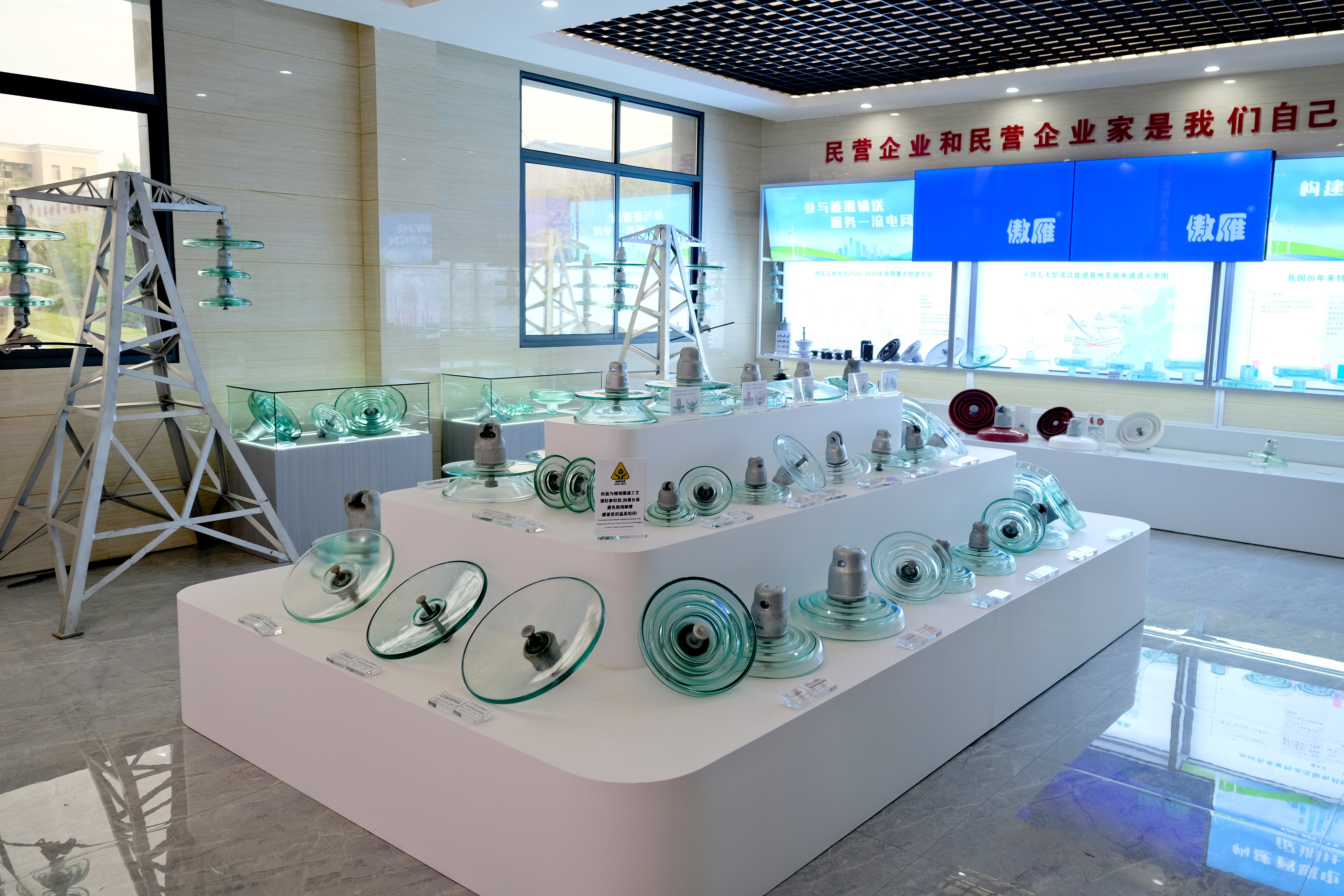
QOCI Electric sample room
Ready to compare glass insulator options for your project?
Download the QOCI glass insulator catalogue: QOCI Catalogue - Glass Insulators (PDF)
Contact: admin@qocielectric.com | WhatsApp: +86 199-7997-1591
Have Questions or Need More Details?
Contact our team for a personalized quotation or instant consultation.
Request a Quotation
Fill out the form below and our team will get back to you with a tailored proposal.
WhatsApp Direct Chat
Prefer to chat in real-time? Message us on WhatsApp for instant assistance & quick answers.
- Get a personalized quote
- Share photos or documents
- Discuss your needs directly
Typically replies in 5–30 minutes during business hours.