Glass Insulator Specs: U70B to U420B Buyer Guide
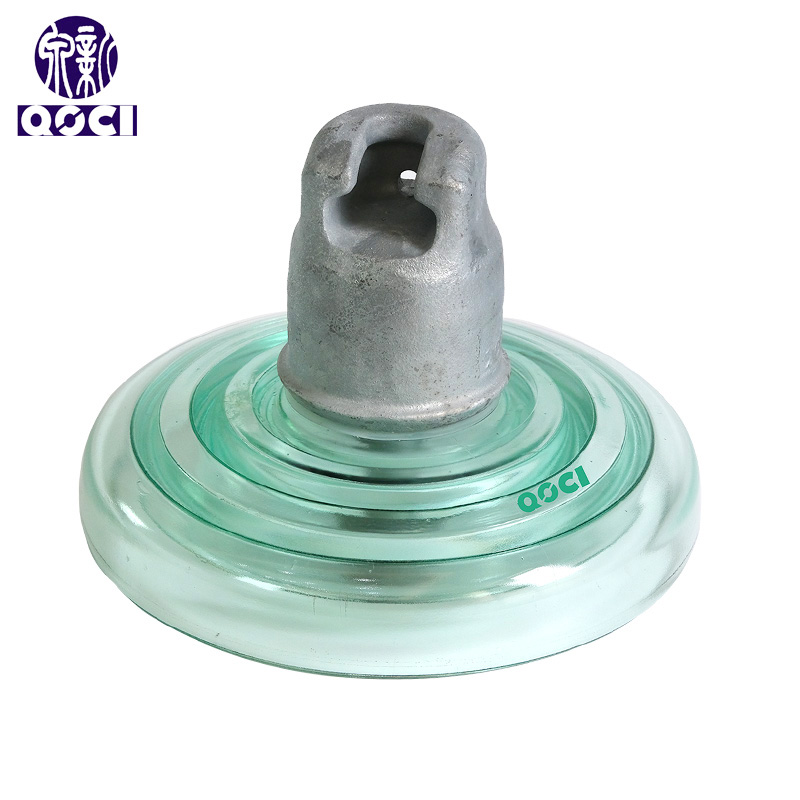
From a procurement standpoint, a glass insulator is not a single product category. It is a family of cap-and-pin or ball-socket suspension units rated from 70 kN to 420 kN, with different shed profiles for clean, polluted, coastal, desert, and high-wind environments. The U70B is the common starting point: a 70 kN tempered glass disc, normally with a 255 mm disc diameter, 146 mm height, and 320 mm creepage distance. This guide explains how to read those parameters, how to choose between standard, anti-pollution, double-shed, and aerodynamic profiles, and what to verify before requesting a quotation.
What This Guide Solves
Project teams often search for glass insulator information during the transition from research to evaluation. The risk at this stage is under-specification. Two products with the same model code can differ in creepage distance, coupling size, corrosion protection, and production quality. A 70 kN U70B unit and a 420 kN U420B unit are not substitutes; neither is a standard-profile unit and an anti-pollution unit meant for the same service condition. This reference keeps the buying decision focused on the constraints that matter: mechanical load, pollution profile, electrical ratings, and supplier evidence.
Industry Background: Why Glass Insulator Specifications Matter
Glass insulators are used in overhead transmission lines to isolate conductors from grounded structures while carrying mechanical loads. The market context helps explain why specification control is becoming more important.
- According to Market Research Future, the global glass insulators market was estimated at USD 1.14 billion in 2024 and is projected to reach USD 1.97 billion by 2035, with a CAGR of 5.1%.
- Grand View Research estimates that Asia Pacific accounted for more than 52% of the market in 2024, supported by grid expansion in China and India.
- OEC data indicates that China concentrated 31.4% of total global exports of electrical insulators in 2024, worth USD 898 million.
- China's electrical insulator exports to Saudi Arabia grew by 219% between 2023 and 2024, making it the fastest-growing single market.
These numbers do not replace project-level verification. They explain why procurement teams must compare specific model data rather than assume that all glass insulators from an exporting region are identical.
Detailed Solution: Reading a Glass Insulator Specification
A reliable glass insulator specification can be separated into five layers: mechanical load, disc profile, coupling, material, and electrical rating.
1. Mechanical failing load
The mechanical failing load is the guaranteed tension level at which the insulator is expected to fail, expressed in kN. Jiangxi QOCI Electric Co., Ltd. supplies suspension glass insulators from 70 kN to 420 kN, including 100 kN, 120 kN, 160 kN, 210 kN, 240 kN, and 300 kN classes. A 70 kN unit such as U70BS is intended for lighter distribution and normal-pollution service; a 420 kN unit such as U420B is intended for river-crossing, mountain-spanning, and other high-tension crossing applications.
2. Disc profile and contamination control
Four profile families cover most transmission projects:
- Standard profile: cap-and-pin disc units with normal creepage, suitable for clean or normal-pollution areas.
- Anti-pollution profile: longer creepage distance and often a zinc-sleeved pin, used in coastal, salt-fog, industrial, and tropical environments. For example, the U70BLP has a mechanical failing load of 70 kN and a creepage distance of 450 mm in one configuration, and 550 mm in another configuration.
- Double-shed profile: extra sheds improve rain washing and pollution runoff. The U120BLD is designed for high-voltage transmission in severely polluted areas, with 450 mm creepage; the U160BLD extends creepage to 550 mm.
- Aerodynamic profile: open or reduced-shed geometry lowers wind load and reduces contamination accumulation. The U210AD is designed for UHV towers in high-wind or typhoon-prone regions.
3. Coupling and string assembly
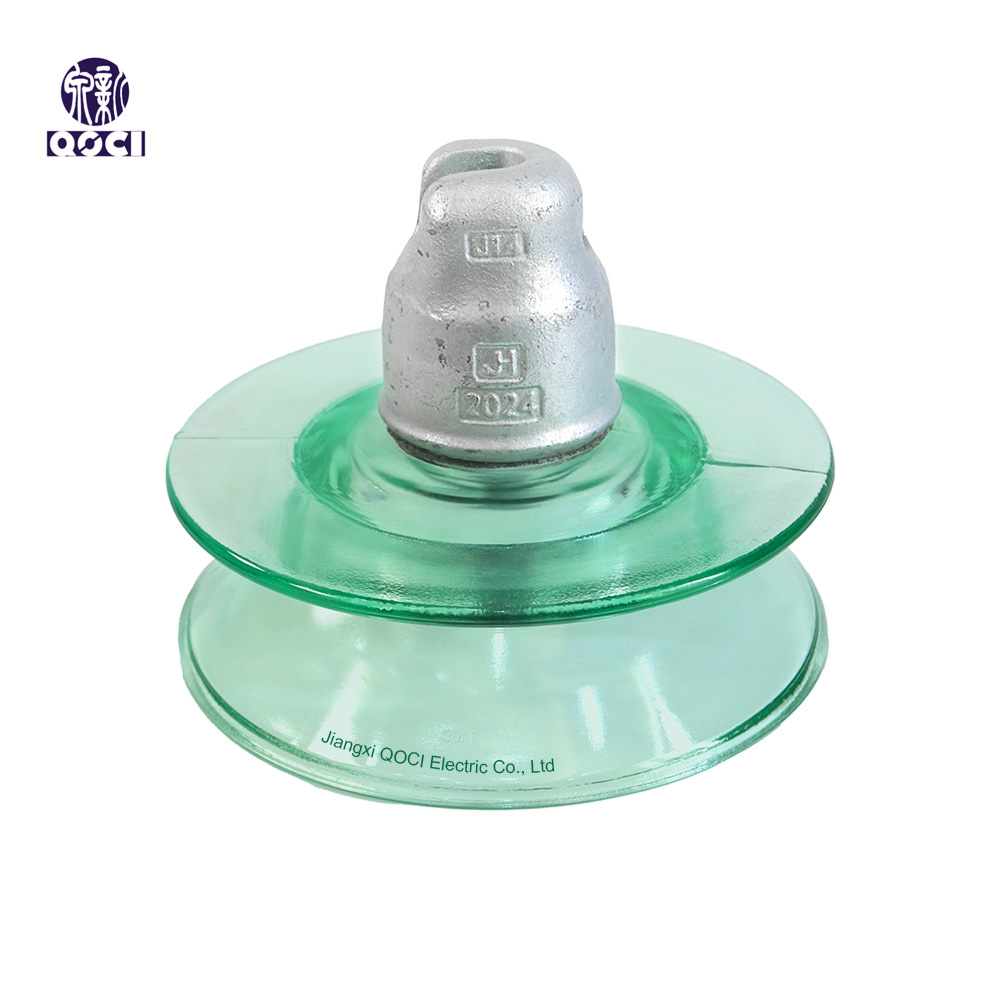
Mechanical connection is identified by coupling type and size. QOCI Electric supplies both cap-and-pin and ball-socket glass insulators. Socket coupling sizes in the range include 16, 20, 24, and 28. A larger socket is normally used with higher mechanical ratings; for example, U420B uses a 28 socket, while U70B-series units use a 16 socket.
4. Materials and corrosion protection
The standard material set is tempered glass for the body, hot-dip galvanized cast iron for the cap, and hot-dip galvanized forged steel for the pin. For severe corrosion service, a zinc sleeve can slow rusting and extend the service life of the insulator string. Anti-pollution models such as U70BLP and U100BLP are designed with enhanced steel-glass interface protection for coastal and salt-fog sites.
5. Electrical ratings
Electrical verification depends on dry lightning impulse withstand, wet power frequency withstand, and power frequency puncture voltage. These differ across models. For instance, the U210B has a power frequency puncture voltage of 130 kV, wet power frequency withstand voltage of 45 kV, and dry lightning impulse withstand voltage of 110 kV. The U420B has ratings of 140 kV, 80 kV, and 140 kV respectively. Include these values in tender documents because they are project-specific.
6. Quality evidence and certifications
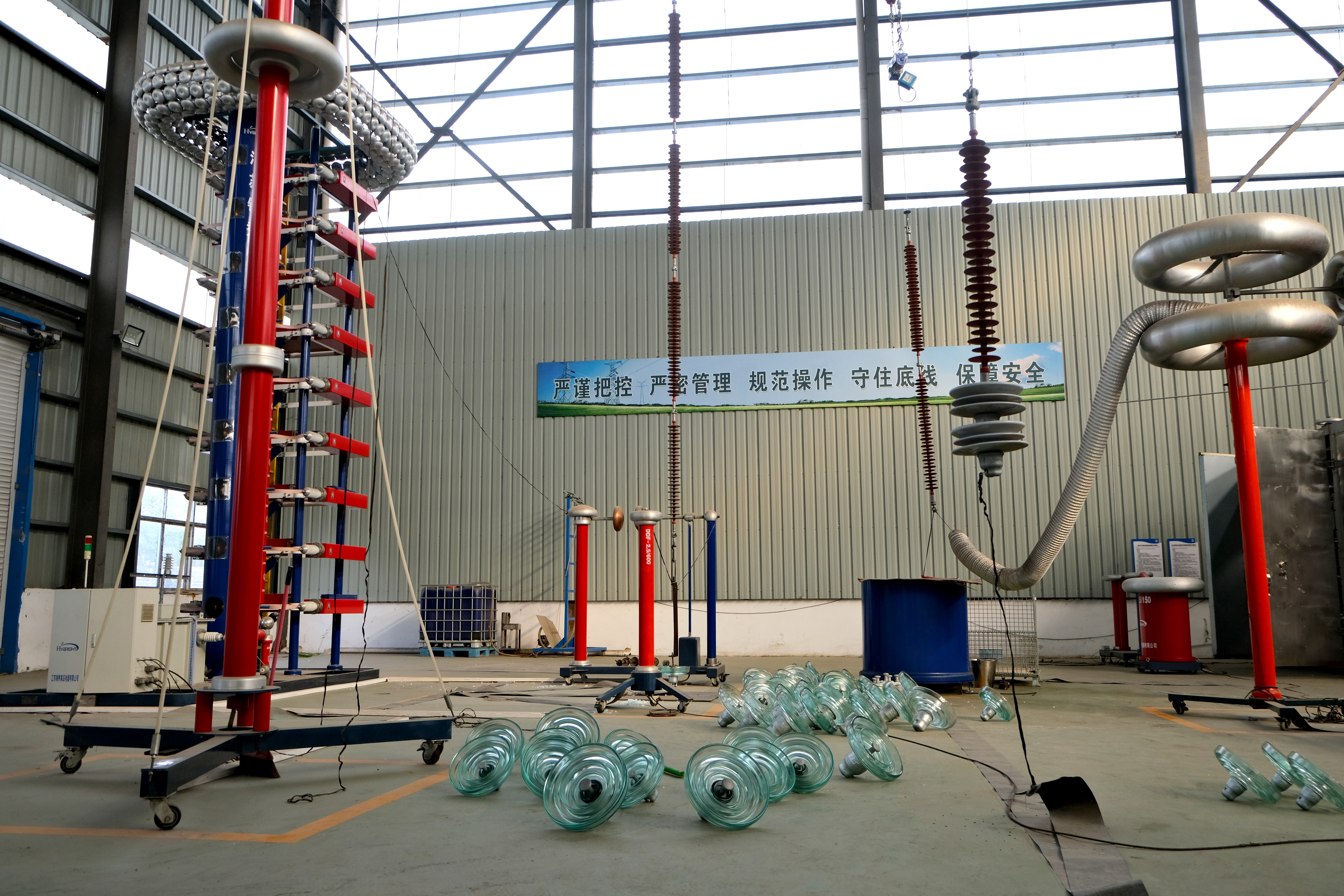
QOCI Electric operates as a manufacturer, not only a trader. The company holds ISO 9001:2015 quality management, ISO 14001:2015 environmental management, and ISO 45001:2018 occupational health and safety certifications issued by China Quality Certification Centre. Its capability unit includes OEM/ODM production, 100% pre-shipment testing, and third-party inspection support such as SGS.
Step-by-Step: How to Match a Glass Insulator to a Project
- Define the mechanical load. Calculate the maximum conductor tension and select an insulator class with enough margin. Common steps are 70 kN, 120 kN, 160 kN, 210 kN, 240 kN, 300 kN, and 420 kN.
- Identify the pollution environment. Use the site class or expected contamination type. Choose standard profile for clean areas, anti-pollution for coastal or industrial areas, double-shed for severe wet pollution, and aerodynamic for dust or high wind.
- Confirm the coupling. Match ball-socket or cap-pin hardware with the existing string fittings. Confirm socket size and locking-device type before order.
- Check electrical withstand values. Confirm the dry lightning impulse withstand, wet power frequency withstand, and power frequency puncture voltage are appropriate for the line voltage and insulation coordination.
- Request evidence. Ask for product drawings, material statements, type-test reports, and quality-control records. Review whether the model can be delivered with third-party inspection.
- Clarify quantity and lead time. QOCI's monthly capacity is 750,000 units, with a 15-to-35-day lead-time window depending on model and quantity. The MOQ is 50 units, which allows a small pilot order before large-volume supply.
Use Cases by Service Environment
Coastal, salt-fog, and industrial zones
For coastal, salt-fog, and tropical service, anti-pollution glass insulators provide longer creepage and improved corrosion resistance. QOCI's U70BLP, U100BLP, U120BLP, U160BLP, and U210BP models are positioned for these conditions. Under severe corrosion service conditions, using a zinc sleeve can significantly slow rusting and extend the service life of the insulator string.
Severely polluted industrial sites
Double-shed profiles such as U120BLD and U160BLD maximize pollution resistance through advanced shed geometry. The U160BLD combines 160 kN mechanical load with 550 mm creepage, making it suitable for EHV projects where contamination and mechanical load are both demanding.
Desert, high-dust, and high-wind lines
Aerodynamic profiles reduce contamination accumulation and wind load. The U210AD uses an open aerodynamic disc profile for UHV transmission towers in typhoon or high-wind regions. The U210BD maintains full mechanical and electrical capacity while using an aerodynamic multi-shed geometry to reduce contamination accumulation.
Heavy crossing and backbone grid projects
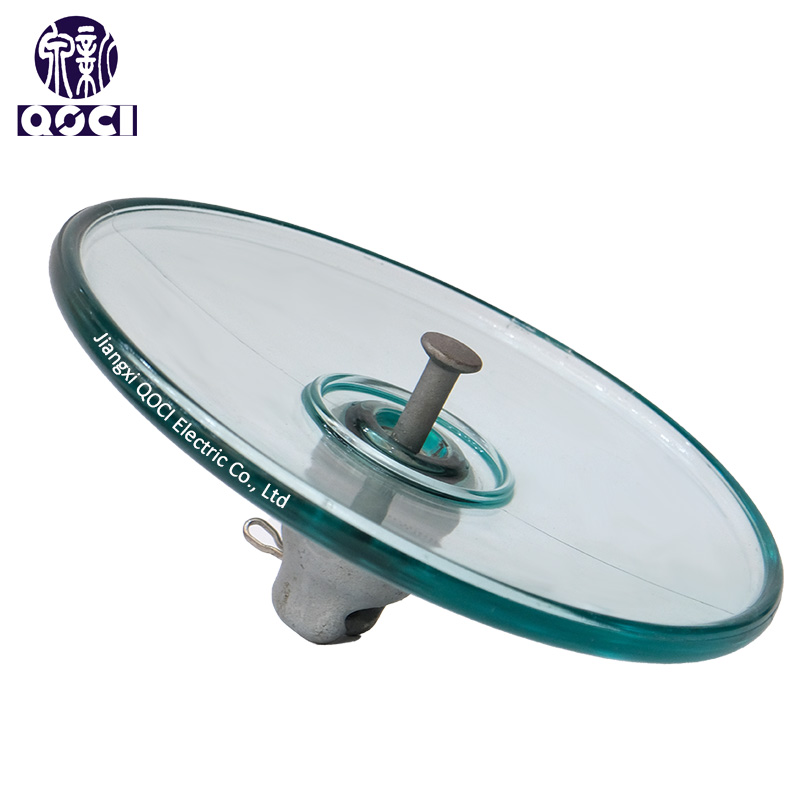
U300B and U420B are designed for ultra-high-voltage, river-crossing, and mountain-spanning applications. The U420B has a 420 kN mechanical failing load, 550 mm creepage distance, 28 socket coupling, and electrical ratings suitable for critical high-tension service.
Export project evidence
QOCI Electric has supplied 200,000 pieces of glass insulators to grid and EPC projects in Uzbekistan, Ukraine, and Iraq: 80,000 pieces, 70,000 pieces, and 50,000 pieces respectively. Reported project results include zero line-tripping incidents, a 70% reduction in maintenance cost, and an 85% reduction in pollution flashover incidents compared with a porcelain baseline. The same case data cites stable operation from -40°C to +55°C and a designed service life of more than 30 years.
Comparison Table: Standard QOCI Glass Insulator Families
The following table is based on QOCI model data. Use it as a first filter only; exact drawings should be requested for each project.
| Model Group | Mechanical Failing Load | Disc Diameter | Spacing | Creepage | Coupling | Typical Use |
|---|---|---|---|---|---|---|
| U70BS / U70BL | 70 kN | 255 mm | 127 / 146 mm | 320 mm | 16 | Distribution and normal-pollution lines |
| U100BS / U100BL | 100 kN | 255 mm | 127 / 146 mm | 320 mm | 16 | Medium-voltage transmission |
| U120BS / U120BL | 120 kN | 255 mm | 127 / 146 mm | 320 mm | 16 | Higher-tension normal-pollution lines |
| U160B | 160 kN | 280 mm | 127 / 146 mm | 360 mm | 20 | EHV suspension strings |
| U210B | 210 kN | 280 mm | 170 mm | 400 mm | 20 | UHV and extra-heavy-load projects |
| U240B | 240 kN | 280 mm | 170 mm | 400 mm | 20 / 24 | UHV backbone transmission |
| U300B | 300 kN | 320 mm | 195 mm | 485 mm | 24 | UHV backbone and crossing towers |
| U420B | 420 kN | 360 mm | 205 mm | 550 mm | 28 | River-crossing and mountain-spanning |
Profile Comparison
| Profile Family | Example Models | Creepage | Preferred Environment |
|---|---|---|---|
| Anti-pollution | U70BLP, U100BLP, U120BLP, U160BLP | 450–550 mm | Coastal, salt-fog, industrial |
| Double-shed | U70BLD, U100BLD, U120BLD, U160BLD, U210BD | 450–550 mm | Severe pollution and wet contamination |
| Aerodynamic | U70BA, U100BA, U120BLA, U160BSA, U210AD | 365–380 mm | High wind, desert, and dust |
FAQ
What should I check when searching for IEC 60383 U70B glass insulator manufacturers?
The U70B is commonly understood as a 70 kN cap-and-pin glass insulator. When a tender references IEC 60383, confirm the required mechanical and electrical characteristics with the supplier rather than treating the model code as a certificate. For string insulator units, IEC 60305 is the relevant dimensional and electrical standard. QOCI Electric's glass insulator facility holds ISO 9001:2015, ISO 14001:2015, and ISO 45001:2018 certifications issued by China Quality Certification Centre, and a project-specific type-test report should be requested before award.
Which mechanical ratings does QOCI Electric offer for glass insulators?
QOCI Electric supplies suspension glass insulators from 70 kN to 420 kN: 70, 100, 120, 160, 210, 240, 300, and 420 kN. The family includes cap-and-pin and ball-socket types, plus anti-pollution, double-shed, and aerodynamic profile variants.
How are glass insulator prices calculated?
QOCI Electric does not publish a general price list because the final price depends on mechanical rating, profile, coupling, quantity, packaging, and inspection terms. A useful starting point is an RFQ with line voltage, mechanical failing load, creepage distance or pollution class, coupling size, and quantity. The sales team can then return a model-specific quotation.
Can I request a glass insulator sample before a full order?
The minimum order quantity at QOCI Electric is 50 units, so a small pilot order can be used for evaluation. For sample availability and sample-related costs, contact the sales team directly by email or WhatsApp.
What is the lead time for QOCI glass insulator export orders?
QOCI's monthly capacity is 750,000 units. Standard lead time is 15 to 35 days depending on model, quantity, customization, and inspection schedule. Export markets include EU, US, Middle East, Asia, Africa, and South America. To confirm current scheduling, email admin@qocielectric.com or WhatsApp +86 199-7997-1591.
Conclusion and Next Step
A glass insulator purchase decision becomes simpler when the project constraints are clear: mechanical failing load, creepage distance, coupling size, pollution profile, and electrical withstand values. Use the model tables in this guide as a first filter, then ask the manufacturer to provide drawings, certifications, and project references. Jiangxi QOCI Electric Co., Ltd. is a China-based manufacturer of glass and porcelain insulators for power transmission and grid construction, with website www.quanxinelectric.com and blog blog.quanxinelectric.com.
Need a model-specific glass insulator quote, drawing, or sample? Contact QOCI Electric for current availability and export documentation.
Have Questions or Need More Details?
Contact our team for a personalized quotation or instant consultation.
Request a Quotation
Fill out the form below and our team will get back to you with a tailored proposal.
WhatsApp Direct Chat
Prefer to chat in real-time? Message us on WhatsApp for instant assistance & quick answers.
- Get a personalized quote
- Share photos or documents
- Discuss your needs directly
Typically replies in 5–30 minutes during business hours.