
Toughened Glass Insulator Compliance Guide: U70B to U420B
Toughened Glass Insulator Compliance Guide: U70B to U420B
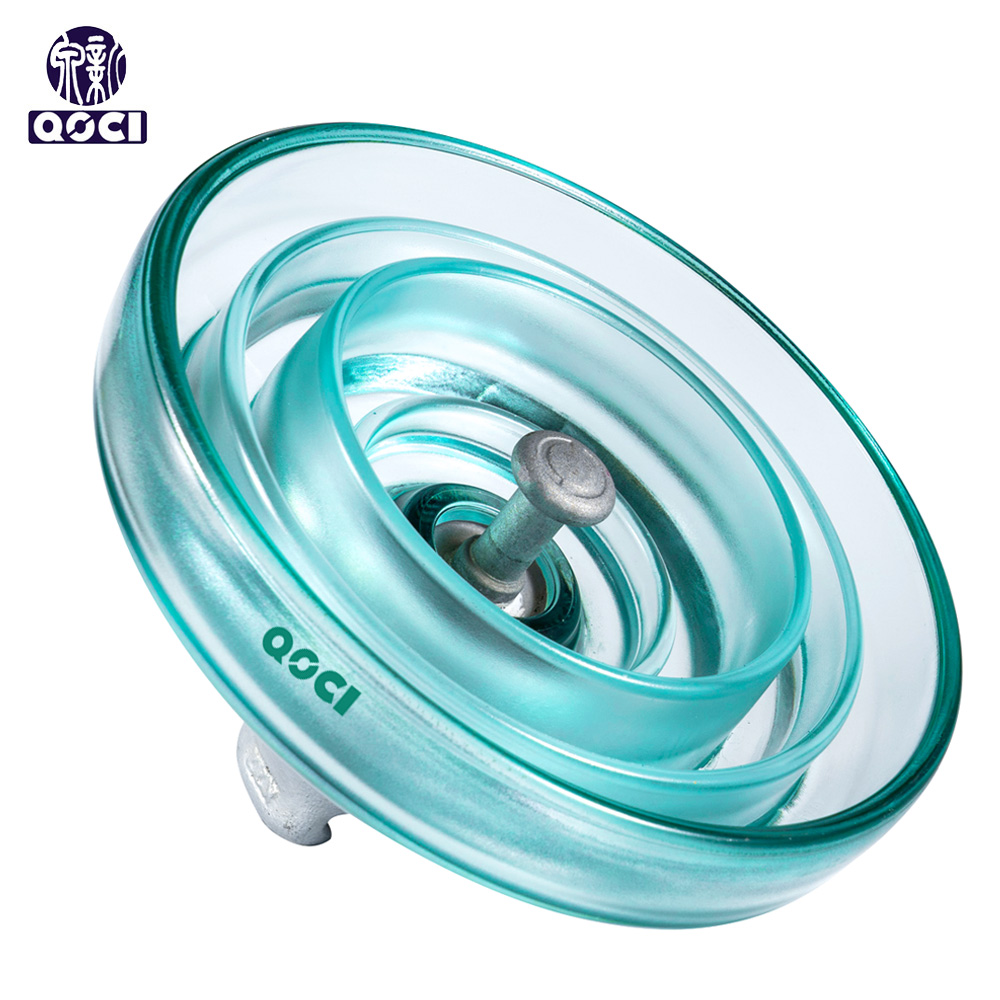
When a transmission line specification calls for a U70B glass insulator or a U420B cap-and-pin insulator, the model name is not just a label. It is a compact way of stating constraints: mechanical failing load in kN, disc diameter, spacing, creepage distance, coupling size, electrical withstand levels, and the material system of glass, cap, and pin. For Research and Evaluation stage buyers, the essential task is to check whether a supplier's product documentation, certifications and test data actually support those constraints.
This guide explains how to verify toughened glass insulators from U70B to U420B against commonly used IEC/ISO requirements. It also shows how Jiangxi QOCI Electric Co., Ltd. frames its glass insulator range, and which commercial and quality control points should be checked before adding a supplier to a tender list.
Why compliance review matters in glass insulator procurement
Distribution and transmission networks operate under outdoor exposure, wide temperature ranges, heavy pollution, coastal salt fog, and long-term mechanical loads. Toughened glass insulators solve the electrical insulation and mechanical support problem, but the acceptable performance range is narrow if the insulator is selected only by visual appearance or by price per piece.
The main procurement risk is not whether the manufacturer can supply a shiny glass disc. It is whether the mechanical failing load, creepage distance, coupling dimensions and withstand voltages match the line design. A U210B glass insulator designed for extra-heavy-load and ultra-high-voltage projects must deliver 210 kN mechanical failing load and standardized IEC/IEEE dimensions for seamless string assembly. If a supplier cannot show corresponding type-test documentation or certification, the model designation becomes meaningless in formal engineering review.
Another risk is environmental matching. For severe corrosion or coastal salt-fog service, using a zinc sleeve can significantly slow rusting and extend the service life of the insulator string. For heavy industrial pollution, anti-pollution profiles with longer creepage distances reduce flashover risk. A standard-profile unit that is appropriate for clean rural lines may be a poor choice for a coastal substation approach or for an industrial corridor. Therefore, compliance review should combine electrical/mechanical parameter checks with application environment checks.
Market context and standards landscape
The global glass insulators market was estimated at USD 1.14 billion in 2024 and is projected to reach USD 1.97 billion by 2035, with an expected CAGR of 5.1% from 2025 to 2035, according to Market Research Future. Asia Pacific accounted for more than 52% of the revenue share in 2024, driven by grid expansion in China and India. China also concentrated 31.4% of total global exports of electrical insulators in 2024, totaling USD 898 million, according to OEC. This explains why utility buyers and EPC contractors worldwide evaluate Chinese manufacturers for glass insulator supply.
On the standard side, IEC 60305:2021 governs mechanical and electrical characteristics of cap-and-pin suspension glass insulator units for AC overhead lines. For project specifications that reference IEC 60383 U70B glass insulator requirements, the manufacturer should provide a clear clause-by-clause mapping to the relevant type-test report, because the project standard and the product standard must be cross-checked. In many cases, the practical baseline for QOCI's product range is standardized IEC/IEEE dimensional coordination, enabling string assembly with common fittings.
U70B to U420B: the QOCI glass insulator constraint matrix
Mechanical failing load classes
The first constraint is mechanical capacity. Jiangxi QOCI Electric Co., Ltd. produces a family of disc-shaped cap-and-pin suspension glass insulators spanning 70 kN, 100 kN, 120 kN, 160 kN, 210 kN, 240 kN, 300 kN, and 420 kN mechanical failing loads. Each class has its own coupling requirements:
- U70B-class units such as U70BS use a 16 mm socket coupling; typical dimensions are 255 mm nominal disc diameter, 127 mm spacing, and 320 mm creepage distance.
- U120B-class units such as U120BS also use a 16 mm socket coupling and can be specified for high-voltage overhead lines.
- U160B-class units such as U160BL use a 20 mm socket coupling and are designed for more heavily loaded transmission towers.
- U210B and U240B units use a 20 mm or 20/24 mm coupling and are positioned for heavy-load and UHV projects.
- U300B uses a 24 mm socket coupling, while U420B uses a 28 mm socket coupling and is reserved for river-crossing, mountain-spanning, or special extra-heavy-duty UHV crossings.
For example, the U210B glass insulator from QOCI has a power frequency puncture voltage of 130 kV, a wet power frequency withstand voltage of 45 kV, and a dry lightning impulse withstand voltage of 110 kV. The U420B has a power frequency puncture voltage of 140 kV, wet power frequency withstand voltage of 80 kV, dry lightning impulse withstand voltage of 140 kV, creepage distance of 550 mm, nominal disc diameter of 360 mm, and nominal spacing of 205 mm. These parameters define the boundary conditions for string design.
Anti-pollution, double-shed, and aerodynamic variants
Beyond the standard profile, suppliers use suffix letters to indicate pollution or wind-oriented sheds. In QOCI's naming convention, P often denotes an anti-pollution/fog profile, D denotes a double-shed or two-wing profile, and A denotes an aerodynamic profile.
The U70BLP suspension glass insulator is an example of an anti-pollution cap-and-pin unit. It has a mechanical failing load of 70 kN and creepage distance of 450 mm. It is suitable for coastal, salt-fog and tropical service conditions because its zinc-sleeved pin enhances corrosion protection at the steel-glass interface. Another anti-pollution design, the U120BLP, has a mechanical failing load of 120 kN. In the higher mechanical class, U160BLP has a creepage distance of up to 550 mm and a 20 mm socket coupling, combining anti-pollution shed geometry with a stronger pin configuration.
Double-shed insulators are intended for severely polluted environments. The U120BLD is suitable for high-voltage transmission in severely polluted areas; its double-shed configuration and advanced shed geometry maximize pollution resistance. The U210BD maintains full mechanical and electrical capacity and is designed for UHV applications; its disc profile helps reduce contamination accumulation. Aerodynamic variants such as U70BA are also available where wind load or self-cleaning behavior is a design priority.
.jpg)
Material and corrosion protection
All QOCI suspension glass insulators use thermally toughened glass as the dielectric body. Caps are made of hot-dip galvanized cast iron; pins are made of hot-dip galvanized forged steel. For example, the U420BP model uses a hot-dip galvanized forged steel pin and a hot-dip galvanized cast iron cap, and is described with a zinc-sleeved pin for special heavy-duty UHV applications. In corrosion-prone conditions, the zinc sleeve acts as sacrificial protection, reducing the rate of rusting at the pin-cement interface and extending service life.
Toughened glass insulators also provide a useful failure detection feature: when an internal electrical puncture occurs, the disc shatters into small particles. This makes the failed unit visible during ground patrol and eliminates the need for regular live-line zero-value testing that is normally required for porcelain insulators. The broken unit retains enough mechanical integrity in the short term, allowing replacement during a planned maintenance window.
Step-by-step supplier verification checklist for tenders
- Define the line parameters. Confirm nominal voltage, phase-to-ground impulse levels, pollution class, and the design tension load. This translates directly into required SML and creepage distance.
- Short-list the required product families. Choose standard-profile for normal pollution, anti-pollution/long-creepage for industrial or coastal zones, and double-shed or aerodynamic variants for severe pollution, high-dust or wind-sensitive segments.
- Ask for dimensional data. The drawing should state disc diameter, spacing, creepage distance, socket coupling, cap/pin material, and total string length. If the drawing does not match IEC 60305 dimensions, evaluate the impact on hardware compatibility and replacement stock.
- Check electrical ratings. Verify wet power-frequency withstand voltage, dry lightning impulse withstand voltage, and power-frequency puncture voltage. These numbers must match the tender's voltage class and insulation coordination.
- Review mechanical and material data. Confirm mechanical failing load and the exact material system: tempered glass, cast iron cap, forged steel pin, galvanization, and whether zinc-sleeved pin is used in corrosive environments.
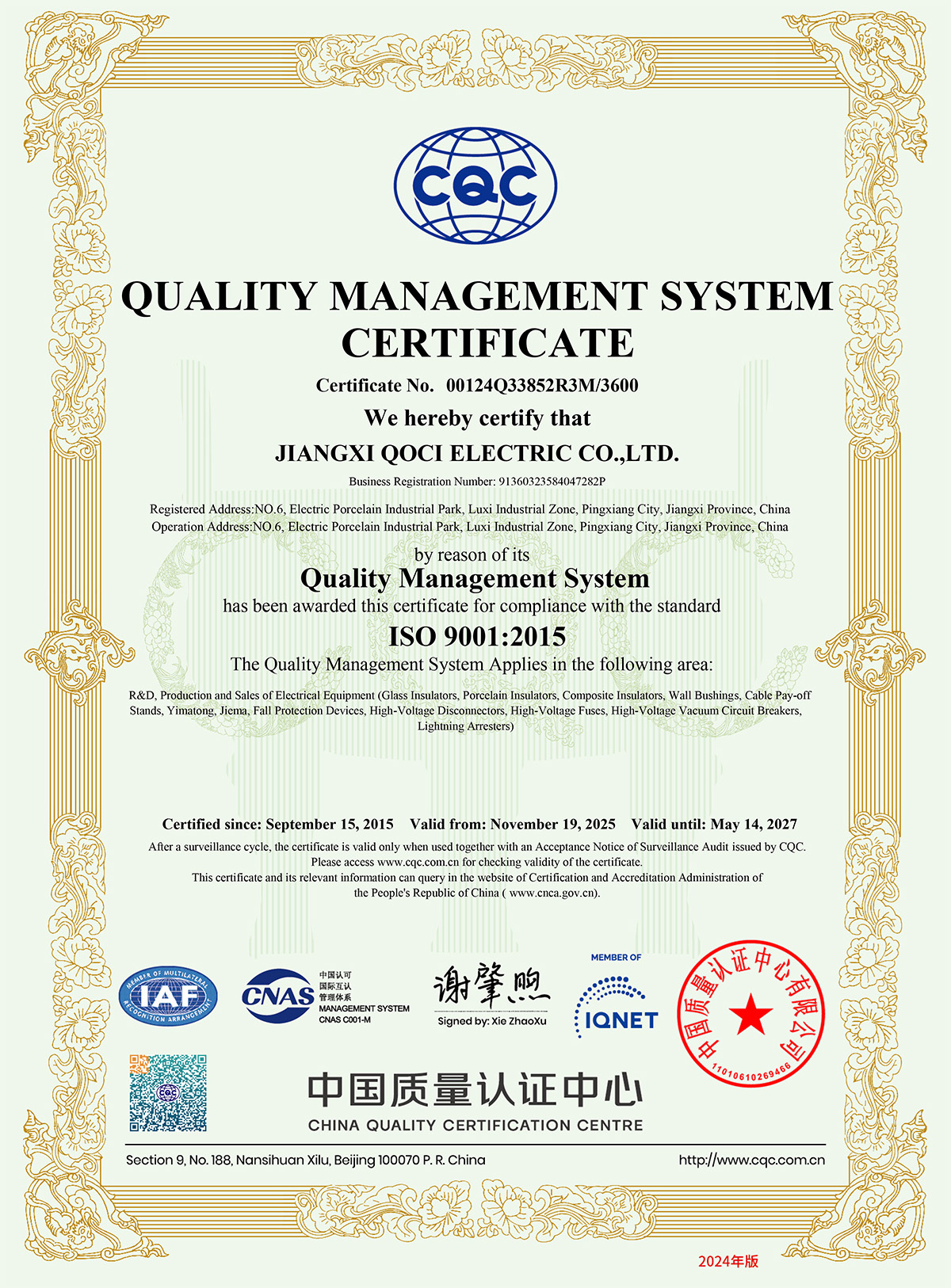
- Verify management system certifications. QOCI holds ISO 9001:2015 certificate No. 00124Q33852R3M/3600, ISO 14001:2015 certificate No. 00125E30701R3M/3600, and ISO 45001:2018 certificate No. 00125S30581R3M/3600, all issued by China Quality Certification Centre. U70B product documentation also references the ISO 14001:2015 certificate 00125E30701R3M/3600.
- Check production and commercial constraints. QOCI lists a monthly capacity of 750,000 units, a lead time of 15–35 days, and a MOQ of 50 units. OEM/ODM is available, with customization such as voltage or logo marking. A 100% pre-shipment test is offered, and third-party inspection, such as inspection by SGS, can be arranged.
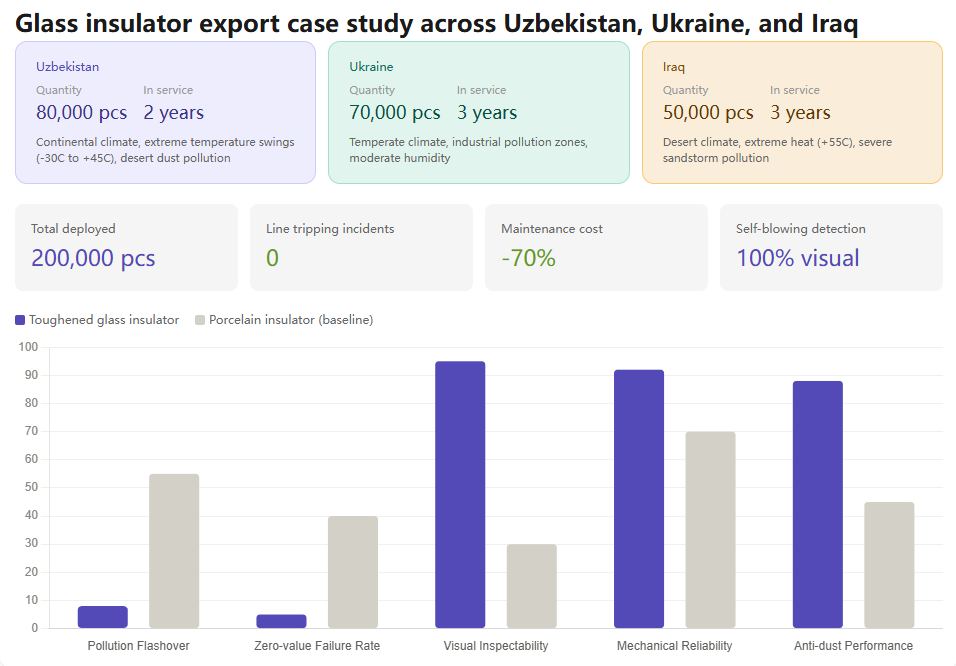
- Require case references and field data. Ask how long the same product family has operated in desert, salt-fog, or industrial pollution zones. QOCI has delivered glass insulators for UHV/EHV projects in Uzbekistan, Ukraine, and Iraq, totaling 200,000 pieces; reported project results include zero line-tripping incidents, 100% visual defect detection without live-line testing, and pollution flashover incidents reduced by 85% versus the porcelain baseline, although results are project-specific.
Application scenarios and observed field results
Three real project contexts illustrate how QOCI glass insulators have been applied.
- Desert and dry high-dust regions. In Uzbekistan, 80,000 pieces of QOCI glass insulators were used on UHV/EHV overhead transmission insulation under desert and industrial pollution conditions. The smooth glass surface and anti-dust self-cleaning behavior supported reliable operation, with operation verified in a wide temperature range.
- Industrial and grid-expansion projects. Ukraine used 70,000 pieces in grid construction and transmission projects. The project performance reporting highlighted zero line-tripping and maintenance cost reduction, together with visual inspection capability.
- Severe EHV crossing and desert terrain. Iraq used 50,000 pieces for high-voltage transmission line insulation. Field experience showed stable operation across extreme temperature conditions.
These applications are not average marketing claims; they are shipment and project performance reports from QOCI's case documentation. Should a utility buyer require a different voltage class or pollution profile, the supplier should adjust the insulator family and repeat the relevant type tests.
Comparison table: selected QOCI glass insulator specifications
| Model | SML (kN) | Disc dia. (mm) | Spacing (mm) | Creepage (mm) | Coupling | Typical use |
|---|---|---|---|---|---|---|
| U70BS | 70 | 255 | 127 | 320 | 16 | Normal-pollution overhead lines |
| U70BLP | 70 | 280 | 146 | 450 | 16 | Coastal, salt-fog, industrial pollution |
| U120BS | 120 | 255 | 127 | 320 | 16 | High-voltage transmission lines |
| U160BLP | 160 | 320 | 170 | 550 | 20 | EHV heavy-tension anti-pollution lines |
| U210B | 210 | 280 | 170 | 400 | 20 | UHV / extra-heavy-load projects |
| U420B | 420 | 360 | 205 | 550 | 28 | Special river and mountain heavy crossings |
For a complete family comparison, QOCI's published catalogue contains the full model list and dimensional drawings.
FAQ
Where can I find IEC 60383 U70B glass insulator manufacturers?
IEC 60383 is the family of standards for insulators for overhead lines with nominal voltage above 1000 V. For cap-and-pin suspension glass insulator units used in AC systems, IEC 60305 defines the mechanical and electrical characteristics. The U70B designation corresponds to a 70 kN mechanical failing load class. Jiangxi QOCI Electric Co., Ltd., based in Pingxiang, Jiangxi, China, is a manufacturer that can supply U70B-family suspension glass insulators, including U70BS and U70BLP. If a tender specifically references IEC 60383, request a clause-mapping document from the manufacturer before contract award.
What ISO certifications should a glass insulator supplier provide?
For utility and EPC evaluation, at minimum check quality, environmental, and occupational health and safety management system certificates. QOCI Electric holds ISO 9001:2015 certificate No. 00124Q33852R3M/3600, ISO 14001:2015 certificate No. 00125E30701R3M/3600, and ISO 45001:2018 certificate No. 00125S30581R3M/3600, all issued by China Quality Certification Centre. The U70B product is also documented under the environmental management system certification number 00125E30701R3M/3600, applicable to the global market. Buyers should verify certificate scope and expiry date, because a quality certificate does not by itself prove product type-test compliance.
Should I select a standard-profile or an anti-pollution glass insulator?
Selection should follow the pollution class and operating environment. Standard-profile units such as U70BS or U120BS are suited to normal-pollution areas. Anti-pollution units such as U70BLP and U160BLP provide longer creepage distances and improved flashover resistance in industrial, coastal, and salt-fog zones. For severely polluted high-voltage environments, double-shed units such as U120BLD add shed geometry advantages; aerodynamic or multi-shed geometries are used to reduce contamination accumulation or wind loading. The manufacturer should recommend a profile based on the pollution severity of the specific route.
What MOQ, lead time, and inspection options are realistic for QOCI glass insulator orders?
QOCI lists a MOQ of 50 units, lead time of 15–35 days, and monthly production capacity of 750,000 units. These commercial conditions are suitable for both project tenders and testing quantities. OEM/ODM production is available and customization may include voltage or logo marking. The published quality control policy includes 100% pre-shipment test and third-party inspection, such as SGS inspection. For an accurate budget estimate, provide the model, required anti-pollution class, quantity, and destination port.
Can I request a sample or the full technical catalogue before final selection?
Before sending a formal inquiry, engineering teams normally want complete dimensional data and test certificates. The full QOCI glass insulators catalogue is available for download, and product-specific drawings can be requested by contacting the sales team. If sample evaluation is required, the MOQ of 50 units or a smaller agreed sample quantity should be confirmed directly with the manufacturer. Contact QOCI Electric through admin@qocielectric.com or WhatsApp for project-specific sample lead time and documentation requests.
Conclusion
Selecting a toughened glass insulator for a transmission project is a constraint-based decision. The numerical range from U70B to U420B gives procurement teams a clear mechanical classification, but the actual specification lives in the creepage distance, coupling size, withstand voltage, material treatment, manufacturing certification, and field history. Jiangxi QOCI Electric Co., Ltd. supplies a broad suspension glass insulator portfolio with documented ISO certifications and production capabilities that can be matched to standard, anti-pollution, double-shed, or aerodynamic requirements.
The final recommendation is procedural: always ask for a drawing, a type-test report, and a certificate overview before comparing price. Then request project references from similar environmental zones. That sequence will reduce specification mismatch and makes the glass insulator string repeatable, maintainable and compliant with the tender documents.
Download QOCI Glass Insulators Catalogue (PDF)
For drawings and quotation: admin@qocielectric.com | WhatsApp +86 199-7997-1591
Have Questions or Need More Details?
Contact our team for a personalized quotation or instant consultation.
Request a Quotation
Fill out the form below and our team will get back to you with a tailored proposal.
WhatsApp Direct Chat
Prefer to chat in real-time? Message us on WhatsApp for instant assistance & quick answers.
- Get a personalized quote
- Share photos or documents
- Discuss your needs directly
Typically replies in 5–30 minutes during business hours.