
Understanding Porcelain Insulators: Types, Applications, and Global Market Context
Understanding Porcelain Insulators: Types, How They Work, and What to Look For
A porcelain insulator is a device made from vitrified ceramic material that provides electrical insulation and mechanical support in overhead power lines, substations, and distribution networks. It is one of the most widely used insulator families in the power industry, with a service track record that stretches back more than a century.
This guide is written for engineers, procurement teams, project planners, and utility buyers who want to understand the types of porcelain insulators, how they are tested, how they are selected, and which questions matter when comparing manufacturers.
What Is a Porcelain Insulator?
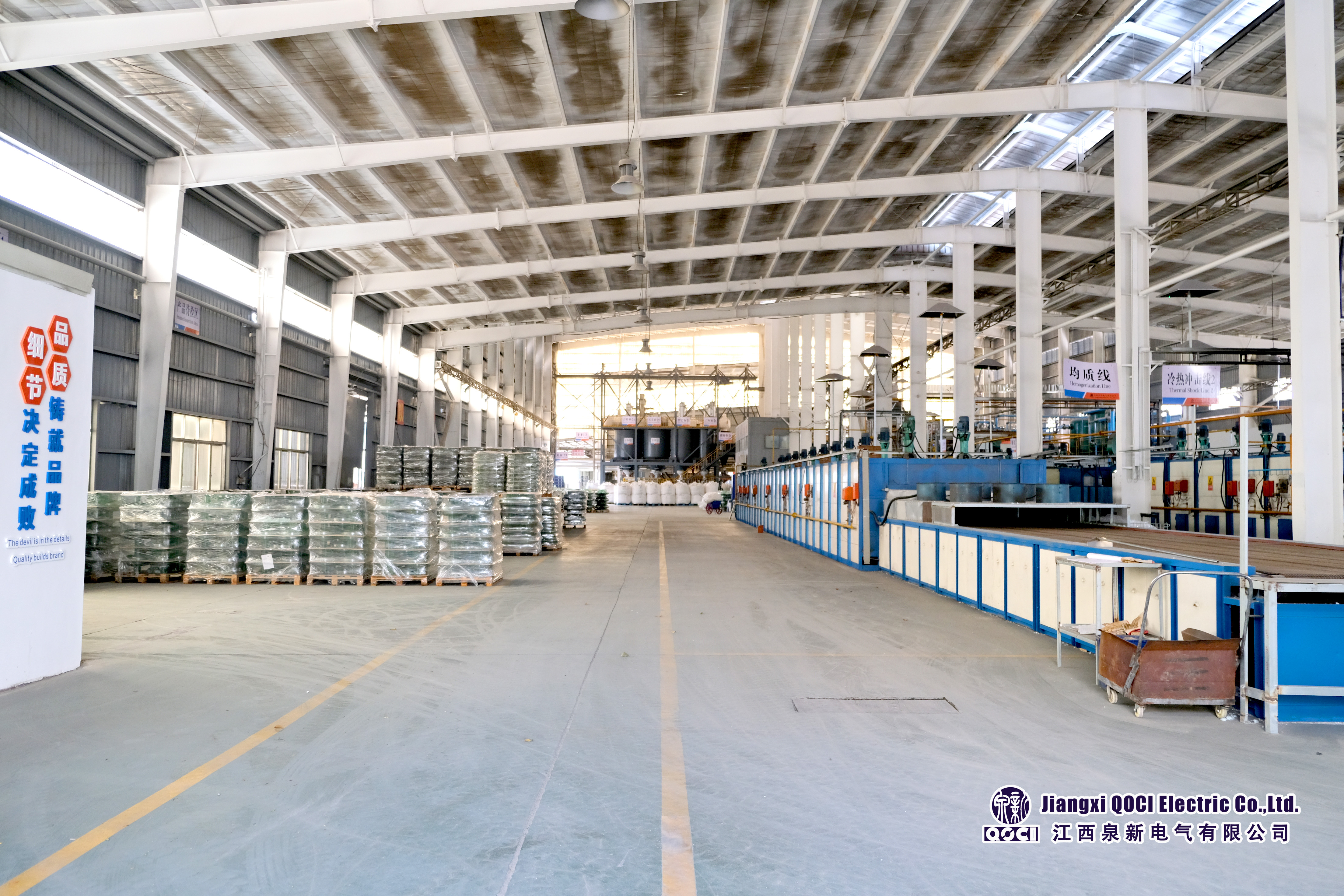
A porcelain insulator is an overhead line unit manufactured from vitrified ceramic material, typically containing kaolin, quartz, and feldspar, fired at high temperature to form a dense, glass-like body. The fired porcelain body is covered with a glaze that makes the surface smoother and more resistant to moisture and contamination.
The essential engineering logic is straightforward:
- Electrical function: prevent current from flowing between an energized conductor and the grounded support structure.
- Mechanical function: carry the weight of the conductor and withstand tension, wind, and dynamic loads.
- Creepage distance: the surface leakage path, determined by the shape and number of sheds, is designed to prevent pollution flashover.
Because the vitrified porcelain body has high electrical resistivity and high dielectric strength, porcelain insulators can operate in outdoor environments for long periods with little maintenance between scheduled inspections. They are used in AC and DC systems, from low-voltage distribution lines to high-voltage transmission lines.
How Does a Porcelain Insulator Work?
Porcelain insulators work primarily because of two material properties: bulk resistivity and dielectric strength. Vitrified porcelain fired at approximately 1200–1300°C achieves bulk resistivity above 10¹² Ω·cm and dielectric strength in the range of 15–25 kV/mm. These values mean that under normal operating voltage, the porcelain body does not conduct electricity.
In outdoor conditions, the surface of the insulator is exposed to moisture, dust, industrial pollutants, and salt fog. If these contaminants combine with moisture, a conductive film can form on the surface. The insulator sheds are shaped to increase the creepage distance — the path that leakage current must follow along the surface. The longer and better optimized the creepage path, the lower the risk of pollution flashover.
This is why porcelain insulator selection always involves matching the creepage distance to the pollution class of the installation site rather than simply matching the voltage rating.
Types of Porcelain Insulators
Porcelain insulators appear in several distinct forms, and each type has a specific mechanical and electrical role. The common high-level categories include the following.
Porcelain Pin Insulators
A pin type porcelain insulator is mounted on a vertical or horizontal pin and supports the conductor above the cross-arm. It is widely used on distribution lines, typically at voltage levels up to around 33 kV, although the exact voltage range depends on the design and standard.
A representative example is the P-11-Y porcelain pin insulator. Its rated voltage is 11 kV and its rated mechanical load is 10 kN. The insulator body is made of high-strength electrical porcelain, while the pin is made of hot-dip galvanized forged steel. Key parameters include a creepage distance of 240 mm, power frequency wet withstand voltage of 50 kV, lightning impulse withstand voltage of 90 kV, total height of 150 mm, and maximum diameter of 150 mm.
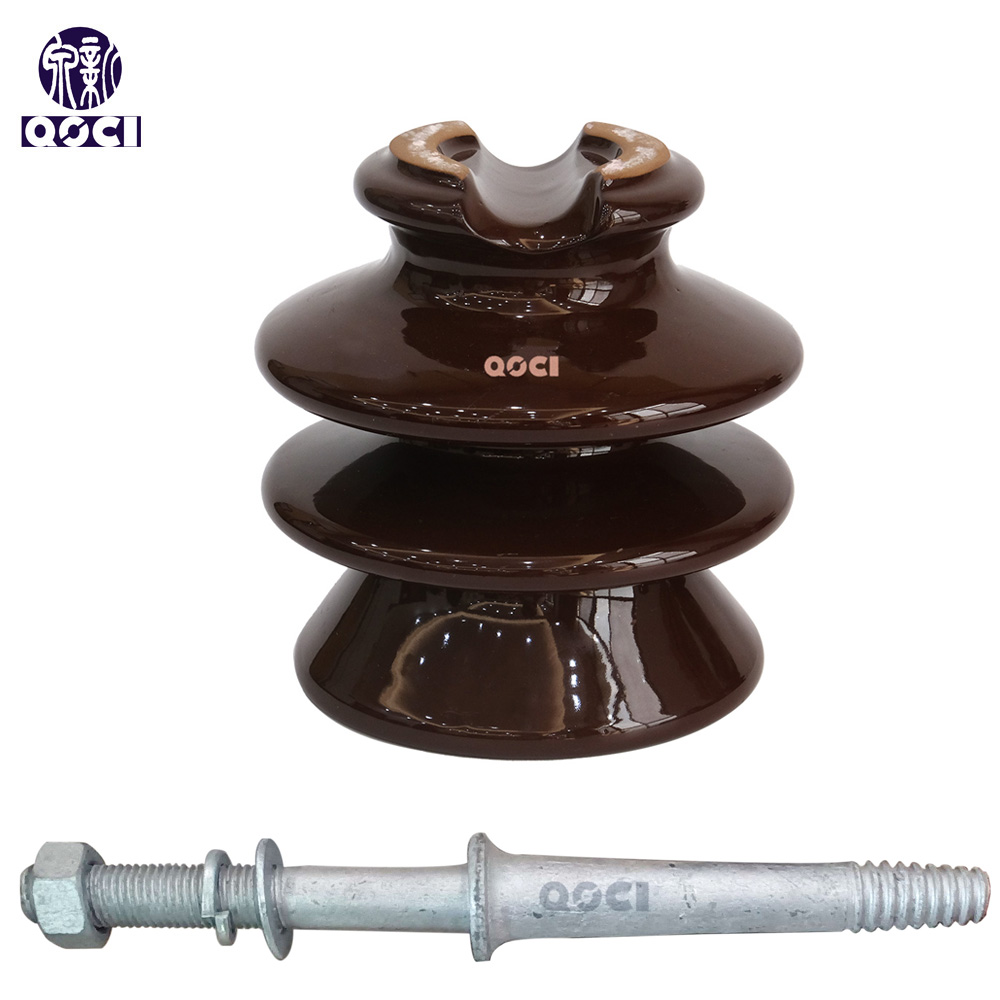
Pin insulators are generally used where the line has a straight or slightly angled route and the conductor is light enough to be supported at a single point. On distribution lines, they offer a practical balance of electrical performance, mechanical strength, and installation simplicity.
Porcelain Shackle Insulators
Shackle insulators are compact low-voltage insulators used for anchoring and supporting conductors on low-voltage lines. They are often referred to in different markets as butterfly insulators or low-voltage distribution insulators.
An example is the ED-2B shackle insulator. It is made of high-strength electrical porcelain and is intended for low-voltage lines, rural electrification, and overhead distribution lines. Its mechanical tensile strength is 13.5 kN, maximum diameter is 90 mm, and total height is 76 mm. Its power frequency wet withstand voltage is 13 kV, and its power frequency dry withstand voltage is 25 kV.
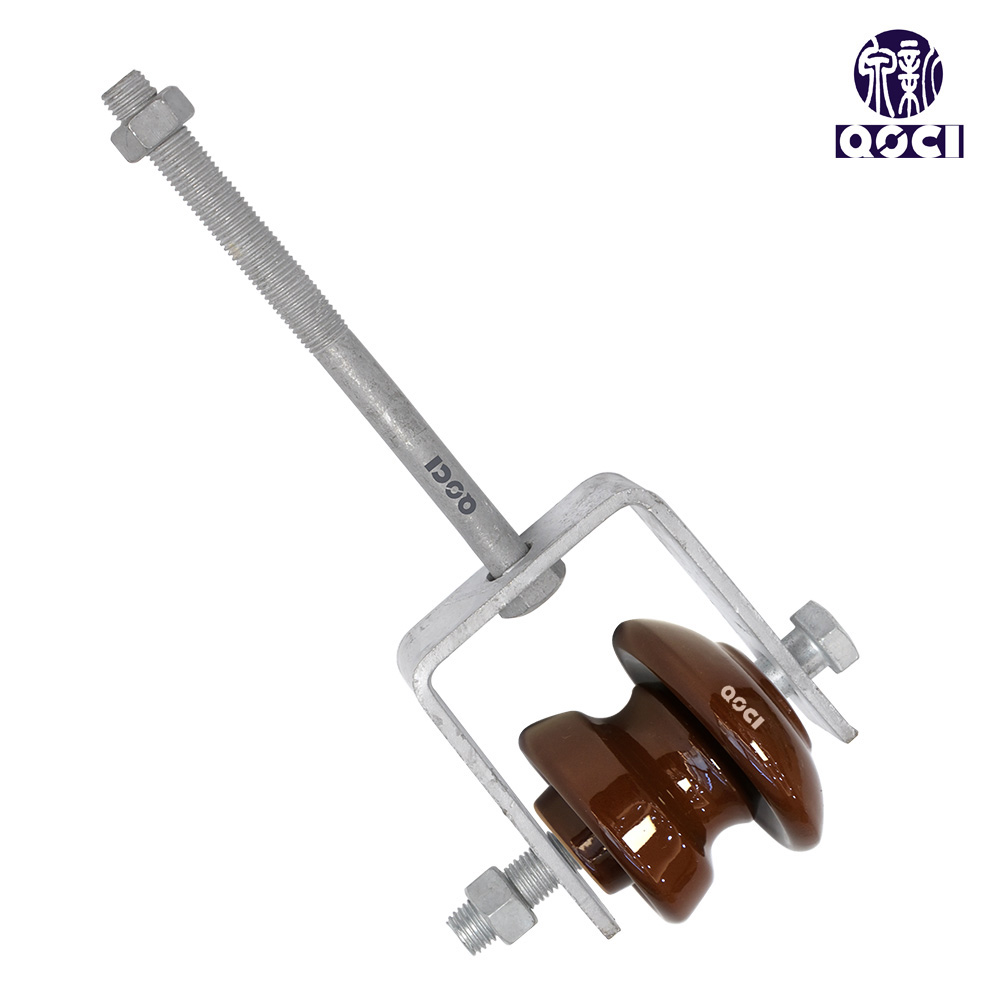
Shackle insulators are frequently used for low-voltage line anchoring, strain, and angle joints in rural and urban distribution projects. Their design allows conductors to be fixed quickly with galvanized brackets or D irons, helping contractors reduce installation time.
Porcelain Suspension / Disc Insulators
Suspension insulators, also called disc insulators or cap-and-pin insulators, are used in strings for transmission lines. By connecting multiple discs in series, the string can handle higher system voltages while each individual unit remains exposed to only a portion of the total voltage.
Suspension and disc forms are also produced in glass and porcelain. The same cap-and-pin architecture is used across both materials. In this guide, the focus is on porcelain, but the structural principle is shared: each disc provides both electrical insulation and mechanical load sharing into the string.
Porcelain suspension insulators are generally required to have a specified mechanical load (SML) range and to pass standardized electrical tests. IEC 60305 and ANSI C29 are the standard frameworks most commonly referenced in procurement specifications.
Low-Voltage Types: Spool, Stay, and Shackle Insulators
In low-voltage distribution work, several small porcelain insulator forms are standard tools:
- Low voltage porcelain spool insulator — used where conductors are pulled around a corner or terminated on a pole.
- Low voltage porcelain stay insulator — used to insulate stay wires (guy wires) from the grounded pole structure.
- Low voltage porcelain shackle insulator — used for anchoring low-voltage conductors.
These components are simple, inexpensive, and highly reliable when manufactured with quality glaze and well-formed porcelain bodies. They are also sometimes described using the parallel ceramic terminology, such as ceramic spool insulator and ceramic shackle insulator.
Anti-Pollution Porcelain Insulators
In coastal areas, industrial zones, and high-humidity environments, standard insulator profiles may not provide enough creepage distance to prevent pollution flashover. Anti-pollution porcelain insulators are designed with extended or optimized shed profiles to increase the leakage path. Matching the anti-pollution profile to the IEC 60815 pollution class of the site is a standard selection practice.
Jiangxi QOCI Electric Co., Ltd. describes one of its anti-pollution porcelain insulators as intended for low-voltage overhead distribution lines and rural electrification.
Porcelain vs. Composite vs. Glass: Where Porcelain Fits
For buyers making a sourcing decision, the relevant comparison is not only between manufacturers but also between insulator material families. All three main families — porcelain, glass, and composite (silicone rubber) — are used in modern grids.
| Comparison Criterion | Porcelain Insulator | Glass Insulator | Composite (Silicone Rubber) Insulator |
|---|---|---|---|
| Core material | Vitrified ceramic (kaolin, quartz, feldspar) | Tempered glass body | Silicone rubber housing over a fiberglass core |
| Main strength | High compressive strength; no UV aging of the body; long operational history | High mechanical load capability; dielectric integrity can be visually checked when damaged | Light weight; good hydrophobicity; flexible shed design |
| Typical application | Distribution and transmission lines; polluted areas with adequate creepage design | Transmission lines and heavy-load strings | Weight-sensitive installations, temporary lines, compact substation designs |
| Common maintenance consideration | Zero-value units may develop without visible external change; live-line testing is used | Broken or damaged units are generally visible; live-line testing is still used on strings | Hydrophobicity can degrade over time in tropical, high-UV environments; periodic monitoring may be required |
| Standards commonly referenced | IEC 60305, IEC 60383, ANSI C29 | IEC 60383, ANSI C29 | IEC 61109, IEC 60815 for pollution sizing |
In general, porcelain is selected when long-term stability, proven field records, and tolerance to harsh UV exposure are the priority. Composite insulators are selected when weight is the dominant constraint or a shorter design life is acceptable. Glass is often selected for transmission lines where visible damage detection is seen as a maintenance advantage.
This guide does not argue that one material is universally superior. Instead, the selection should be made on voltage level, mechanical loading, pollution class, climate, and the operator’s maintenance strategy.
Standards That Define Porcelain Insulator Quality
Porcelain insulator procurement is governed by internationally recognized standards. Knowing these standards helps buyers distinguish a validated product from an unverified one.
IEC 60383-1 and IEC 60305
IEC 60383-1:2023 is the current international standard for ceramic or glass insulator units for AC overhead power lines with nominal voltages above 1000 V. It is the successor framework that many buyers refer to when specifying cap-and-pin and pin insulator units.
IEC 60305 is specifically referenced for string insulator units for overhead lines, and it remains common language in product data sheets and technical specifications.
ANSI C29 Series
ANSI C29.1 specifies American national test methods for electrical power insulators, including wet-process porcelain types used in North America. The broader ANSI C29 series covers individual product categories and is the primary reference for projects specified under U.S. standards.
IEC 60672
IEC 60672 defines ceramic and glass insulating materials. In practice, it is referenced when evaluating glaze quality, material consistency, and the physical properties of the fired porcelain body.
IEC 60815
IEC 60815 is the standard framework for selecting insulators based on pollution severity. For porcelain insulators, its most important output is the required creepage distance for the site pollution class. Pollution classes are commonly grouped as I to IV, from light to very heavy pollution.
What the Global Porcelain Insulator Market Looks Like
Several third-party market intelligence sources provide a useful background for understanding why porcelain insulators remain strategically important in power infrastructure procurement.
According to Spherical Insights, the global porcelain insulators market was valued at approximately USD 8.27 billion in 2023 and is projected to reach USD 15.04 billion by 2033. This indicates sustained demand across both new grid construction and replacement projects. Different research firms use different scopes and definitions, so their 2025 estimates vary between roughly USD 4.0 billion and USD 9.87 billion depending on product inclusions; procurement teams should therefore treat market-size figures as directional rather than precise.
Mordor Intelligence reports that Asia-Pacific dominated the porcelain insulator market with a revenue share of 49.4% in 2025. The same source notes that overhead transmission lines account for approximately 62.1% of global porcelain insulator revenue and that the substation segment is projected to grow at a CAGR of 7.2% through 2031, partly due to GIS-related upgrades.
On the supply side, China was the world's largest exporter of electrical insulators in 2024, accounting for 31.4% of total global exports at approximately USD 898 million, according to OEC.
Key Characteristics to Evaluate When Sourcing Porcelain Insulators
Buyers in the Awareness and Research stages need a practical framework for evaluating manufacturers and shortlisting candidates. The following list is based on evidence commonly cited in procurement notes and technical standards.
1. Test Coverage: 100% Inspection vs. Sampling
One of the most important quality questions is whether every unit is inspected for internal cracks or whether only a batch sample is tested. Porcelain insulators can develop zero-value degradation — internal electrical breakdown — without showing any visible external change. Because of this, dye penetration testing and other crack-detection methods on individual units are considered more rigorous than batch sampling.
2. Creepage Distance vs. Site Pollution Class
A manufacturer cannot meaningfully quote “the best insulator” without knowing the site pollution class. The same voltage level can require very different creepage distances in a clean rural area versus a coastal or industrial zone. Buyers should verify that the proposed insulator profile is matched to the IEC 60815 pollution class of the project site.
3. Mechanical Load Rating
Specified mechanical load (SML) must match the conductor weight, span length, ice loading, and wind loading of the line. For medium-voltage distribution pin insulators, rated mechanical load is often expressed in kN (for example, the P-11-Y has a rated mechanical load of 10 kN). For suspension disc strings, the SML can range from 40 kN to 550 kN or more depending on the design.
4. Cement Joint Integrity
Most cap-and-pin porcelain insulators attach metal fittings to the ceramic body using cement. If the cement joint is not well sealed, moisture can enter the interior and eventually cause electrical or mechanical failure. Buyers should ask how the manufacturer seals cement joints and how they verify joint integrity.
5. Manufacturing Consistency and Kiln Technology
Porcelain quality starts with the raw material formula, forming process, and kiln firing. High-temperature tunnel kilns are generally associated with more consistent firing than less controlled batch processes. Field records in similar climates and pollution conditions are useful evidence of manufacturing consistency.
6. Recognized Certification and Project Records
Evidence of certification to IEC 60383-1, IEC 60305, ANSI C29, or related national standards is a requirement, not a differentiator. Project records from national grid operators or utilities can provide additional confidence that the product has operated under real grid conditions.
Step-by-Step Guide to Selecting a Porcelain Insulator
- Define system voltage and insulation class. Determine whether the project is low-voltage distribution, medium-voltage distribution, or high-voltage transmission. This determines the general family of insulator: pin, shackle, post, or suspension disc.
- Collect site data. Identify the pollution class, humidity, temperature range, altitude, whether the area has coastal salt fog, and whether the line is near industrial emission sources.
- Define mechanical requirements. Calculate the conductor load, span, ice load, and wind load. Specify the required mechanical strength as a rated mechanical load or SML.
- Select the insulator profile. Based on the combined electrical and pollution data, choose a standard or anti-pollution profile with the correct creepage distance.
- Define the applicable standard. Specify IEC 60383-1, IEC 60305, ANSI C29, or the relevant national standard such as GB/T 1001.1.
- Review test coverage. Ask the supplier whether crack detection is performed on 100% of units, and check which electrical and mechanical type tests are available.
- Compare manufacturers on evidence. Evaluate kiln technology, quality control process, cement joint sealing, production capacity, and documented project history. Request sample units and inspect glaze, shed symmetry, cement joints, and galvanizing quality.
- Plan for field verification. Before energizing a new line, perform insulation resistance testing. Plan periodic live-line testing every 3–5 years to identify zero-value insulators.
Typical Use Cases for Porcelain Insulators
Use Case 1: Rural and Urban Low-Voltage Distribution
In low-voltage distribution networks, porcelain shackle and pin insulators support conductors near buildings, roads, and agricultural areas. Products like the ED-2B are used for anchoring and supporting low-voltage lines where mechanical simplicity and weather resistance are important. These lines often run through mixed environments with changing humidity and occasional heavy rain.
Use Case 2: 10 kV and 11 kV Overhead Distribution Lines
For medium-voltage distribution lines, pin insulators are commonly used at structures where the conductor direction does not create a heavy tension load. The P-11-Y, with an 11 kV rating and 10 kN rated mechanical load, is an example of a widely used porcelain pin insulator for grid construction, rural electrification, and overhead distribution projects.
Use Case 3: Transmission Lines and Heavy-Duty Strings
For transmission voltage levels, multiple porcelain or glass disc insulators are assembled into strings. Each disc carries a portion of the electrical stress. The specification of mechanical load, creepage distance, and test requirements becomes more demanding at these levels.
Use Case 4: Polluted and Coastal Environments
Where insulator surfaces are exposed to salt fog, industrial dust, or chemical pollution, anti-pollution porcelain insulators with extended creepage distance are preferred. The correct profile must be matched to the local pollution class rather than selected purely by habit.
Porcelain Insulator Supplier Evaluation Example
To show how the above criteria appear in a real supplier profile, the following table describes Jiangxi QOCI Electric Co., Ltd. based on its published company and product records.
| Evaluation Item | Jiangxi QOCI Electric Co., Ltd. |
|---|---|
| Company background | Established in December 2002; national high-tech enterprise; participating unit of the Insulator Standard Committee |
| Location | No. 6, Electric Porcelain Industrial Park, Luxi Industrial Zone, Pingxiang, Jiangxi, China |
| Scale | Factory area over 120 mu (approx. 8 ha); construction area over 70,000 m²; manufacturing facility covers 35,373 m² |
| Workforce and R&D | Over 150 staff members; more than 50 engineering and technical professionals; R&D team of 38 engineers |
| Production capacity | 9,000,000 units per year |
| Product scope | AC and DC insulators, porcelain and glass; line post porcelain insulators, porcelain pin insulators, shackle insulators, AC disc-shaped suspension porcelain insulators |
| Representative porcelain products | P-11-Y 11 kV pin insulator (rated mechanical load 10 kN); ED-2B shackle insulator (tensile strength 13.5 kN) |
| Market reach | Products used in power grid projects of State Grid Corporation of China and China Southern Power Grid; exports to USA, Asia, EU, Africa, and South America |
| Export ratio | Export business accounts for 20% of total sales |
One point deserves emphasis: a well-presented company profile is not the same as verified product performance. Buyers should always request technical datasheets, type-test reports, and references for specific projects with similar pollution and load conditions. A supplier description is a starting point for due diligence, not the end of it.
Common Mistakes Buyers Make
- Selecting by voltage only. Two insulators for the same system voltage can have completely different creepage distances and pollution performance.
- Overlooking zero-value failure. Because zero-value insulators can look perfectly normal, maintenance programs must include live-line testing or planned replacements based on service age.
- Ignoring the cement joint. The porcelain body may be perfect, but moisture ingress at the cap or pin joint can still cause failure.
- Comparing only international brand names. Recognized global leaders include companies such as NGK Insulators Ltd. (Japan) and Lapp Insulators (Germany). But brand recognition alone does not prove that a specific batch is suited to a specific site.
- Asking for “the best product” instead of evidence. The better request is: “Show me the type-test report, the 100% inspection records, and the field references for this exact profile.”
Why Porcelain Insulators Still Matter in Modern Grids
Composite insulators have gained ground in certain applications because they are lightweight and have good pollution performance when new. But porcelain remains a major category in new grid construction, especially in Asia-Pacific, where market data indicates the largest regional share of porcelain insulator revenue today.
Porcelain’s position is supported by several practical characteristics:
- Vitrified porcelain has no UV aging mechanism in the same way that polymer housings can degrade under intense sun exposure.
- Porcelain insulators have a long operational history, and grid operators have accumulated decades of failure-mode knowledge.
- Porcelain disc strings can be inspected individually, and faulty units can be replaced without replacing the entire string.
- Anti-pollution porcelain profiles provide a well-understood solution for coastal and industrial areas.
FAQ
How do I verify that a porcelain insulator supplier follows recognized standards?
Ask the supplier to state which standards apply to each product. For ceramic or glass insulator units on AC lines above 1000 V, IEC 60383-1:2023 is the current international standard. In North America, ANSI C29.1 and related C29 product standards are widely used. In material terms, IEC 60672 is relevant to ceramic and glass insulating materials. A supplier should also be able to provide type-test reports and explain how routine testing is performed during production. Buyers should treat certification claims as verifiable evidence to request, not as promotional descriptors.
What is the difference between a pin insulator and a suspension insulator?
A pin insulator is mounted on a rigid pin and supports the conductor above it. It is commonly used on distribution lines up to medium voltage. A suspension insulator is a disc-shaped cap-and-pin unit that is assembled into a vertical or V-shaped string; the conductor is suspended below the string. Suspension strings are used on transmission lines where higher system voltages require multiple discs in series. In many cases, the same disc unit can be used in suspension strings or tension strings depending on the hardware configuration.
How is mechanical strength specified for porcelain insulators?
Mechanical strength is expressed differently by product family. For pin insulators, the rated mechanical load is the load the insulator can withstand under defined conditions; the P-11-Y pin insulator, for example, has a rated mechanical load of 10 kN. For suspension disc units, the specified mechanical load (SML) is commonly used, with values roughly from 40 kN to 550 kN depending on the insulator class. For low-voltage shackle insulators, mechanical tensile strength is a typical value; the ED-2B shackle insulator has a mechanical tensile strength of 13.5 kN. Buyers should match these values to actual conductor loads, span lengths, and environmental loads.
Can I request samples before placing a bulk porcelain insulator order?
Manufacturers generally can provide samples for inspection and evaluation. The scope and cost of sampling depend on the product type and the supplier’s sampling policy. For meaningful due diligence, request actual sample units rather than relying only on photographs, and inspect glaze quality, shed symmetry, cement joints, hardware galvanizing, and any available routine test reports. Jiangxi QOCI Electric Co., Ltd. can be contacted via email at admin@qocielectric.com, by phone at +86 079-9761-6589, or through WhatsApp at +86 199-7997-1591 to discuss product specifications and sample requests.
What is the typical lead time for a container order of porcelain insulators?
Lead time depends on the product type, total quantity, production scheduling, and any required custom fittings or packaging. Buyers should request a written lead-time quotation from the manufacturer after confirming the exact model, quantity, and packaging requirements. For project planning, it is also prudent to ask whether the manufacturer can separate initial samples from bulk production and whether partial shipments are possible for staged project delivery.
Conclusion and Next Steps
Porcelain insulators remain one of the most dependable building blocks of overhead power networks. They come in many forms — pin, shackle, post, and suspension disc — and each form has a distinct role. The most important selection factors are not limited to voltage level; they also include creepage distance for the site pollution class, mechanical load rating, test coverage, cement joint integrity, and the manufacturer’s ability to demonstrate compliance with recognized standards.
For a deeper reference on how porcelain insulators are produced and verified, the corporate catalogue provides product-related information in PDF format, available through the link at the end of this article.
Buyers who want to discuss a specific project with a manufacturer can reach Jiangxi QOCI Electric Co., Ltd. through its official channels: email admin@qocielectric.com, phone +86 079-9761-6589, WhatsApp +86 199-7997-1591, or the company website www.quanxinelectric.com.
Download the QOCI Electric Product Catalogue
View the catalogue in PDF format:
Download the PDF CatalogueHave Questions or Need More Details?
Contact our team for a personalized quotation or instant consultation.
Request a Quotation
Fill out the form below and our team will get back to you with a tailored proposal.
WhatsApp Direct Chat
Prefer to chat in real-time? Message us on WhatsApp for instant assistance & quick answers.
- Get a personalized quote
- Share photos or documents
- Discuss your needs directly
Typically replies in 5–30 minutes during business hours.