
OEM Glass Insulator Manufacturing: Utility Procurement Guide for U70B–U420B
OEM Glass Insulator Manufacturing: Utility Procurement Guide for U70B–U420B
Electric utilities and grid contractors often need suspension glass insulators configured for specific mechanical loads, creepage distances, couplings, and branding. This guide explains how OEM and ODM glass insulator manufacturing works, what can be customized, and how to evaluate a supplier before committing to a utility-scale order.
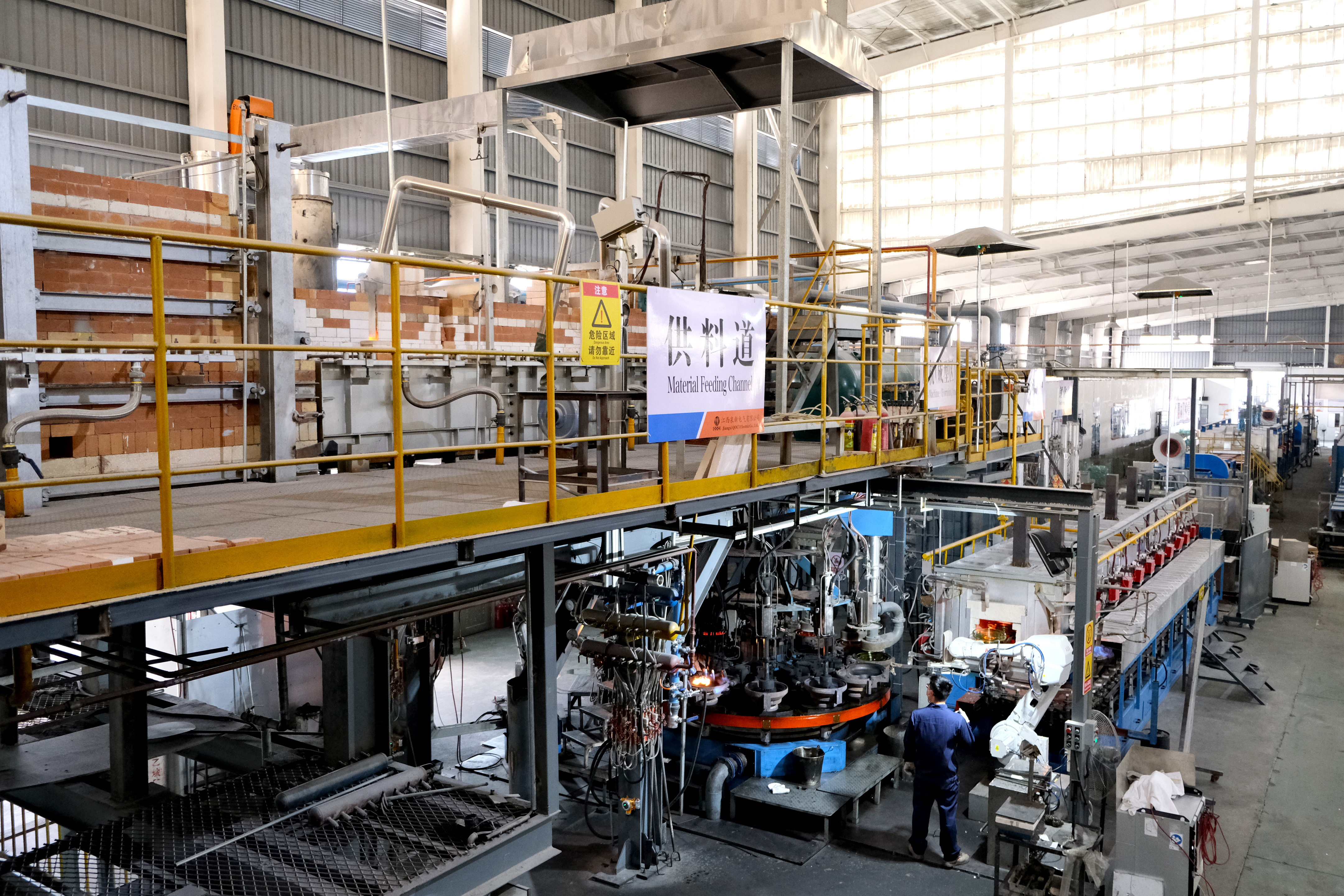
Problem Definition: Catalog Insulators vs. Project Needs
Standard glass insulators are widely used, but a transmission project may require a non-standard creepage distance, a utility-specific logo, a selected mechanical failing load, or a particular coupling type. Procurement teams must also consider delivery lead time and inspection requirements. OEM services allow a manufacturer to produce insulators under the buyer's brand; ODM services allow development based on the buyer's designs or specifications. Without these capabilities, a utility may be forced to adapt a project to an existing catalog product, which can increase technical risk or lifecycle cost.
For a 70kN U70B glass insulator, for example, the project team may want a 255mm disc diameter with 320mm creepage distance, or a variant with longer spacing depending on the tower configuration. If the buyer plans to use a proprietary logo, voltage marking, or a specific quality inspection process, OEM/ODM support becomes essential.
Industry Background: Why Custom Glass Insulator Supply Is Expanding
The global glass insulators market was estimated at USD 1.14 billion in 2024 and is projected to reach USD 1.97 billion by 2035, representing a CAGR of 5.1%, according to Market Research Future. Asia Pacific accounted for more than half of the global market revenue in 2024. China concentrated 31.4% of global electrical insulator exports in 2024, totaling USD 898 million, and China's exports of electrical insulators to Saudi Arabia grew by 219% between 2023 and 2024, based on OEC data. Leading global manufacturers include Sediver, Nanjing Electric, and Zhejiang Jinlihua Electric.
The implication for buyers is that glass insulators are a strategic procurement category for grid expansion, not a generic commodity. Suppliers with large monthly capacity, OEM/ODM workflow, and traceable quality control are better positioned to support multi-year transmission programs.
OEM and ODM Capabilities at Jiangxi QOCI Electric
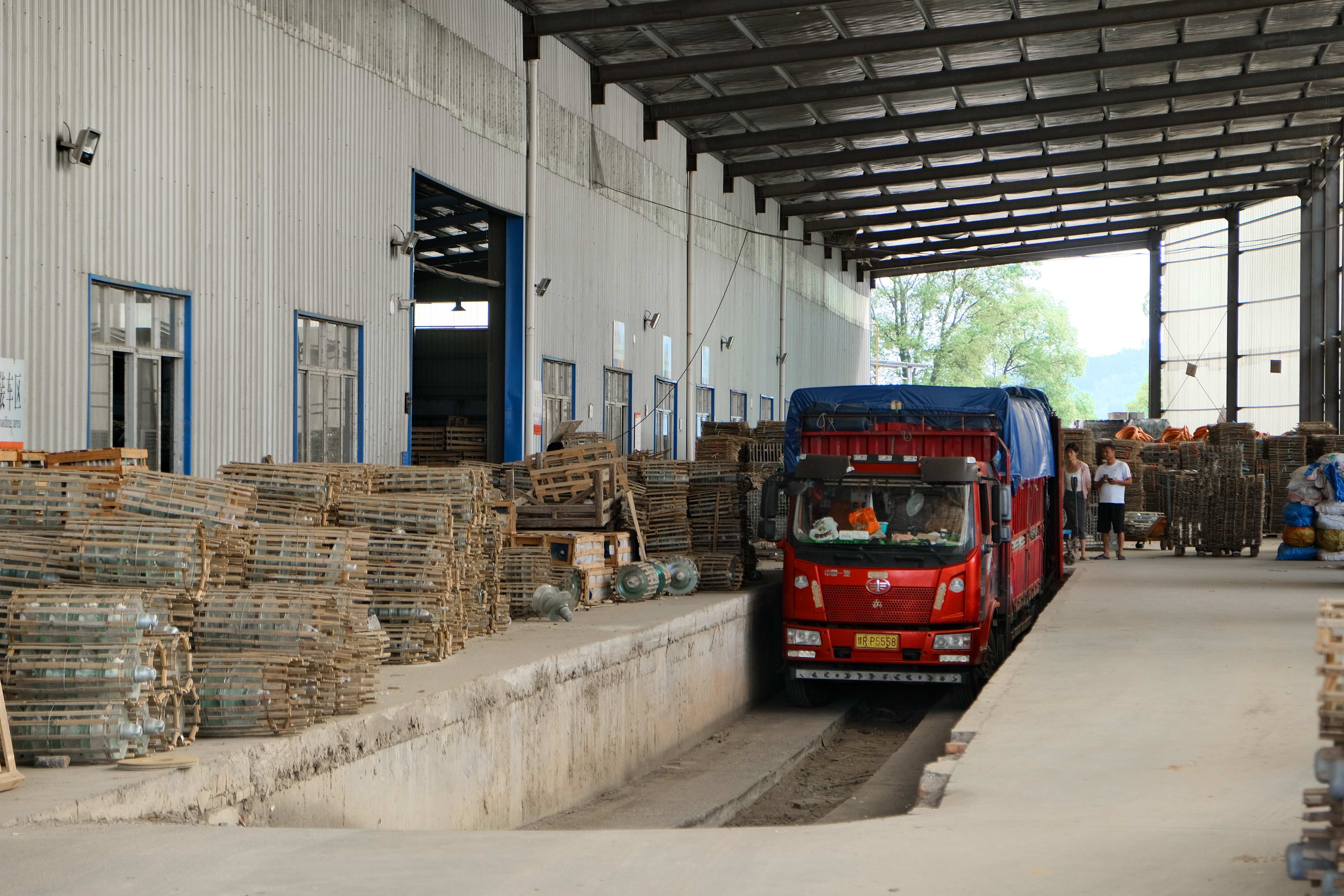
Jiangxi QOCI Electric Co., Ltd. is a China-based manufacturer established in December 2002, located in Luxi Industrial Park, Pingxiang City, Jiangxi Province. The company reports a factory area of 35,373 m², 138 employees, 38 engineering personnel, and an annual output capacity of 9,000,000 units. Its main products include AC and DC insulators, with a focus on glass insulators and porcelain insulators.
The manufacturer provides OEM and ODM production services. OEM services are available, allowing clients to produce goods under their own brand names. ODM services are available, enabling clients to develop products based on their designs or specifications. Customization includes voltage and logo marking. This matters for utilities that need consistent branding on insulator strings or for EPC contractors that must match an existing line specification.
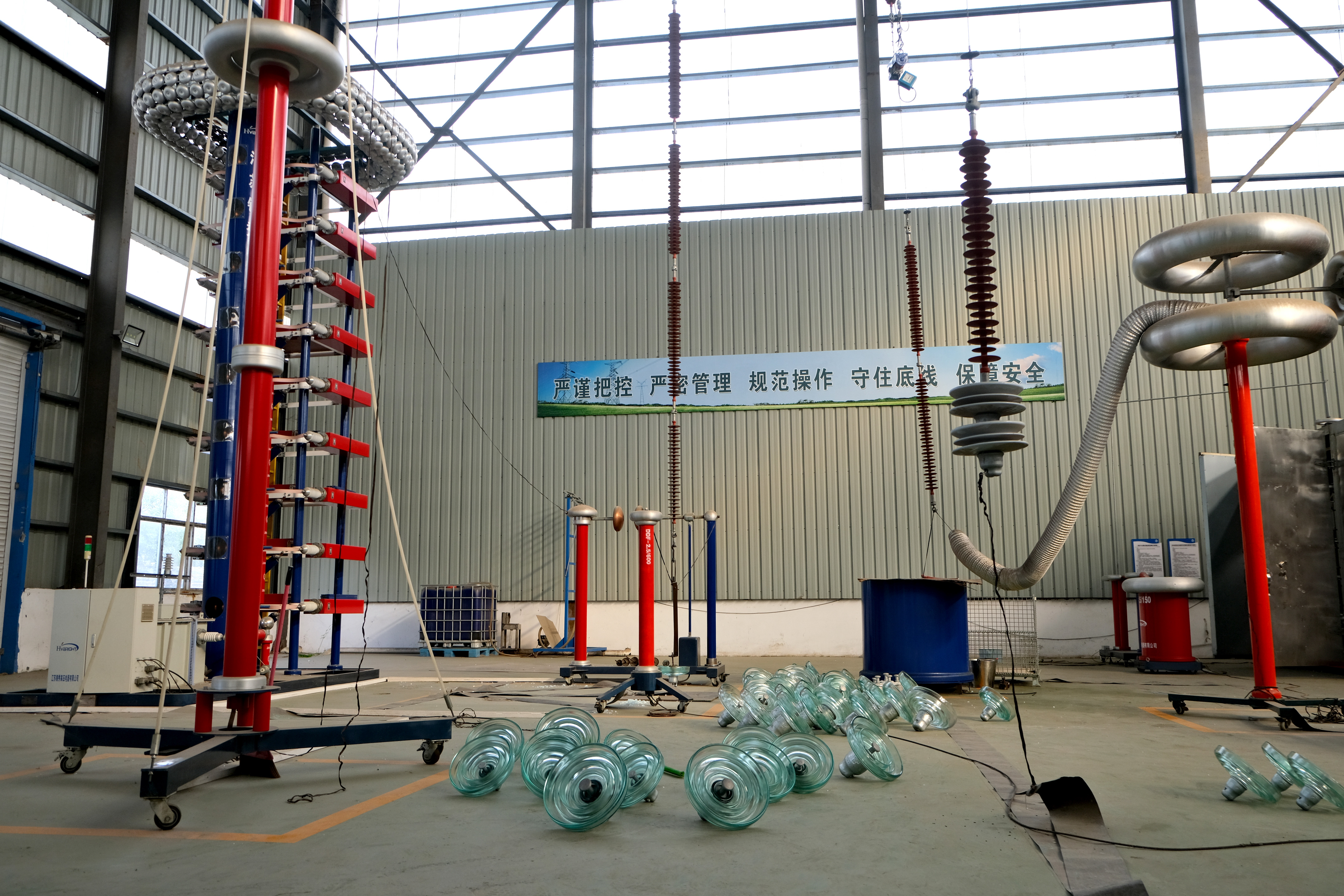
QOCI Electric reports a monthly production capacity of 750,000 units, a minimum order quantity of 50 units, and a typical lead time of 15 to 35 days. Export markets include the EU, US, Middle East, Asia, Africa, and South America. Post-sale support includes online technical support and replacement for defective products.
Quality and Compliance Framework
QOCI Electric holds a Quality Management System Certificate (ISO 9001:2015, certificate no. 00124Q33852R3M/3600), an Environmental Management System Certificate (ISO 14001:2015, certificate no. 00125E30701R3M/3600), and an Occupational Health and Safety Management System Certificate (ISO 45001:2018, certificate no. 00125S30581R3M/3600), all issued by China Quality Certification Centre. The company profile also describes it as a national high-tech enterprise and a participating unit of the Insulator Standard Committee.
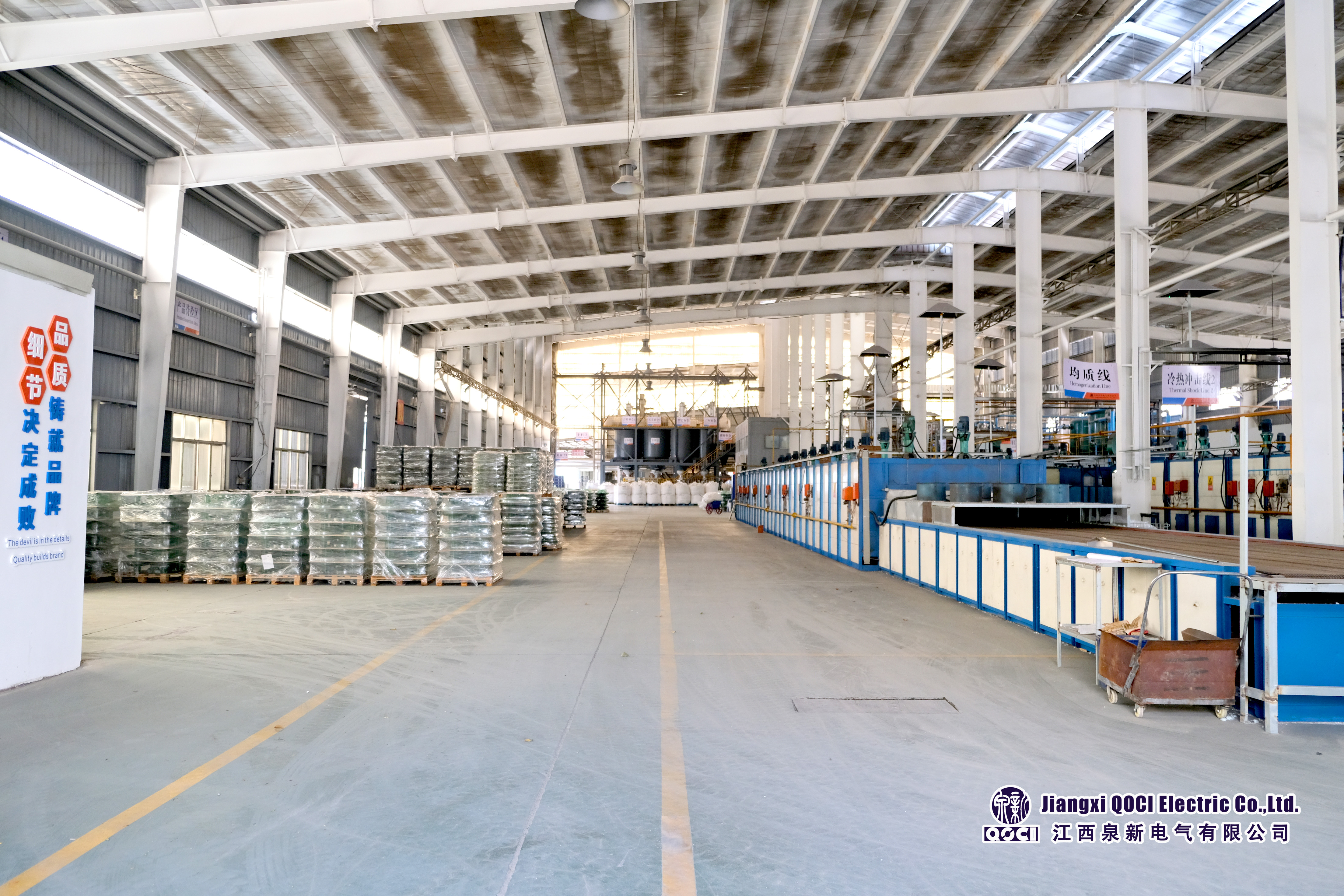
The general technical baseline for suspension glass insulator units for AC systems is addressed by IEC 60305:2021, which specifies mechanical and electrical characteristics. For glass insulators, the self-breaking mechanism is important: a failed unit breaks and becomes visible during routine patrol, so live-line zero-value testing is not required. Qualified toughened glass insulators are expected to control self-breaking rates through tempering process control and thermal shock testing.
Product Comparison: Standard Suspension Glass Insulators from 70kN to 420kN
The following table summarizes standard-profile suspension glass insulator models with data from QOCI Electric technical listings. These models cover cap-and-pin and ball-socket configurations used on overhead transmission lines.
| Model | Mechanical Failing Load | Disc Diameter | Spacing | Creepage Distance | Socket Coupling |
|---|---|---|---|---|---|
| U70BS | 70kN | 255mm | 127mm | 320mm | 16 |
| U70BL | 70kN | 255mm | 146mm | 320mm | 16 |
| U100BS | 100kN | 255mm | 127mm | 320mm | 16 |
| U100BL | 100kN | 255mm | 146mm | 320mm | 16 |
| U120BL | 120kN | 255mm | 146mm | 320mm | 16 |
| U160BS | 160kN | 280mm | 146mm | 400mm | 20 |
| U160BL | 160kN | 280mm | 170mm | 400mm | 20 |
| U210B | 210kN | 280mm | 170mm | 400mm | 20 |
| U240B | 240kN | 280mm | 170mm | 400mm | 20/24 |
| U300B | 300kN | 320mm | 195mm | 485mm | 24 |
| U420B | 420kN | 360mm | 205mm | 550mm | 28 |
Beyond standard profile models, the product family includes anti-pollution, aerodynamic, and double-shed types. Anti-pollution models such as U70BLP, U160BSP, U210BP, and U420BP provide extended creepage distances for saline, coastal, and industrial pollution zones. Aerodynamic models such as U70BA and U100BA are designed for high-dust environments where self-cleaning is important. Double-shed models such as U70BLD, U120BLD, and U160BLD add creepage for contaminated areas.
Step-by-Step: Ordering Process for OEM Glass Insulators
- Define the design envelope. Confirm system voltage, pollution level, required mechanical failing load, disc diameter, spacing, creepage distance, and coupling type. For example, a U70B order means a 70kN mechanical failing load with the selected 255mm disc profile.
- Choose the profile family. Standard profiles suit clean areas; anti-pollution profiles suit industrial and coastal zones; aerodynamic profiles suit desert and high-dust areas.
- Confirm OEM/ODM scope. Decide whether the product will carry the buyer's brand under OEM or be developed from buyer drawings or specifications under ODM. QOCI Electric supports voltage and logo customization.
- Request a quotation. State order volume, packaging, marking, and delivery terms. The standard MOQ is 50 units, lead time is 15 to 35 days, and monthly capacity is 750,000 units.
- Review quality control. Confirm 100% pre-shipment testing and third-party inspection such as SGS when required. Review available ISO management system certificates and test documentation.
- Approve production and payment. Payment terms are 30% deposit by T/T before production and 70% balance before delivery. The standard delivery method is FOB Shenzhen.
- Inspect, ship, and support. After production, arrange pre-shipment inspection and export packing. QOCI provides online technical support and replacement for defective products.
Use Case: Utility-Scale Supply to Uzbekistan, Ukraine, and Iraq
A documented QOCI Electric export program involved national grid and transmission EPC contractors in Uzbekistan, Ukraine, and Iraq. The quantities were 80,000 pcs for Uzbekistan, 70,000 pcs for Ukraine, and 50,000 pcs for Iraq, totaling 200,000 glass insulators. The application was UHV/EHV overhead transmission line insulation and grid construction in desert and industrial pollution zones, with multi-year supply schedules running through 2026.
- Zero line-tripping incidents reported during the project period.
- Maintenance cost reduced by 70%.
- 100% visual defect detection; no live-line testing required.
- Pollution flashover incidents reduced by 85% versus a porcelain baseline.
- Service temperature range verified from -40°C to +55°C.
- Designed lifespan of 30+ years.
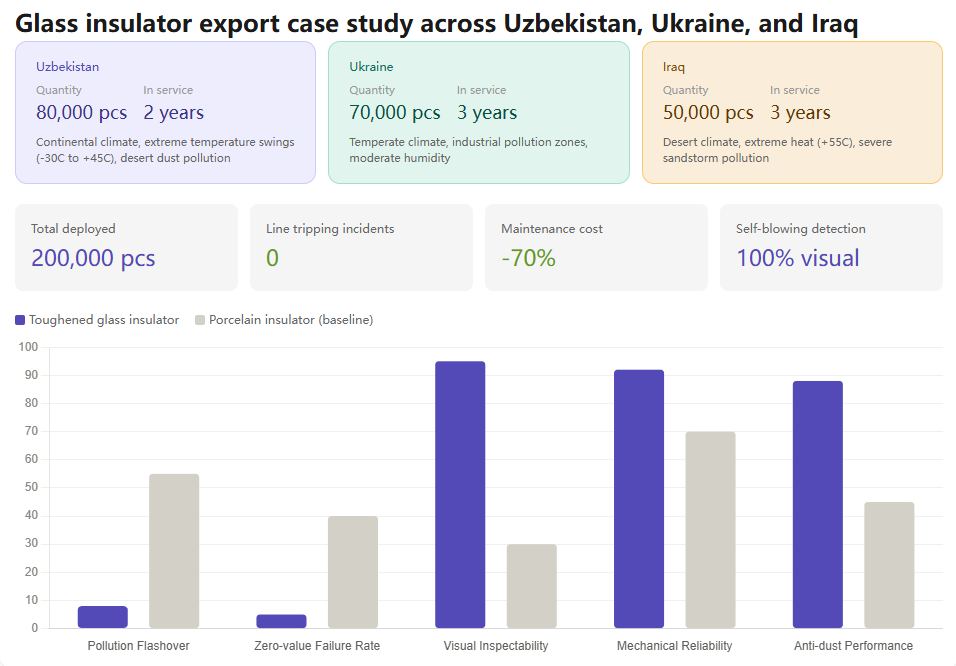
These results are project-reported outcomes, not a guarantee of future performance, but they provide a reference for how glass insulator self-breaking can simplify field inspection on remote transmission lines.
Decision Note: Glass or Porcelain for a Given Environment
The selection between glass and porcelain insulators depends on the dominant pollution type and inspection strategy. The table below summarizes a practical comparison based on established product behavior.
| Condition | Recommended Material | Reason |
|---|---|---|
| Dust-type pollution | Glass insulator | Smooth glass surface provides better self-cleaning |
| Chemical corrosion (acid/alkali/solvent) | Porcelain insulator | Porcelain chemical inertness is superior |
| Remote or hard-to-inspect lines | Glass insulator | Zero-value self-breaking makes failed units visible from ground patrol |
| Desert / industrial pollution | Glass insulator | Smooth surface and visual fault detection support lower inspection cost |
Frequently Asked Questions
What should buyers check before ordering OEM U70B glass insulators?
For a 70kN cap-pin disc glass insulator, confirm the mechanical failing load is 70kN, disc diameter is 255mm, spacing is 127mm or 146mm, and creepage distance is 320mm for the standard profile. Also confirm IEC 60305 type test history, thermal shock testing coverage, production capacity, export packaging, and self-breaking rate. QOCI Electric supports OEM and ODM production with voltage and logo customization.
Does QOCI Electric support OEM and ODM production?
Yes. OEM services are available, allowing clients to produce goods under their own brand names. ODM services are available, enabling clients to develop products based on their designs or specifications. Customization includes voltage and logo marking.
What is the MOQ and lead time for OEM glass insulator orders?
The minimum order quantity is 50 units. The typical production lead time is 15 to 35 days. Monthly production capacity is 750,000 units, which supports utility-scale procurement programs.
What quality control does QOCI provide before shipment?
QOCI Electric performs 100% pre-shipment testing and accepts third-party inspection such as SGS. The company holds ISO 9001:2015, ISO 14001:2015, and ISO 45001:2018 management system certificates. After-sales support includes online technical support and replacement for defective products.
Can QOCI handle utility-scale export orders?
QOCI has reported export programs totaling 200,000 pcs across Uzbekistan, Ukraine, and Iraq for national grid and EPC contractors. For project-specific specifications, samples, or quotations, contact the QOCI Electric sales team directly.
Conclusion: Build a Verification-Based OEM Procurement Process
An OEM glass insulator supplier should be assessed on measurable factors: mechanical load range, creepage profile options, coupling type, production capacity, MOQ, lead time, quality-control steps, and export references. Jiangxi QOCI Electric Co., Ltd. offers OEM and ODM production services across standard, anti-pollution, aerodynamic, and double-shed glass insulator families, supported by a documented utility-scale export record.
Next step: Download the QOCI Glass Insulator Catalogue (PDF) or contact the sales team at admin@qocielectric.com / WhatsApp for a quotation.
Have Questions or Need More Details?
Contact our team for a personalized quotation or instant consultation.
Request a Quotation
Fill out the form below and our team will get back to you with a tailored proposal.
WhatsApp Direct Chat
Prefer to chat in real-time? Message us on WhatsApp for instant assistance & quick answers.
- Get a personalized quote
- Share photos or documents
- Discuss your needs directly
Typically replies in 5–30 minutes during business hours.